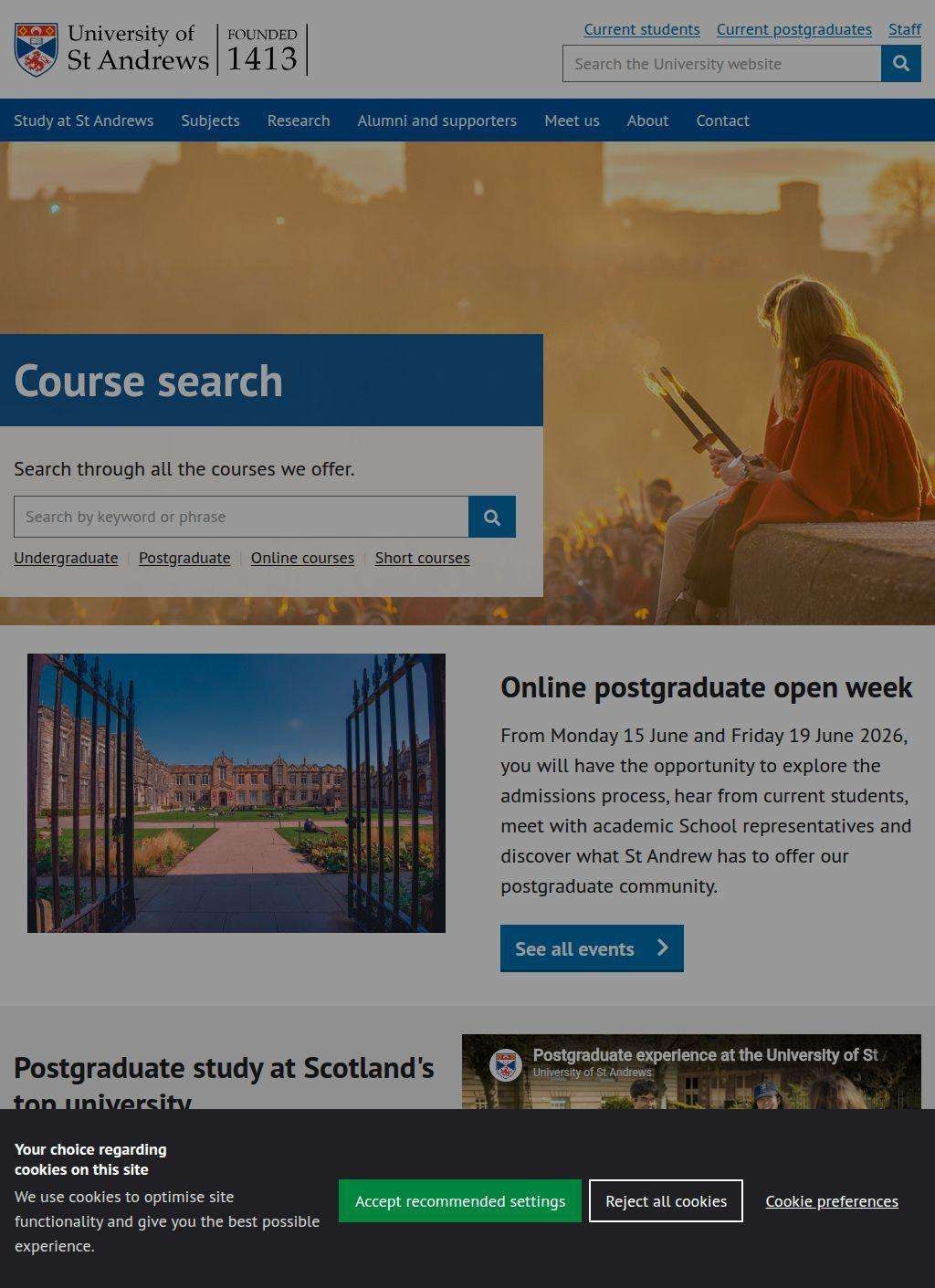
Scotland's oldest university opened its doors in 1413, and the University of St Andrews has spent the centuries since growing into a name that now sits second in the UK and first among Scottish institutions in the major league tables. That is a long run of relevance for a place this small. The town is a coastal one in Fife, and the campus shares its character: compact, residential, the kind of place where the institution and the streets around it are hard to separate. Listed in rankings indexes and higher education directories, the name consistently occupies the top tier.
From campus study to online courses
The teaching span is wide for an institution of this footprint. Undergraduate degrees form the base, and above them sit postgraduate taught Masters offered both on campus and online, research routes through PhD and MRes, and a layer of executive education for people already working. There are foundation programmes for students who need a bridge into degree study, summer schools, and self-paced online short courses that let someone dip into a subject without enrolling in full. The online and self-paced options have been built out deliberately alongside the residential core, so University of St Andrews is reaching people who will never set foot in Fife.
Schools across three faculties
Academically the range is genuinely broad. The University of St Andrews runs schools and departments in Physics and Astronomy, Divinity, Computer Science, Earth and Environmental Sciences, Geography and Sustainable Development, Management, Mathematics and Statistics, Biology, Chemistry, Philosophy, Art History, International Relations, and Medicine, among others, grouped into three faculties covering Arts, Science and Medicine. That spread means a prospective student at the University of St Andrews finds humanities and science both present and both taken seriously, which universities of comparable size do not always manage.
Global partnerships and study abroad
Further than the geography suggests. The joint degree programme with William and Mary lets students split their study across two institutions on two continents, and a broad set of study abroad partnerships opens up further movement during a degree. The student body itself is international in composition, so the coastal town setting belies a population drawn from well beyond Scotland. For anyone weighing where to spend three or four years, the combination of a tightly bounded campus and a globally sourced student community is an unusual one worth thinking through.
Student services and funding support
Supporting all of this is the infrastructure a research university needs. There is a main library, student accommodation, a careers centre, and an alumni network that keeps graduates connected after they leave. Scholarships and funding programmes exist for both home and international students, given how much the cost question shapes who applies. None of these are additions that get much publicity. They are the practical scaffolding that decides whether a place works day to day, and the University of St Andrews has the full set in place.
Fundraising campaign and campus redevelopment
There is forward motion on the estate and the finances too. A fundraising campaign called Making Waves is aiming at a target of 300 million pounds, and a redevelopment of New College is underway. The university also holds a Race Equality Charter Bronze Award, a recognition that sits at the entry tier of that particular scheme. The award has been formally acknowledged without being inflated into something grander, which seems like an honest position to hold in public.
Research strength across the faculties
The research dimension deserves its own mention. Departments like Physics and Astronomy and International Relations carry reputations that extend well past undergraduate teaching, and the presence of MRes and PhD routes across the faculties confirms that original work is expected here. Medicine sits in the mix as well, which broadens the institution past the arts-and-pure-science profile some smaller universities settle into. For a research-minded applicant, the breadth on offer at the University of St Andrews is a genuine argument in its favour.
Is a small town right for you?
If there is a tension here, it is the one built into the place itself. The University of St Andrews is small and residential in a town that is also small. That suits some people enormously and leaves others wanting the anonymity and sprawl of a large city university. It is a defining trait rather than a flaw, and a sensible applicant should sit with it honestly before applying. The strength of the academic offering does not change the fact that life there will be shaped by the size and remoteness of the setting.
Choosing a masters or research route
Weighing it all, the University of St Andrews comes across as a serious institution that has translated a very old foundation into a current, research-active and internationally connected operation, while staying small enough to keep its character. The combination of academic breadth, online and on-campus pathways, the William and Mary link and a working set of student services makes it a substantial choice. A prospective postgraduate weighing a taught Masters or a research degree will find enough on the University of St Andrews pages to make an informed shortlist decision; the relevant school's programme detail and the funding office's scholarship listings are the two sections worth reading closely.
Business address
University of St Andrews
College Gate, North Street,
St Andrews,
Fife
KY16 9AJ
United Kingdom
Contact details
Phone: 01334 476161