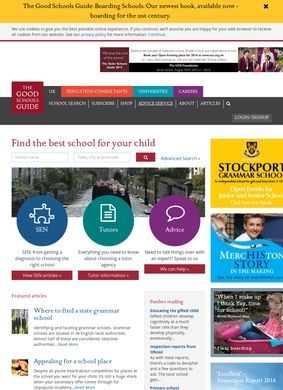
Narrowing 30,000-plus UK schools down to a workable shortlist is the problem The Good Schools Guide was built to solve. It covers roughly 1,300 of them, with editorial reviews written by visiting editors who tour the campus, sit in on lessons, and interview the head before forming a judgement. That selectivity is the whole point. The Good Schools Guide is not a directory dump of every school in the country; it is a curated set of detailed write-ups across state, independent, boarding, day, mainstream, and special needs schools, with an international arm that extends the same approach to schools in more than 35 countries. The editorial model has been running long enough that the print books predate the website, and the brand carries real weight in UK independent school circles.
Editorial reviews from visiting editors
The reviews read like someone was physically present, because they were. A visiting editor walking corridors and watching a maths lesson produces a different kind of information than a league table does, and that human observation is what families pay attention to when they read these pages. Schools notice too. Plenty of UK independent and international schools quote their own Good Schools Guide review in marketing and prospectuses, treating the inclusion as a credential. That outside uptake tells you more about the standing of the reviews than any self-description could. It also explains why The Good Schools Guide charges for its full archive: the editorial independence depends on not being funded by the schools it writes about.
School data and comparison tools
Alongside the editorial reviews sits a data aggregation tool that pulls together publicly available school data and combines it with information The Good Schools Guide collects itself. The promise is comparison without ten browser tabs open: results, intake, and the sort of figures parents otherwise have to hunt across separate government and school sources. How deep that proprietary layer goes is hard to judge from the outside, but the idea of one place that merges the official numbers with first-hand notes is a reasonable one.
Regional guides and tutor search
There are also county and city guides, Hertfordshire and Bristol among them, which is a sensible way to slice the problem for families who already know roughly where they want to live. A tutor search covering UK tutors rounds out the self-service side. None of this is flashy, and that suits the audience. Parents making a decision this consequential tend to want substance over polish, and The Good Schools Guide has consistently aimed at that.
Education consultants for school placement
Where The Good Schools Guide shifts from reference to paid service is the Education Consultants arm. Families are matched with specialist consultants for UK and international placement, scholarship and bursary support, and special educational needs advice. Clients receive bespoke written reports and ongoing liaison with schools about whether places are available, which is the practical bottleneck most parents hit. This is the commercial engine behind the free-to-read reviews, and the model makes sense: the editorial credibility feeds the advisory business, and the advisory business funds the editorial work.
How to contact the consultancy
Getting in touch runs through an inquiry form. The consultancy section asks for a name, contact details, the child's name and date of birth, and a short outline of what the family needs. No phone number or email was visible up front, though the form process is laid out clearly enough on the consultancy pages. For a service that hinges on a personal match between family and consultant, a structured intake form is a defensible front door, and the information it requests is proportionate to what a consultant would need to begin. A visible direct line would still reassure some parents, and its absence is worth noting even if it does not undermine the offering.
Reputation and press recognition
On outside opinion, the picture is uneven. Trustpilot shows six reviews at a four-star average, too few to draw much from either way. The more meaningful indicators come from elsewhere: The Good Schools Guide is cited positively by the Financial Times and The Guardian, and the schools that reproduce their reviews in prospectuses are, in effect, endorsing the credibility of the process. For a brand this established, a low Trustpilot count reads more as parents not thinking to leave platform reviews than as any real dissatisfaction. The press coverage and the schools' own behaviour tell a clearer story.
The honest limitation is coverage. Reviewing 1,300 schools out of more than 30,000 means the odds that any given family's local options are written up are modest. A household outside the catchment of the reviewed schools may find the free side leaves them wanting, and the paid consultancy becomes the only route to tailored help. That is a fair trade for the depth on offer, but it is a trade. The Good Schools Guide is strongest for independent, boarding, and international school decisions, where the reviewed set is densest and the stakes highest.
For an ordinary local state primary, the firsthand write-ups may simply not reach that far, and the value then rests on the data tools and the option to pay for advice. Useful, well-sourced, and clearly respected in its field, with a reach that is deliberately narrower than the size of the school system it covers.