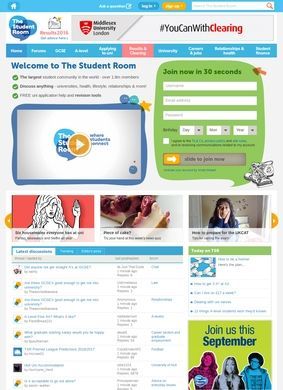
Long-running and UK-based, The Student Room is an online community for students built around dozens of discussion forums and a deep stack of article sections. It covers the whole arc of British education, from the GCSE years through university and out the other side into postgraduate study and first jobs. Anyone who has revised for exams in Britain over the last couple of decades has probably landed on one of its threads without meaning to, usually through a late-night search for a past-paper answer.
The site is free to read, and the article sections sit alongside the forums, so a visitor can slide between a written guide and a live discussion of the same topic.
The scale is the first thing to grasp. The Student Room is not a single-subject site or a tidy revision app; it is a large forum where students post questions and other students, plus the occasional teacher or graduate, answer them. That format decides both its strengths and its weak spots. The upside is volume and immediacy: on almost any British qualification, at almost any hour, someone has probably already asked your question and been answered. The downside is the flip side of the same coin, and it comes up at the end.
Exam revision and getting into university
The core of The Student Room, and the reason most people arrive, is exam and admissions help. Two clusters of forums do the heavy lifting.
That split works well: the article sections give a fixed, edited take on a topic, while the forum threads underneath let a student ask the follow-up question an article cannot anticipate. Between the two clusters below, the site covers nearly every route through the English and devolved exam systems, casting a wider net than a typical single-subject revision site.
GCSE, A-level and the newer qualifications
The revision forums cover GCSE and A-level across the usual subjects, and the coverage stretches to qualifications that get less attention elsewhere. The Student Room handles T-levels, the Extended Project Qualification, and Scottish qualifications specifically, which is genuinely useful, since a Highers student in Glasgow or someone slogging through an EPQ often ends up an afterthought on English-centric revision sites.
Threads tend to fill up in the run-up to exam season, so a student stuck on a past paper at eleven at night has a fair chance of finding someone who has faced the same question. The value here is timing as much as content. Official revision guides are static; a forum thread updates as the exam season builds, so the questions that surface tend to track what students are actually panicking about that year, from a tricky module to a rumoured topic. For the less fashionable qualifications especially, that responsiveness is worth a great deal.
The personal statement and application forums
The other pillar is university applications. The Student Room runs a dedicated Personal Statement forum alongside an "All university articles" section, and the two together cover the anxious middle of the UCAS process: what to write, where to apply, what an offer really means. This is where the peer format that defines The Student Room pays off, because a current undergraduate who went through the same course application a year earlier can say things a prospectus never will.
I found the application material the most convincing part of the whole site, precisely because it trades on lived experience the official channels lack. A university's own admissions page tells you what it wants to hear; a thread on The Student Room tells you what a real applicant actually wrote, whether it worked, and what the reply from the admissions office really said.
That candour is the whole appeal, though it also means the advice is only as reliable as the person offering it.
Subjects, regions and life after the exams
Beyond exams and admissions, The Student Room fans out into study help by subject and by place. The Student Room's subject forums run through Biology, Chemistry, Physics, Maths, History, wider STEM courses and Arts and Humanities, so a student can find a room devoted to their actual discipline instead of a general homework channel. Layered on top are regional forums for Scotland, Wales, Northern Ireland, the North and South of England, the Midlands and Greater London, which help with the parts of university choice that are really about geography: cost of living, commuting, which campuses sit within reach of home.
The site does not stop at the undergraduate gate. The Student Room carries postgraduate and international study forums, and a spread of careers and jobs boards covering finance and accountancy, legal, medicine and healthcare, marketing, the public sector, apprenticeships, and part-time or temporary work. Student finance guidance sits alongside all of it. For a sixth-former trying to work out whether a given degree leads anywhere, that continuity from revision help to career board under one roof is a real advantage.
Few sites follow a user across so many life stages. A person can arrive at fifteen worrying about GCSE grades and still find the place useful at twenty-two, comparing graduate schemes in accountancy or law, which builds a familiarity most single-purpose sites never earn.
Everything else the forums cover
A site this size is never only about work, and The Student Room knows it. The Student Room carries general chat, entertainment, sport, fashion and health forums, including sexual-health discussion, plus debate and current-affairs boards that run into UK and world politics. There is even a feedback and problem-reporting forum, a small sign of a community that expects to be told when something breaks. A dedicated mobile app extends the whole thing to a phone, useful for an audience that barely puts one down.
The breadth of these lighter forums does real work: it is what turns a revision tool into a place students actually hang around, which in turn keeps the study threads populated. A homework-only site empties out the moment exams end. A community with sport, entertainment and relationship talk alongside the coursework keeps its regulars, and those regulars are the ones answering the next cohort's questions.
All of that breadth is what makes The Student Room worth consulting, and also what raises the one real doubt about it.
Here is the catch. A forum answer is only as good as the stranger who wrote it, and on a site this vast the quality swings hard from thread to thread. The same crowd that gives an honest, first-hand account of a course can also hand out a confidently wrong exam technique or an out-of-date entry requirement, and The Student Room offers no obvious way to tell the two apart at a glance.
Old threads linger, exam specifications change, and a panicked student is not always in a state to check whether the advice on screen still holds. The Student Room is one of the most useful places a British student can go, and it can also mislead one, and no version of the site fully resolves that tension.
Moderation and upvotes help sort the good from the bad, but they cannot verify that a poster claiming an offer from a given university actually received one, or that a confidently stated grade boundary belongs to this year and not three years ago. For general orientation, encouragement and a real sense of what the process feels like from the inside, the site is genuinely valuable.
As the sole source of fact for a decision this consequential, it needs a second opinion, and that caveat does not fade no matter how busy the threads are.