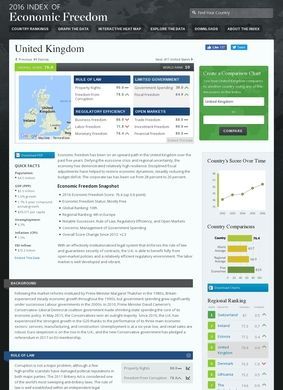
Heritage: United Kingdom Economy is the UK country entry in the Heritage Foundation's Index of Economic Freedom, a long-running project that scores more than 180 countries on how free their economies are. The listed address does not land there directly. It 301-redirects to economicfreedom.heritage.org, the dedicated home of the Index, now in its 32nd edition.
There is a wrinkle worth stating plainly. When I followed the exact URL for the United Kingdom page, the country slug did not resolve, throwing an "Invalid country name" error and bouncing back to the tool's homepage; the working UK page now lives at a different path on the same site. So the specific link filed under Heritage: United Kingdom Economy is stale, even though the content it points at is very much live.
What the Index measures
The core of Heritage: United Kingdom Economy is a single ranked list. Countries are graded and sorted, and the top of the table on view runs Singapore at 84.4, Switzerland at 83.7, Ireland at 83.3, and Australia at 80.1. A reader can search for one country, or compare several through an interactive heat map that also plots trends over time.
The UK-specific page, once you reach the right address, folds British data into that same framework, pulling in metrics like average inflation and an assessment of government price controls and subsidies as scoring inputs. Heritage: United Kingdom Economy is one slice of a global model, then, not a standalone report, and it only makes sense read against the wider ranking.
The ranking and the heat map
As a data instrument, Heritage: United Kingdom Economy is genuinely usable. The heat map turns a spreadsheet of scores into something a person can actually explore, letting a reader hold two or three countries side by side or watch a single nation's line move across editions. Under it sits a data-exploration and rankings section for anyone who wants the raw ordering rather than the visual.
For a student or a journalist wanting a quick, consistent number to anchor a comparison, the tool puts one within a couple of clicks, and the fact that it applies the same yardstick to every country is part of what makes it citable. Whether that yardstick is the right one is a separate matter, and it is where the reservations start.
About the Index, and the page that moved
The supporting material behind Heritage: United Kingdom Economy is thorough. An "About the Index" section carries an FAQ, a contributors list, the methodology, and the major works cited, so the scoring is documented rather than asserted. The full report is downloadable, complete with preface, executive highlights, and analysis, and there is a book edition to download or buy. Laying out the methodology and the sources in the open is the right instinct, and it lets a skeptical reader trace how a score was built instead of taking the final number on faith.
What the presentation does not do is flag that the UK country link is broken, which is exactly the kind of maintenance gap that erodes trust in Heritage: United Kingdom Economy before a visitor has read a single figure.
The foundation behind the numbers
None of this data sits in a vacuum, and Heritage: United Kingdom Economy cannot be judged apart from its publisher. The parent site, heritage.org, is the public home of the Foundation, a Washington think tank that describes its own mission in conservative, free-market terms and pairs research with open political advocacy. That framing is the single most important context for reading any of its scores, because the organization is not a neutral statistics bureau; it is an advocacy institution that also produces data.
Getting in touch is straightforward. A Contact link sits in the navigation of both Heritage: United Kingdom Economy and the main site, next to Press, Events, Donate, and Renew, and the Charity Navigator listing adds a public Washington address and a phone number for the Foundation. Transparency of access is not the issue here; anyone wanting to reach the organization or question a figure has an obvious route to do it, which is more than some data publishers bother to offer.
Where credibility gets complicated
Reputation is where Heritage: United Kingdom Economy splits along familiar lines. On accountability, the Foundation earns a Charity Navigator Four-Star rating at 97 percent, covering finances, governance, and planning, so as a well-run organization it checks out cleanly. On the content itself, the picture shifts: Media Bias/Fact Check rates the group's output as Right in bias with Mixed factual reporting and Medium credibility, and Wikipedia catalogues it as a conservative advocacy think tank with a documented run of controversies. Quora threads and SourceWatch push harder still, questioning the Foundation's objectivity over disputed claims on other topics.
Those are not customer complaints in the usual sense; no conventional review platform like Trustpilot, Yelp, or the BBB carries a rating for the site or the tool. What the criticism reflects is a partisan argument about whether an ideologically committed institution can be trusted to score the world's economies without a thumb on the scale. The Index is methodologically transparent and the Foundation is financially sound, and both of those things can be true while a reader still doubts the framing.
Heritage: United Kingdom Economy leaves one question unresolved: whether a freedom score built by an openly free-market advocacy group counts as a neutral yardstick or as an argument dressed up as data. The tool does not settle that for its readers. It hands over the number and leaves the judgment to them.