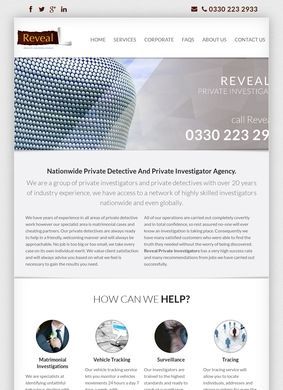
Private investigation in the UK is largely unregulated, which means the gap between a credible agency and a dubious one can be hard to spot from the outside. Reveal Private Investigator, operating since 2010 and working for both individuals and companies across the country, is one of the easier ones to assess because it puts its credentials upfront instead of burying them.
Personal investigations and counter-surveillance
On the personal side, Reveal Private Investigator covers covert surveillance including rural observation, matrimonial and infidelity work, address and person tracing, GPS vehicle tracking, polygraph testing, and bug sweeping to check for hidden listening devices. The counter-surveillance offering is a step beyond the following-a-spouse cliche that many agencies stop at. The corporate menu is equally detailed: employee investigations, pre-employment and general background checks, asset tracing, fraud cases, injury and insurance claim investigation, mystery shopping, process serving, and enquiry agent work all appear.
Corporate services for employers
Insurance claim and injury investigation tend to attract repeat work from solicitors and insurers, so an agency listing them is usually disciplined about producing evidence that will survive later scrutiny. Process serving and asset tracing slot into that same legal-support world. The combined personal and commercial range points to a firm earning most of its income from steady professional referrals rather than walk-up clients in a crisis.
Why solicitors return for insurance work
Geography is handled sensibly. The keyword leanings point at Birmingham, and the agency names a Birmingham base, but coverage extends across London, Warwickshire, Wolverhampton, Liverpool, Manchester, Worcester, and Solihull. For surveillance especially, local knowledge is the deciding factor, so naming specific Midlands and northern towns reads more credibly than a blanket national claim with nothing behind it. Reveal Private Investigator sits in that first camp.
Local coverage across the Midlands
Credentials are where Reveal Private Investigator pulls ahead of the field. Membership of the Association of British Investigators is the recognised industry marker in the UK, because the profession has no statutory licensing and the ABI vets its members. Alongside that sit BS 102000 accreditation (the British Standard for the provision of investigative services), stated GDPR compliance, and RIPA-compliant evidence collection. RIPA compliance is the one that should reassure anyone planning to use findings in court or a tribunal, because surveillance gathered the wrong way can be thrown out and worse. For the polygraph work, Reveal Private Investigator cites qualified members of both the British Polygraph Society and the American Polygraph Association. Whatever a person thinks of lie detection generally, naming the professional bodies behind the examiners is more honest than presenting it as some proprietary technique.
Industry accreditations and standards
That stack of accreditations counts for something concrete in a trade where credibility is the whole product. Anyone can put up a website calling themselves an investigator. Far fewer can point to a British Standard and a vetting body. The combination is the strongest indicator in the brief that Reveal Private Investigator runs a properly organised outfit, and it frames the polygraph and counter-surveillance offerings as part of a regulated practice rather than gimmicks bolted on for marketing.
What the credentials mean in practice
Reputation outside the company's own pages backs this up to a useful degree. Trustguide, which pulls together Google and other public reviews, records 88 reviews at 4.9 out of 5 for Reveal Private Investigator, a strong score across a sample big enough to mean something. The Facebook page shows only two reviews and no aggregate rating, so that channel adds little, and there are no Trustpilot, Yelp, or BBB entries to consult. The single Trustguide figure is doing the heavy lifting, but 88 ratings at that level is not the sort of thing a small firm easily fabricates, and it lines up with the professional credentials.
Independent ratings on Trustguide
There are limits worth naming honestly. Polygraph results have no legal standing in UK courts and remain scientifically contested, so the lie-detector service is best understood as a tool for private reassurance or internal disputes, whatever the examiners' qualifications. The review picture beyond Trustguide is narrow, which means a prospective client is largely leaning on one aggregator plus the agency's own published claims. And the absence of a visible street address, while defensible for an investigation agency where clients rarely visit and a public office can complicate confidentiality, does leave one ordinary checkbox unticked.
Polygraph limitations and missing details
Set against those caveats, the substance holds. The service list is specific and coherent, the accreditations are the right ones for the work, the geographic claims are concrete, and the independent rating is genuinely good. Reveal Private Investigator describes what it does in enough detail to verify, which puts it well ahead of the short-on-detail pages that dominate this corner of the market.
How to verify claims before engaging
A reasonable way to approach Reveal Private Investigator is to call and explain the situation in confidence, ask directly how evidence would be gathered and whether it would survive any formal proceedings, and for the polygraph option specifically, confirm which professional body the examiner is accredited through. The published record answers most of the preliminary questions a careful client would raise, and the accreditation trail is traceable to named bodies. That alone separates Reveal Private Investigator from most of its competitors in this field.