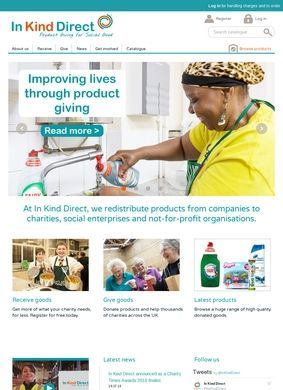
A food bank runs out of nappies mid-week, a refuge needs cleaning products it cannot afford to buy at retail, a homelessness project wants toiletries in bulk without blowing its tiny budget. These are the moments In Kid Direct is built for. It is a UK charity that runs a product-donation platform, sitting between companies with surplus stock and the charitable organisations that can put that stock to immediate use. Manufacturers and retailers pass on goods they would otherwise write off, and registered charities browse and order from the resulting catalogue at a fraction of the usual cost.
How the donation platform works
The mechanics are the interesting part. Companies list donated products, and charities that have joined the network log in and order what they need, paying only a small handling contribution rather than market price. So the model turns two separate problems, corporate overstock on one side and frontline funding gaps on the other, into a single supply chain. For a small charity, the practical draw is obvious: a catalogue of usable goods that would otherwise cost money it does not have.
Named campaigns target specific needs
The site splits cleanly along its two audiences. For Charities explains eligibility, how to register, and how ordering works, while For Companies sets out how a business can offload surplus and, in some cases, join a wider push. Those pushes are the named campaigns. "End Hygiene Poverty" targets the specific shortage of soap, sanitary products and cleaning supplies among people who cannot afford them, and "Joy of Play" points at toys and play equipment for children. Naming the campaigns tells you the donations are steered toward defined needs rather than whatever a warehouse happens to be clearing that month.
Scale and reported reach
The scale is spelled out in numbers. In Kid Direct reports 9,280 charities supported in 2025 and around 930,000 people reached each week. Those are large figures, and they read as a genuine measure of throughput. Whether every one of those charities is actively ordering or simply registered is not something the site pins down, and that ambiguity is worth holding in mind when you weigh the reach against the effort. In Kid Direct chooses to publish the numbers, which is more than many charities of comparable size do.
Content Hub and research resources
Beyond the transactional core, there is a Content Hub that goes deeper than the average charity site, a clear step up from a business directory listing with a single "about us" page. It carries research reports, news, and funding resources, backed by a Reports and Research archive. For a charity manager, the funding material and sector research could be as useful as the goods themselves, and In Kid Direct publishing its own reports points to an organisation trying to document its impact instead of merely asserting it.
Volunteering, fundraising, employment options
The Get Involved area covers the routes you would expect from an established charity: volunteering, fundraising events, and a jobs or employment section for people wanting to work there. An FAQ section handles the common queries, which is sensible given that two very different groups, corporate donors and charity staff, arrive with very different questions. The layout does a decent job of not making one audience wade through the other's material, and In Kid Direct keeps the paths for donors and recipients visibly distinct from the first click.
Contact information and accessibility
Contact details are unusually complete and easy to find. There is a phone number, an email address, a physical address in central London (care of Canopi on Tanner Street, SE1), and a contact form on the site. For an organisation asking companies to hand over stock and charities to register their details, that openness is the right call, and it removes the friction you sometimes hit when trying to reach a body that operates mostly through an online portal. A charity director deciding whether to sign up can pick up the phone and ask, which counts for something.
Limited independent reviews available
Independent feedback does not stretch far. A Facebook page has 94 percent of reviewers recommending it, drawn from 19 reviews. That is a small sample, and it is warm, but 19 is not many for a charity claiming to touch nearly a million people a week. Searches turn up no Trustpilot, Google, or BBB profile tied to this organisation. A Trustpilot listing that surfaces belongs to inkind.com, an unrelated US gift-card platform, and should be ignored entirely when judging In Kid Direct.
Gap between scale and user feedback
That gap between reported scale and visible independent feedback is the sticking point. The registration model partly explains it, since the relationship is business-to-charity and B2B work rarely generates the public review trail that consumer services do. Nobody leaves a star rating for a soap donation the way they would for a takeaway. Still, an organisation with this much throughput and this many partner charities might reasonably be expected to have accumulated a broader body of testimony somewhere, and its relative absence is a fair thing for a newcomer to notice.
What the site does well is describe a concrete, checkable mechanism and back it with numbers and named programmes. In Kid Direct runs a redistribution engine with clear entry points for both sides. The reporting archive and the published research lend it weight, the contact routes are open, and the model itself answers an unglamorous but pressing need. A charity weighing whether to join gets enough here to make an informed decision and a starting phone number to chase the rest.
Legitimacy is not the issue: the London address, the campaign detail and the reporting all support it. What stays open is whether the everyday experience matches the headline reach. Nineteen Facebook reviews cannot confirm that a charity ordering through In Kid Direct finds the catalogue stocked with what it needs, that fulfilment is quick, or that the handling contribution stays low enough to be worth it against the effort of registering. The platform tells you convincingly what it intends to do. Proof of how reliably it delivers, in the words of the charities on the receiving end, is the piece a cautious sign-up will still want and the site does not yet put in front of you.