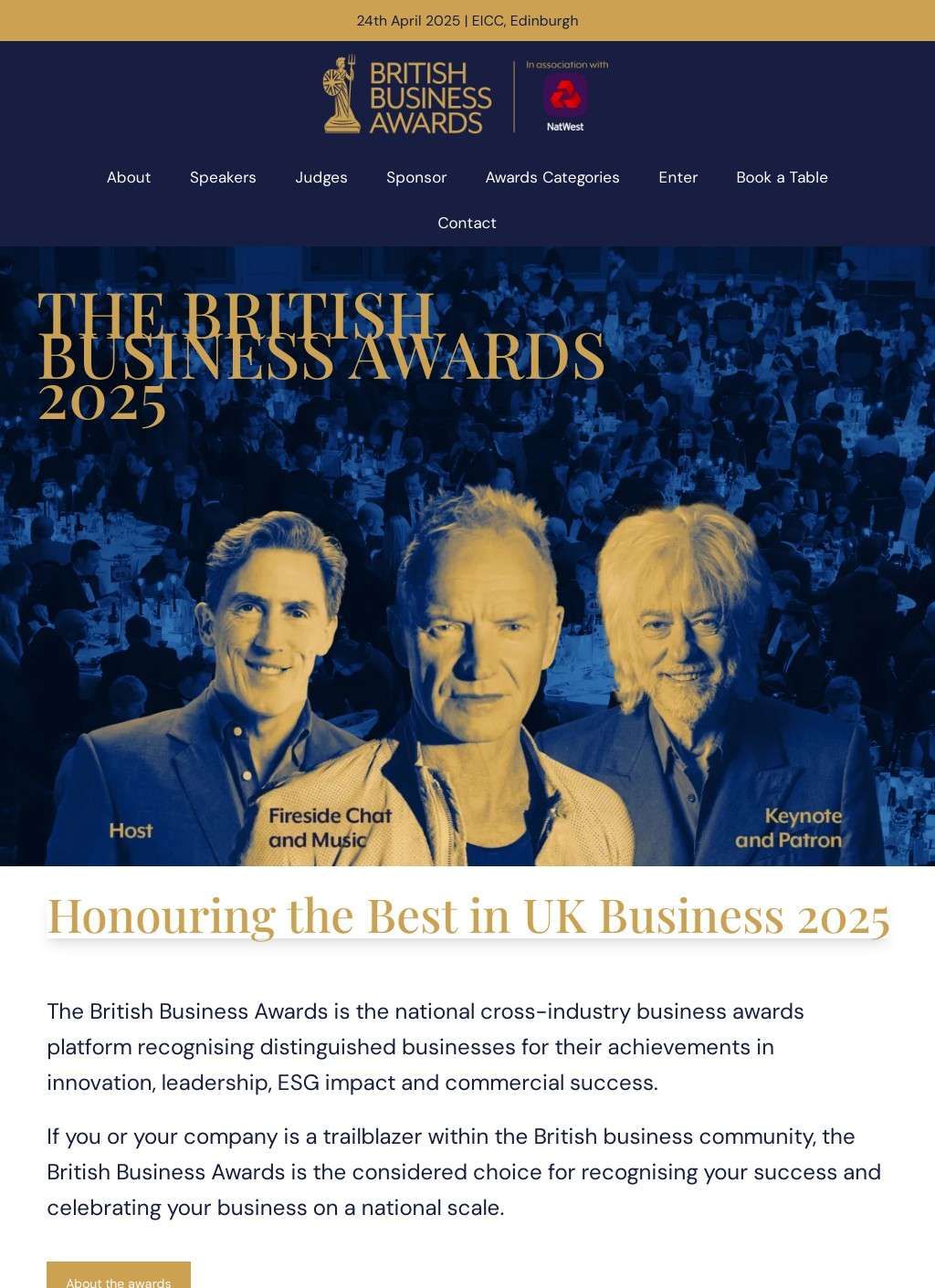
Britain's national business awards landscape is crowded, so The British Business Awards has to earn attention with visible, verifiable partners behind it. The 2026 ceremony is booked for April 30 at the Edinburgh International Conference Centre, a black-tie evening sized for up to 2,000 business leaders. The format is laid out plainly: an open call for entries, a spread of categories covering innovation, leadership, ESG impact and commercial performance, and no entry fee. Removing the cost barrier is a meaningful choice; most recognition schemes charge just to submit, which quietly filters out smaller firms before judging even begins.
Verified partners behind the awards
The weight behind The British Business Awards comes from named partnerships rather than brand-building copy. NatWest Group is listed as the headline partner, proceeds go to Social Bite (an Edinburgh homelessness charity), and The Times and the Sunday Times appear as official media partners. These are associations a visitor can check independently. That kind of named, verifiable backing pulls the event well away from the generic trophy programmes that trade on vague prestige, and it gives the charity link a coherence that The British Business Awards otherwise relies on celebrity anecdote to establish.
2025 shortlist and photo gallery
The archive material does useful work. A shortlists-and-winners section shows the 2025 shortlist with recognisable companies included, Greggs and The Ivy Group among them, and a photo gallery from that year's ceremony gives a sense of scale and atmosphere. Visible past participants with brands attached is the practical difference between a credible programme and a site that is still waiting for its first serious entrant. A prospective company can browse the 2025 names and gallery before deciding whether the room matches what The British Business Awards claims to be.
Sponsorship packages and table bookings
The commercial side is also covered: sponsorship packages for businesses wanting their name attached to the evening, and table bookings for the ceremony itself. This is useful context for understanding what The British Business Awards is. It is a corporate gala with a charitable engine, funded through sponsors and table sales while the entry route stays free. Whether the judging process matches the ambition of the branding is harder to assess from the public pages, since the panel composition and scoring criteria are not laid out in the same detail as the entry mechanics. The business directory listing gives a route in, but the how-judging-works section is the gap a serious applicant will notice.
Checking the celebrity claims
The about page is where the tone shifts in a way worth flagging. It claims the attendees represent over 200 billion pounds in combined company value and names George Clooney as a past guest. A celebrity reference plus an aggregate valuation figure are exactly the sort of assertion that is easy to make and hard for an outsider to verify. The Clooney mention most likely traces back to his association with Social Bite, so it reads as plausible context for the charity link, though the site does not spell that out. A more careful visitor will want sourcing for the 200 billion figure before treating it as firmer than marketing shorthand.
Contact options exist: there is a form on the site, so a route in is available. What is absent is a phone number or physical address for the organisation on the homepage. The EICC is named as the venue, which is not the same as a registered office, and a national scheme handling free entries, sponsorship money and table bookings would inspire more confidence with a visible street address. Routing all contact through a web form to reduce inbox noise is reasonable, but the absence of any corporate footprint to check against Companies House without digging leaves a real gap in the picture.
Searching for outside reviews
Outside reputation is the genuine blank for The British Business Awards. A search for the exact domain turns up the site's own pages and little else of relevance. There is no Trustpilot profile, no Google rating, no third-party review trail tied specifically to this operation. The UK is crowded with similarly named programmes, and anyone searching casually could land on the wrong body and form an impression based on a different organisation's record entirely. The shared-naming problem is not the organiser's fault, but it makes building a distinct public profile harder and means a visitor has to confirm they are reading about the right entity.
Weighed together, the strengths are concrete. The NatWest partnership, the Times media tie-in, the Social Bite cause and the named 2025 shortlist are verifiable anchors, not assertions. Free entry lowers the barrier for smaller firms that would never pay to be considered. A company deciding whether to enter The British Business Awards, or take a sponsorship package, gets enough on the page to understand the event's shape and ambition, and the partner roster supports The British Business Awards' prestige framing more credibly than copy alone could.
Judging process transparency gaps
The doubts that linger are mostly about transparency. The judging process sits largely out of view, the headline claims on the about page rest on the organiser's word, and the contact details stop short of what would let a cautious applicant verify who is running things and where. For an event built so heavily on named partners and implied prestige, the gap between the impressive associations on display and the sparse information about the body itself is the thing worth keeping in mind.
Business address
The British Business Awards
Edinburgh,
EH3 6AA
United Kingdom
Contact details
Phone: 0131 516 1655