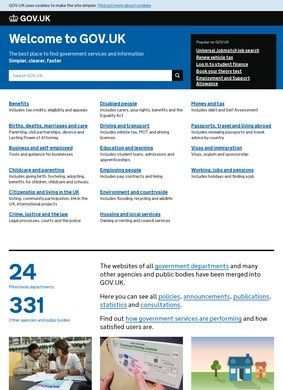
Where does a person in the UK go to renew a passport, check whether a used car has a valid MOT, register to vote, or file a Self Assessment tax return? For most of these, the answer is the same single website. Gov.uk is the official digital front door for central government, pulling every department, agency and public body onto one domain so that a citizen does not have to guess which obscure office handles which task. That consolidation is the whole point of it, and it is the reason the site is worth knowing how to navigate.
Sixteen life categories mapped to government services
The structure leans on sixteen broad categories, and they map closely to the moments in life when most people actually need the state. Benefits is one of them, covering Universal Credit, tax credits and the appeals process when a decision goes against you. Another groups together births, deaths, marriages and care, which is where you go for civil partnerships, divorce, or setting up a Power of Attorney for an ageing parent. There is a section for business and self-employment that handles company registration, VAT, PAYE and trade licences, and a separate one for employing people that deals with pay, contracts and redundancy. The split between running a business and hiring staff is a sensible one, since the questions rarely arrive at the same time.
Benefits, family care, business registration
Driving and transport is probably the corner of Gov.uk that gets the heaviest everyday traffic. Vehicle tax renewal, MOT history checks, and applying for or renewing a driving licence all sit here, and these are the kind of small obligations that used to mean a queue at a counter. Money and tax runs in parallel, with Self Assessment, debt management guidance and the HMRC tools that let you square things with the taxman without a phone call. The site also carries a National Insurance record checker, and gaps in that record quietly shape what state pension a person eventually receives, so it is worth a visit before assuming everything is in order.
Vehicle tax, MOT checks, driving licences
Families and people in difficult circumstances are not an afterthought. Childcare and parenting covers fostering, adoption and school admissions. There is a category built around disabled people, with disability benefits and support for carers, and another for citizenship and living in the UK that handles voting registration and community matters. Crime, justice and law brings together the courts, legal aid and the slightly dreaded summons to jury service. Each of these is the sort of subject where bad or out-of-date information found elsewhere can cause real harm, so having the authoritative version in one place is a genuine advantage.
Support for families, disabled people, citizenship
Travel and movement across borders get two distinct categories, which makes sense given how different the needs are. Passports, travel and abroad covers passport renewals and the foreign travel advisories broken down country by country, the same notices people check before booking somewhere they are unsure about. Visas and immigration is the heavier counterpart, dealing with work, study, visit and settlement applications, an area where the rules shift and where reading them from the source is the safest course. A holiday entitlement calculator and pension guidance sit under working, jobs and pensions, alongside the official job search.
The remaining categories round out the picture in a way that reflects how much of ordinary life touches government. Education and learning takes in student loans, apprenticeships and Ofsted reports on schools. Environment and countryside handles flood alerts, farming and waste, with the flood warnings in particular being the sort of thing you want coming from the body that actually monitors the rivers. Housing and local services pulls in council tax, planning permission and renting rights, three subjects that often land on the same household in the same year. None of these sections is padding; they each answer questions that genuinely arrive at someone's door.
Official news, statistics, policy documents
Beyond the transactional side, Gov.uk is also the public record of what the government is doing and saying. It hosts official news, ministerial speeches, statistics, research publications and transparency documents from across every department. That second function is easy to overlook when you have only ever come to the site to tax a car, but it is what makes Gov.uk useful to journalists, researchers and students trying to read policy from the source rather than through a second-hand summary. The same place that renews your licence will also hand you the raw figures behind a headline. Treated as a business directory it covers the practicalities; treated as a policy archive it goes considerably further.
Finding information across sixteen subject areas
There is a practical wrinkle worth flagging. A site that tries to be the answer for sixteen sprawling subject areas is, by its nature, enormous, and the breadth can make finding one exact form feel like work. The category labels are clear and the search tends to land you in the right region, yet the sheer depth means a first-time visitor sometimes has to dig through a couple of layers before reaching the precise page they wanted. A GOV.UK mobile app exists to smooth some of that for the most common tasks, and the step-by-step guides scattered through Gov.uk do real work in steering people who are not sure what they are looking for.
Plain design with readable language throughout
What lifts Gov.uk above a mere catalogue of services is consistency. The design is plain on purpose, the language is kept readable rather than legalistic, and the same calm layout follows you whether you are checking a pension forecast or reading a flood warning. That uniformity is not glamorous, and it is exactly what you want from the place that handles your tax, your passport and your right to vote. A citizen rarely visits because they want to; they visit because they have to, and Gov.uk treats that obligation with a steadiness that has built genuine trust over the years it has been running.
From scattered offices to one navigable site
Taken as a whole, Gov.uk consolidates what used to be a scattered mess of offices and forms into one navigable whole, and the value of that grows the more of life you have to manage through it. Anyone living, working, studying or doing business in the UK will brush up against this site eventually, probably repeatedly. Gov.uk does what it sets out to do without trying to sell anything or bury the answer, and that is a harder thing to pull off at scale than it appears.