A claim starts moving through the group chats around lunchtime. A minister has resigned, or a storm is about to close the schools, and every screenshot tells the story slightly differently.
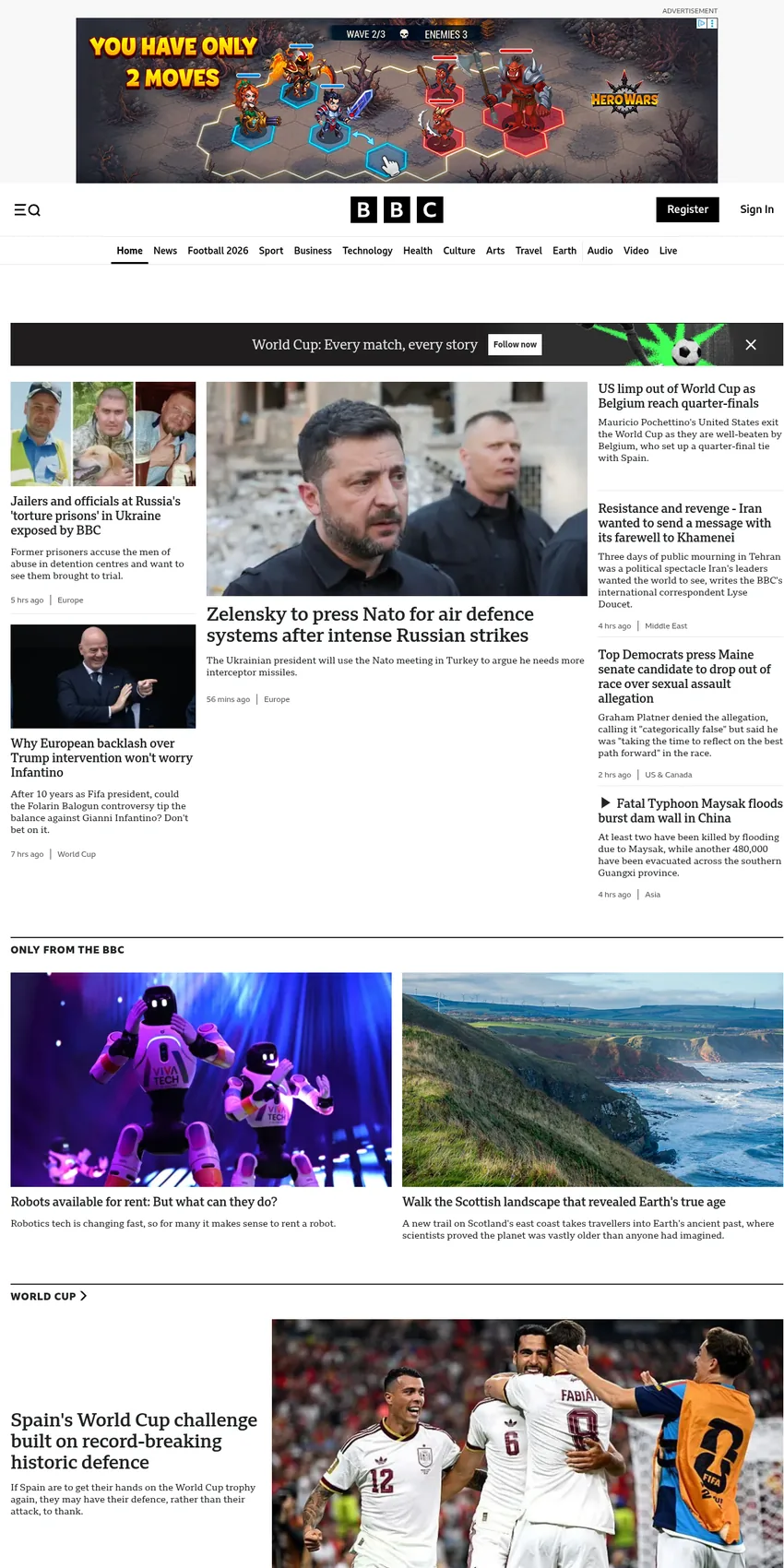
For millions of people in the UK the next move is automatic: go to the BBC and check.
That reflex took a century of broadcasting to build, and the site it lands on now covers far more ground than the news that made the name. The BBC homepage works as a switchboard for the whole corporation. Top stories sit beside live sport results, a weather search and highlight tiles for iPlayer and Sounds, so a single visit can settle three or four errands at once.
This is the UK edition of the operation; an international edition lives on a separate domain, and the version reviewed here is the one built for British readers, viewers and listeners. The distinction matters mostly for what surfaces first: domestic politics, UK fixtures, local forecasts.
Behind the grid sits a public service broadcaster operating under Royal Charter, and that status shapes the experience in ways a visitor feels without having to think about them. Nothing about the reporting is gated. There is no paywall, no sign-in demand halfway down an article, and the pages read cleanly on a phone in a queue. Start with the part of the portal that has no rival, because it explains why the rest gets so much traffic.
iPlayer, Sounds and the feature sections
No newspaper site in Britain can match this half of the operation, because none of them run a television network.
The BBC folds its broadcast output into the same front door as its journalism, and that single fact changes what the site is for. People arrive for a headline and stay for the evening. Culture and Travel, the two long-form sections, sit slightly apart from the daily churn and publish feature writing paced for a slow read.
I opened both intending to skim them for this review and surfaced the better part of an hour later. They are easy to miss from the main grid, and they repay the detour, particularly on a weekend when the news itself has gone quiet.
Television on BBC iPlayer
iPlayer is the television arm: live channels streamed in the browser, plus the BBC's own programmes on demand. The front page is a wall of programme artwork that behaves the way a current streaming service is expected to behave, which was no certainty for an institution of this age. The practical effect is that the broadcast schedule stops dictating the viewer's evening; the programme is there whenever the viewer is.
Live channels deserve a separate word, because they solve a different problem. On a big news night or during a major sporting event, the on-demand catalogue is beside the point; what people want is the channel itself, live, without hunting for an aerial or a set-top box.
Having that inside the same site as the written coverage is quietly one of the strongest arguments for the whole portal.
Radio and podcasts on BBC Sounds
Sounds does the matching job for audio, streaming live radio, music and podcasts from a single interface. The BBC's radio output spent most of its history tied to the dial; here a listener pulls up a station live or picks a programme after the fact, and the podcast catalogue sits in the same player.
Anyone who has tried to catch one specific programme at its exact broadcast hour knows what the on-demand model fixes.
News, sport and weather
BBC News anchors the portal all the same. The front page runs UK and world reporting beside politics, business, health and science desks, arranged as a photo-led story grid that rewards a quick scan. Range is the point here.
A reader can move from a political story to a new health study to a markets piece without leaving the section, and the register stays plain and sourced throughout.
It also turns over fast. The corporation publishes free public RSS feeds with reuse terms spelled out in its own terms of use, the front-page feed refreshes on a cycle measured in minutes, and a story seen at breakfast has usually moved on by mid-morning. Headlines can be followed from a feed reader without visiting at all, a courtesy that has become rare among publishers of any size, and the section rewards checking more than once a day. BBC Sport gets the same treatment on its own front: live scores plus match coverage across football, cricket, rugby and the rest of the UK sporting calendar.
The section is organised around the fixture list, which on a crowded weekend is the right shape, and the live score pages are the quickest route to a result on a Saturday afternoon. Match reports arrive with photography rather than as bare text feeds.
BBC Weather completes the utility row with forecasts for the UK and for locations worldwide.
It is a plain tool doing a plain job, and the restraint suits it. A forecast page has one question to answer, and this one answers it without ceremony. Faults are worth naming, and the list is short but real.
Breadth makes the homepage dense: a first-time visitor meets a wall of tiles before any hierarchy emerges, and the strongest slow material, Culture and Travel above all, sits several clicks back from the front. The portal asks for a little navigation patience.
It never asks for more than that. The fairest way to end is against the alternative a UK reader would name first: Sky News. On a breaking story Sky is fast, its live blogs are genuinely useful, and the site costs nothing to read, so as a second source for cross-checking a developing headline it does that job well. But Sky News is a news operation, and the comparison stops at the newsroom door.
It has no answer to iPlayer or Sounds, and nothing that matches the Culture and Travel desks when the appetite runs longer than a bulletin.
So the choice sorts itself by need. Pick Sky when the next hour's headlines are the whole errand, nothing more. Everything else on a British Saturday runs through the BBC instead: the match report, the forecast for the school run, the evening's viewing, the podcast queued for the commute.
An afternoon spent across its sections makes the case on its own.






Business address
British Broadcasting Corporation (BBC)
Broadcasting House, Portland Place,
London,
W1A 1AA
United Kingdom
Contact details
Phone: 0370 010 0222
Football finance expert Kieran Maguire says the potential sanctions for Manchester City will be 'significant' after the sources…
The prime minister told the BBC an early poll would throw the country into a "backward-looking process".
Experts say the hack could leave agents vulnerable to scams, blackmail and targeted attacks.
The BBC's financial situation "may well mean" some channels and stations close, Matt Brittin says.