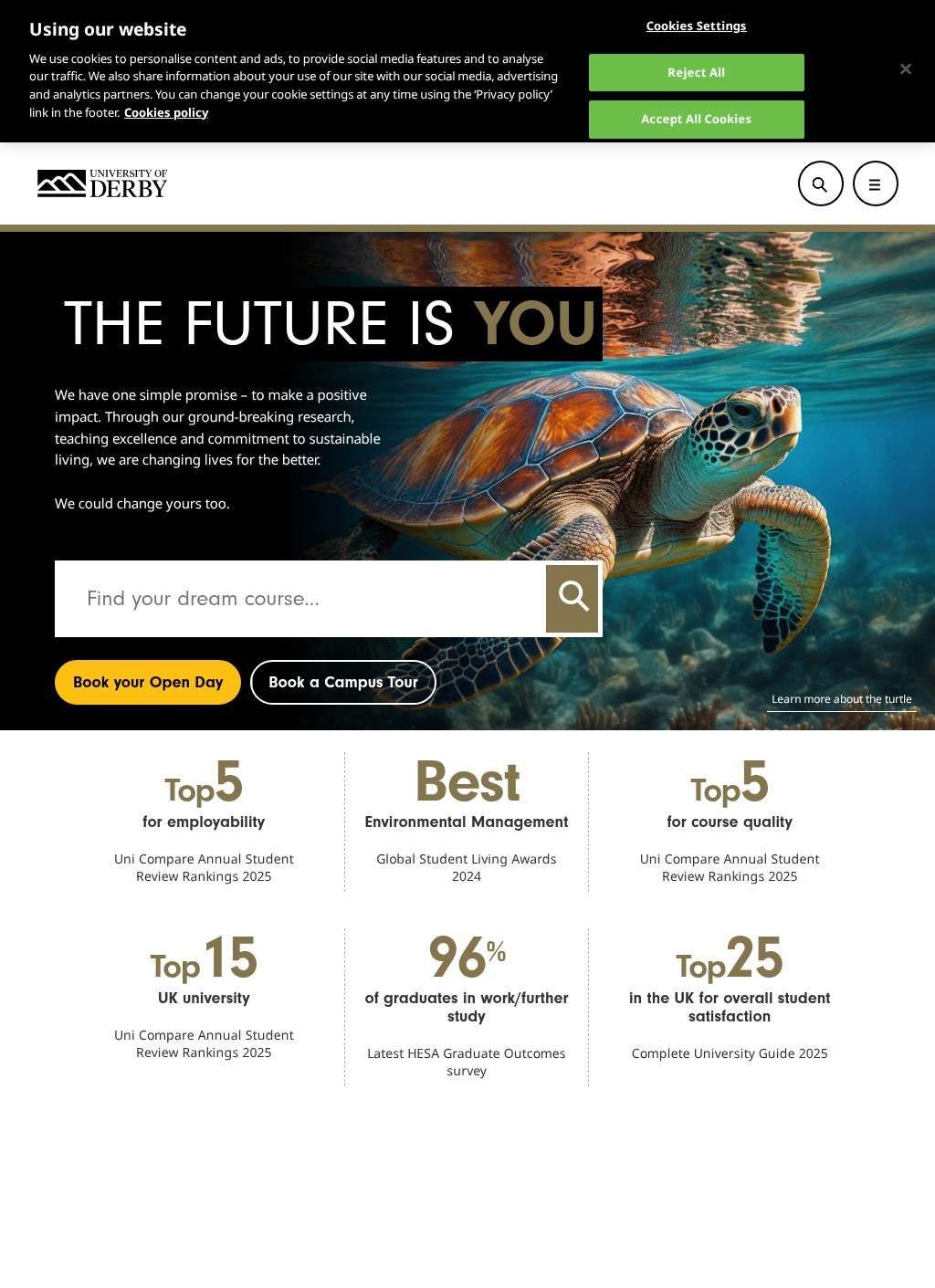
Derby's publicly funded university sits in the English Midlands, with its main teaching base in the city and a second campus in Chesterfield. It runs the full ladder of higher education qualifications, from foundation and bachelor's degrees up through integrated master's, taught postgraduate routes such as MA and MSc, and doctoral research. What separates it from a purely academic prospectus is how much of the provision sits outside the standard three-year residential model. There are fully online part-time courses for people who cannot move or stop working, short professional development courses aimed at upskilling, and degree apprenticeships that pair paid employment with a qualification. Taken together, the University of Derby reads as an institution trying to widen who can reach a degree and how they get there.
Subject areas and academic range
The subject range at the University of Derby is broad and worth reading carefully before assuming it covers the usual suspects. Arts and design is a genuine strength here, grouped under a Games@Derby banner that splits the discipline into Game Art, Game Design, and Game Programming, which is more granular than many institutions bother with. Beyond that, the catalogue takes in business, health sciences, engineering, education, law, psychology, and the social sciences. That spread tells you the place functions as a full general university and not a specialist college that happens to have expanded.
Graduate outcomes and external ratings
On outcomes, the University of Derby puts forward figures that are verifiable against the usual sector measures. It reports that 94 percent of graduates are in work or further study within 15 months of finishing, and it points to a first-in-category employability ranking and a claim of being named UK University of the Year 2027 in a set of student-led rankings. It holds Teaching Excellence Framework Gold from 2023, which is the highest band in that national assessment and is decided independently of the university itself. Prospective students should still read these in context, because rankings vary wildly by who compiles them, but TEF Gold in particular is a meaningful external marker of teaching quality.
Student accommodation and campus life
The student-life side is covered in enough depth to be genuinely useful to someone making a three-year commitment. The University of Derby provides on-campus accommodation, advertised at the time of writing with a 500 pound discount, alongside clubs and societies, sports facilities, and a Union of Students that gives the student body a formal voice. Study abroad programmes are available for those who want a term elsewhere, and there is a dedicated support structure for international students, which covers the practical maze of visas, arrival, and settling in that domestic applicants never have to think about. None of this is unusual for a UK university, but it is all present and accounted for, which is the relevant point.
Research partnerships with business
One part of the offering that often gets buried is the business-facing arm, and it is more substantial than a token outreach page. The University of Derby markets research and innovation partnerships, knowledge transfer work, and talent recruitment pipelines to external organisations, plus commercial training and paid access to specialist facilities. For a regional employer, a research-active university on the doorstep that will rent out lab or workshop capacity and run bespoke training is a practical resource. This is the activity that explains why a public institution lists itself in a business directory and elsewhere, aiming at prospective business partners as well as school-leavers.
Checking course information online
The website itself does the job a university site needs to do. Course information is organised by level and by subject, the distinction between online and on-campus study is made clear, and the apprenticeship and short-course routes are not hidden behind the undergraduate funnel. The University of Derby keeps active channels on Facebook, Instagram, LinkedIn, TikTok, X, and YouTube, which is the expected footprint for a university competing for school-leavers who live on those platforms. That presence also gives applicants somewhere to see day-to-day campus life rather than only the polished prospectus shots.
From accessibility to employment focus
Weighed against a near neighbour such as the University of Nottingham, Derby is the less research-heavy and less selective of the two, and an applicant chasing a traditional Russell Group name and a high entry tariff will lean the other way. Where the University of Derby makes its case is on accessibility: the spread of online, apprenticeship, and foundation entry points, the TEF Gold teaching rating, and the strong graduate employment figure point to an institution built around getting a wide range of people into qualified work, rather than around research prestige alone. The published evidence is solid enough that flexibility-focused or employment-focused applicants in the East Midlands have a credible option here, and one with an external quality rating to back it up.