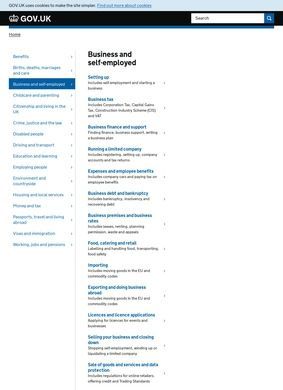
Gov.uk: Business is the official guidance hub for businesses and self-employed people on the UK central government website, maintained by HM Government. It gathers, in one place, the rules and tools that someone running a company in Britain has to deal with sooner or later: how to register, how to file tax, what an employer owes its staff, how goods move across a border. The page is a directory of links, not a single article, splitting the subject into 19 topic groups that fan out into hundreds of individual guides maintained by the departments responsible for each area. It inherits the broader government portal's plain, no-frills approach to information, and that aesthetic is a deliberate choice, not a design oversight.
The breadth is the point. Pre-launch planning sits next to the mechanics of choosing and managing a structure, whether that is a limited company, a partnership or a sole trader setup. Employer duties get their own run of pages covering hiring, payroll and the obligations that come with taking someone on. There is a finance strand covering funding, growth support and, usefully, debt solutions, which is the sort of subject most commercial sites avoid. A link sends you to the guide, the guide tells you the rule and the deadline, and that is that. The way Gov.uk: Business is organised assumes you have a specific job to do and want the official answer with the least fuss possible. That assumption is mostly correct.
Tax filing and company lookups
Most people who land on Gov.uk: Business arrive with a tax problem, and this is where the resource is at its strongest. The page funnels into the HMRC online account, the single portal for Self Assessment, VAT and Corporation Tax. Self Assessment in particular has a dedicated filing route reached straight from here, so a sole trader chasing the January return reaches it directly. The company information lookup tied to Companies House is the other heavily used tool, letting anyone check a registered company's filings and officers without paying for a third-party service.
How the resource handles tax obligations
This section does not pretend the system is friendlier than it is. The guidance is written to be followed step by step, with the assumption that the reader has a real obligation and a real deadline. Tax authority being what it is, the language stays neutral and procedural. There is no upsell, because there is nothing to sell. For the everyday filing tasks that eat a small business owner's evenings, Gov.uk: Business is the authoritative starting point, and the links resolve to the actual government services rather than to summaries of them. That distinction sounds minor until you have lost an hour on a site that only described the form you needed.
Finance guidance alongside debt solutions
The finance and debt material deserves a mention alongside the tax tools. Guidance on business debt management is grouped with the funding pages, which is a sensible pairing: the same operator who needs growth capital this year may need a debt route next year. Intellectual property, environmental compliance and premises licensing all get coverage too, the sort of obligations that catch out new owners precisely because they are easy to overlook until a letter arrives.
Trade rules for imports and exports
Anyone moving goods out of Great Britain will find a substantial strand on customs, trade tariffs and licensing. This is material that shifted considerably after the UK left the EU, and having it maintained by the Department for Business and Trade alongside HMRC means the customs detail and the trade detail are not telling different stories. For an importer or exporter, the value of a single official source is hard to overstate, because the cost of acting on outdated third-party advice in this area is measured in held shipments.
Sector-specific compliance content
The sector-specific guidance reaches further than expected. Beyond the usual construction, retail and transport entries, Gov.uk: Business carries compliance content for manufacturing, energy, professional services, healthcare, farming, media, childcare and education, aerospace and even mining. A childminder and an aerospace supplier face wildly different rule sets, and the page does not pretend one generic guide covers both. Depth varies by sector, though, and the hub is a routing layer: it points you to the right department's material and does not hold the full detail itself, so some clicks are needed before you reach the substance. A reader who already knows their sector will move through Gov.uk: Business quickly; a reader who does not may spend time finding which heading their question lives under.
Inside the maintenance and data sources
Maintenance is the quiet strength running underneath all of this. Content comes from HM Revenue and Customs, Companies House and the Department for Business and Trade, among others, which means the people writing the rule are the people enforcing it. Accessibility support, cookie controls and feedback mechanisms are built in throughout, in line with the wider government site standard. The whole thing is free, with no tier, no account wall on the guidance and no advertising. Gov.uk: Business is also the one place where a UK business guide can be updated the same day a regulation changes, without waiting for a third-party publisher's next edition.
Using Gov.uk as a reference tool
The resource spans every stage, from someone weighing up whether to register at all, through ongoing compliance, to international trade. That range means Gov.uk: Business is less a destination you read end to end and more a hub you return to whenever a new obligation appears. The first visit is usually about setting up; later visits are about a VAT threshold or a new hire or a customs code. Treating it as a reference to dip into, not a guide to read once is the right approach, and the page structure rewards that behaviour.
When the structure feels like handoffs
It is worth being honest about a limitation. Because Gov.uk: Business is built from links into many departments, the experience can feel like a series of handoffs, and the reader sometimes has to know roughly what they are looking for to phrase a search well. The plain styling that makes the tax pages so usable also means there is little hand-holding for a complete beginner who is not yet sure which of the 19 topics their question belongs to. Gov.uk: Business rewards a clear question more than a vague one, and a first-time owner who does not yet have a clear question may find the structure cold.
From setup to ongoing compliance needs
As a verdict, Gov.uk: Business is the definitive UK reference for what it covers. For tax filing, company lookups and trade rules there is no stronger starting point, because it is the source other sites are quoting. The one honest qualification is that it operates as a routing layer, so the answer to a specific question is often two or three clicks deep, and the breadth across 19 topics and a dozen sectors means depth is uneven once you arrive. For an established owner who knows the territory, that is minor friction. For a first-timer, pairing Gov.uk: Business with a more explanatory guide for the early steps is reasonable.
But on the core question of what the rule actually is, Gov.uk: Business is where the correct answer lives, and the rest of the web is mostly paraphrasing it. Its value is as the primary legal and procedural reference for UK operations, and that is not a small thing. The bookmark belongs near the top.