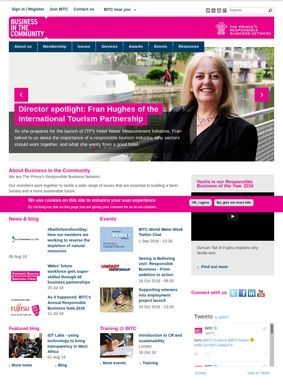
King's Seeing is Believing takes business leaders out of their offices and onto site visits where they meet the community problems most boardrooms never encounter firsthand. That single programme tells you a lot about how Business in the Community operates. It is a membership network and registered charity that wants senior people to confront hard local realities and then change how their companies behave. It has run for decades, carries royal patronage, and positions itself as a convener rather than a campaign group shouting from the sidelines.
Four pillars of business responsibility
The work is organised around four pillars broad enough to cover most of what a company might worry about when it considers its social and environmental footprint. People covers employment, skills, race equality, gender equality, and workplace wellbeing. Place covers local and community economic development, with a Pride of Place network attached to it. Planet covers just transition and climate action. The fourth pillar, Responsible Business, is where the practical consultancy sits: advisory work, management training, and guidance on AI ethics. That last item is worth flagging because a charity founded long before anyone worried about algorithmic bias has clearly kept pace with what its members now actually face.
Membership network and peer learning
Business in the Community is built for organisations, not individuals browsing for tips. Membership is the route in, and the value proposition is the peer network: business leaders learning from each other, comparing notes, and getting nudged by people who have already tried the thing they are nervous about. The site reflects that orientation. It is heavier on programmes, recognition schemes, and published thinking than on the kind of step-by-step how-to content a small business owner might want for free.
Recognition schemes with public credibility
The recognition side is concrete and publicly verifiable. The Times Top 50 Employers for Gender Equality scheme is one of the more visible things Business in the Community runs, and it has real pull in UK corporate circles precisely because it is a public list with a known name behind it. Companies put effort into landing on it. A benchmarking scheme that employers compete to appear on is a fair measure of organisational clout. It is not a self-published trophy handed out quietly behind closed doors.
Published material and accessibility
Alongside the programmes, the output is substantial: reports, toolkits, factsheets, and podcasts, most of it educational content aimed at member organisations. Whether the genuinely useful material sits behind the membership wall or out in the open is muddier than it should be. Some of it is clearly public. How much of the deeper, more practical guidance requires a paid relationship is harder to tell from the front-facing pages, and that ambiguity will frustrate anyone weighing up whether to join.
Regional structure across devolved nations
One thing worth noting is the geographic spread. Business in the Community is not a London body with a national label stapled on. There are regional presences in Scotland, Wales, and Northern Ireland, sitting alongside the England-wide network. For an organisation that talks about Place and local economic development, having actual feet in the devolved nations is the difference between a slogan and a working structure. A company in Glasgow or Belfast is dealing with a different policy environment than one in Manchester, and the regional setup acknowledges that directly.
Breadth versus depth in advisory expertise
The breadth does raise a fair question about depth. Four pillars covering everything from race equality to climate to community regeneration to AI ethics is an enormous remit for one body. Some readers will see a genuinely holistic approach to responsible business. Others will wonder whether any single pillar gets the concentrated expertise it would if Business in the Community specialised. The site itself does not fully resolve that tension, and a prospective member would want to probe how deep the advisory bench really goes on the specific issue they care most about.
The published material leans toward the strategic and the boardroom-facing, which fits the intended audience. This is language for people who set company policy, not for a junior HR coordinator looking for a template. That is a deliberate pitch and a defensible one, given who pays the membership fees. But it does mean Business in the Community can feel abstract in places. A reader hoping to walk away with something immediately actionable may instead find framing, principles, and invitations to engage further through a programme or a follow-up conversation.
The podcasts and factsheets soften that a little. They are the more digestible end of the catalogue, and they give an outsider a way to sample the thinking without any formal commitment. If you want to understand how Business in the Community actually talks about responsible business, the audio and the shorter written pieces are the honest place to start. The heavier reports are better treated as reference material than as a casual read.
What the organisation does well is connect activity to named, recurring vehicles. The Seeing is Believing visits, the Pride of Place network, the gender equality list: these are not one-off campaigns that evaporate after a press cycle. They recur, they accumulate participants, and they build a track record that a newcomer can examine. That continuity is the strongest argument the site makes for itself, stronger than any of its mission statements.
A search of major review platforms found no consumer or employee ratings for Business in the Community, which is not surprising given the membership is corporate rather than retail. There are no Trustpilot or Google review counts to report. The public record you can examine is the body of published reports, the named programme participants, and the longevity of the schemes themselves. That is a reasonable evidence base for an organisation operating in this space.
For the right organisation, the appeal is clear. A mid-to-large UK employer that has decided responsible business is a genuine priority gets a peer group, a set of established programmes, and a body with real standing in the policy conversation. Business in the Community offers advisory consultancy and management training so member organisations can act on those intentions, not merely declare them. The recognition schemes provide external validation that a company can point to with some credibility. Whether Business in the Community delivers depth on the specific issue a prospective member cares about most is the one question the published material leaves genuinely open, and it deserves a direct answer during any initial conversation with the organisation.