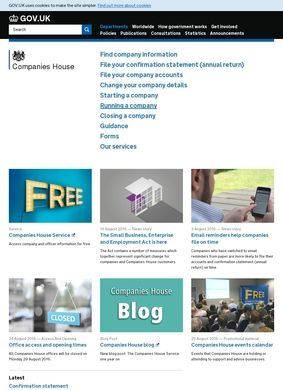
Someone has just decided to start a limited company, or they have received a letter warning that a filing is overdue, or they want to know whether the firm a relative keeps asking them to invest in is even a real registered entity. All three of those situations funnel to the same place. Companies House is where a UK company legally begins, where it files what the law requires of it, and where it eventually ends, and the site exists to handle every step of that lifecycle through one register.
Registration and company lifecycle
It is the official registrar of companies for the United Kingdom, run as an executive agency of the Department for Business and Trade. That status defines the limits of what the agency does and does not do. Companies House incorporates limited companies and limited liability partnerships across England, Wales, Scotland and Northern Ireland, it keeps the record of them while they trade, and it processes their dissolution when they close. The register itself stretches to several million entities, active and dissolved, which is most of the formal corporate memory of the country held in one place. Few public bodies touch as many ordinary business decisions as quietly as this one does.
For a first-time founder, the practical draw is incorporation. A new limited company or LLP can be registered through Companies House directly, and the same body that creates the company is the one that will then expect to hear from it every year. That continuity is part of the point. The formation step is not a separate product from the ongoing obligations; it is the front door to them, and the guidance tries to make that connection clear before a director takes on duties they may not have read.
Filing obligations and digital submission
Once a company exists, the law puts it on a schedule, and Companies House is the recipient of nearly everything on that schedule. Confirmation statements, which replaced the old annual return, have to be submitted to Companies House to verify that the public record is still correct. Company accounts are filed here. Changes to directors and officers, new appointments, resignations, changes of registered address, all of these go through the register so that the public version stays current.
WebFiling and the Companies House Service
The agency runs two digital routes for this. WebFiling and the Companies House Service, usually shortened to CHS, are the online portals where submissions are made and where the register is read. The split between filing and viewing is worth understanding: WebFiling is the side a company uses to send its returns, while CHS is the side anyone uses to look things up. Most of the friction people describe with Companies House tends to sit around deadlines and the consequences of missing them, since late filing carries penalties that the agency applies fairly mechanically and with little appetite for excuses.
Charges and asset mortgages
There is also the matter of charges, meaning mortgages registered against a company's assets. When a company borrows against what it owns, that charge is recorded here, which lets a lender or a counterparty see what claims already exist over a business before they extend their own. It is a quieter function than incorporation, but for anyone doing due diligence on a trading partner it is one of the more revealing parts of the record.
Identity verification for directors
A newer and more contested addition is identity verification. Directors and people with significant control, the PSCs, are now subject to identity checks. This is a real shift for Companies House, which historically took filings largely on trust, and it is aimed at the long-standing criticism that the register could be populated with fictional or untraceable names. How smoothly that verification works in practice, and how much it slows down ordinary honest filers, is the kind of thing that will only become clear as more people pass through it.
Free public search access
The part of Companies House that reaches furthest beyond company directors is the free public search. Anyone can look up a registered company on the Companies House register, read its filing history, download its accounts, and see who its officers are, without paying and without an account. Journalists use it, credit teams use it, suppliers checking a new customer use it, and ordinary people checking whether a company is genuine use it too. The absence of a paywall on the basic record is a deliberate and significant choice, and it is the feature that gives the agency its weight as a reference.
Bulk data for research
That openness extends to bulk data. The agency publishes data sets covering the register for research and commercial reuse, which is what feeds the many third-party tools and credit products that resell or repackage company information. The register of dissolved companies sits alongside the active one, so a company that closed years ago does not simply vanish from the record, and its history remains traceable.
What the register does not do
What a visitor should be clear about is the boundary of all this. Companies House records what companies tell it and what the law requires them to tell it. It is not, for the most part, an investigator or a verifier of the truth of every filed figure, and the identity checks now coming in are a partial move toward closing that gap, not a complete one. The accounts on the register are the accounts the company filed, and reading them well still requires the reader to bring judgement. Companies House gives access to the raw record; it does not interpret it, and it does not vouch for the numbers a director chose to put in front of it.
Guidance on formation, compliance, closure
The guidance layer tries to bridge that for people who arrive without legal training. Companies House publishes material on formation obligations, annual compliance, and closing a company through striking-off or dissolution. For a director who reads it, the path is reasonably well mapped. The risk is the director who does not read it until a penalty notice arrives, and no guidance fully solves that.
Taken as a whole, Companies House does something narrow and does it at enormous scale: it is the single authoritative answer to the question of whether a UK company exists, what it has told the state, and who stands behind it. The strength of the register is its completeness and the fact that the core of it costs nothing to consult. For incorporation, for annual filing, for checking a counterparty, this is the primary source, and the third-party services that charge for company data are almost always reselling what originates here.
Trustworthiness of the record
The open question is one the agency is still in the middle of answering. A register built on self-declared information is only as trustworthy as the checks behind it, and for years critics pointed to how little stood between a fraudster and a clean-looking incorporation. Identity verification for directors and PSCs is the Companies House response, and on paper it should harden the record considerably. Whether it genuinely makes the register harder to abuse, or mostly adds steps for the law-abiding while determined bad actors find the seams, is not yet settled, and it is the thing worth watching before treating every name on the file as proven.