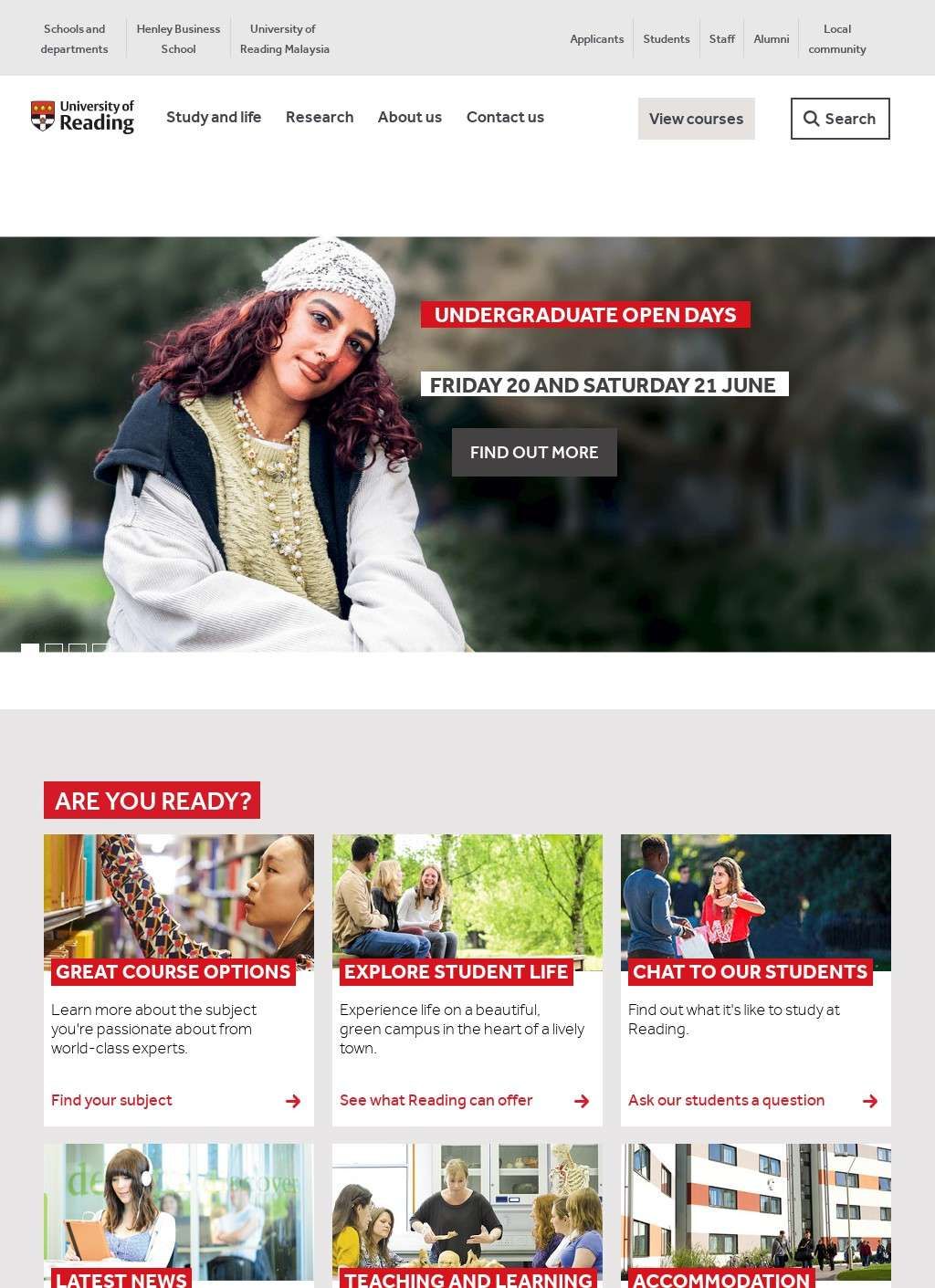
Founded in 1892 and granted its Royal Charter in 1926, the University of Reading is a public research university spread across Berkshire, with its main Whiteknights campus south of the town centre, a second site on London Road, executive teaching at Greenlands near Henley, and a full degree-awarding branch in Malaysia. That last point is worth noting early: the Malaysia campus awards the same UK-accredited qualifications, so international applicants who cannot relocate to England still have a route to a Reading degree.
Undergraduate programmes and Foundation pathways
The undergraduate catalogue is broad without feeling padded. Programmes for 2026/27 cover accounting, architecture, biological sciences, chemistry, computer science, economics, engineering, English literature, law, mathematics, pharmacy, psychology and zoology, among others. Zoology stands out specifically because many civic universities of similar size quietly dropped it years ago, and its survival here is a reasonable indicator of genuine depth in the biological and environmental sciences. For school-leavers on non-standard routes or students arriving from overseas education systems, Foundation Programmes and International Foundation Pathways bridge into the main degrees.
Postgraduate taught degrees across technical fields
Postgraduate provision is where the catalogue gets dense. The taught list passes 150 programmes across artificial intelligence, data science, environmental science, education, healthcare, information technology and management, plus two distinct MBA tracks: one for people earlier in their careers and one for those who are further along. Splitting the MBA that way is a sensible acknowledgement of who is in the room, since the needs of an early-career manager and a seasoned one genuinely diverge. Teacher training and a separate education stream sit alongside these, consistent with a university that has run education programmes for a long time. A working professional can find a taught route in a technical field like data science or a managerial one, and the University of Reading treats the two as different products with their own entry expectations.
Three Berkshire campuses plus Malaysia branch
Whiteknights holds most schools and student accommodation and is the clear centre of gravity. London Road handles a smaller, more specialised set of activities, and Greenlands serves the management and executive side from a separate riverside location. Keeping three Berkshire sites plus a Malaysia branch coherent is a real organisational challenge, and the published figure of more than 500 million pounds invested in facilities is the number that explains how the estate stays functional rather than merely large.
Research partnerships and business collaboration
Research runs across faculties with international partnerships spanning science, the humanities and the social sciences. The published material does not break that down by named centre, so the honest summary is that research is treated as a core activity across the board. A prospective postgraduate researcher would need to go deeper into the specific department to find out where the actual supervision and funding sit, because that level of detail is not available at the overview stage. The University of Reading also runs business partnership and knowledge-transfer programmes through which companies can tap academic research or collaborate on projects, an area that naturally suits local Berkshire employers and larger firms looking for a research partner, and which sits alongside the executive teaching at Greenlands.
From open days to graduate employment outcomes
Prospective students get the usual decision-making tools, and some are genuinely useful. Open days, undergraduate and postgraduate prospectuses, and virtual campus tours are all available, and the University of Reading lists each of them by applicant type instead of collapsing them into one generic page. Student services extend past admissions into on-campus accommodation, peer mentoring and career guidance, with international students given their own support pathways and dedicated guidance on visa and arrival logistics. The one hard outcome figure on the page is that 95 percent of graduates were employed or in further study within fifteen months of finishing. That is a concrete number worth comparing against the same measure at similar universities before drawing any conclusion from it.
Subject breadth backed by estate investment
What comes through across all of this is a mid-to-large civic institution that has kept an unusually wide subject range intact, from pharmacy and engineering to zoology and English literature, and backed it with serious estate spending. The structure rewards careful reading: which campus a course belongs to and which department delivers it will shape the actual experience more than any summary description. The University of Reading puts out separate prospectuses and pathways for different applicant types, and that volume of material reflects a deliberate decision to be understood at the level of the individual school rather than the cover page.
UK accreditation across all campus locations
A degree from the University of Reading carries the same UK accreditation whether earned at one of the Berkshire campuses or in Malaysia. The 95 percent graduate outcome figure and the three-campus footprint give prospective students two concrete reference points for comparison with other institutions, which is more than many universities publish at this level of visibility.