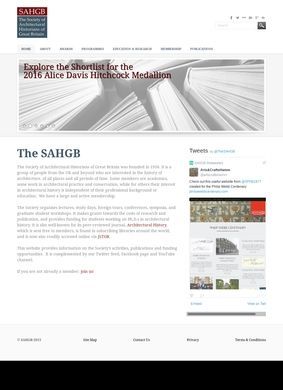
Where does someone go to take architectural history seriously in Britain, beyond a single university department or the odd heritage blog? The Society of Architectural Historians of Great Britain answers that with a body that has been doing the work for decades and gathers most of the field under one roof. It publishes a peer-reviewed journal, runs events, funds research, keeps an oral archive, and opens its doors to anyone curious about buildings. The motto on its membership page, "All Periods, All Places, All Welcome," is unusually candid for an academic society, and the site mostly lives up to it.
Publications for scholars and enthusiasts
The anchor of the whole operation is the journal, Architectural History, which is peer-reviewed and clearly meant for people who want scholarship that has been through proper scrutiny. Alongside it sits a members' magazine, The Architectural Historian, which reads as the lighter, more current counterpart to the journal's longer studies. Having two distinct publications, one rigorous and one readable, tells you The Society of Architectural Historians of Great Britain understands it is talking to more than one kind of reader: the academic chasing citations and the enthusiast who simply wants to know more about a terrace or a chapel. That split feels deliberate, and it is one of the more sensible things I noticed about how the place is run.
Capturing voices through oral histories
Then there is the material that does not fit the old model of a learned society at all. The Society of Architectural Historians of Great Britain produces a podcast and maintains an Oral Histories archive, a set of recorded interviews with British architectural historians. That second resource is genuinely worth flagging. Disciplines lose their own memory when the people who built them stop talking, and capturing those voices while they can still be recorded is the sort of quiet, unglamorous work that pays off for researchers years later. It is also the kind of thing that does not happen unless an organisation decides it matters and puts effort behind it.
The Society of Architectural Historians of Great Britain organises conferences, seminars and networking events on a regular footing, and recordings of these are made available to members, which is a practical touch for anyone who cannot travel to attend in person. This matters for a UK-wide membership where a seminar in one city is out of reach for half the people who would want to be there. Putting the recordings behind the membership, and keeping them available indefinitely, turns one afternoon's talk into a standing resource.
Funding, jobs and professional recognition
On the support side, The Society of Architectural Historians of Great Britain administers funding programmes for research and projects, the Girouard Fund among them, and it lists job vacancies and professional awards. That combination tells you the organisation is a publisher, an events host, and a small engine for the field's working life: it helps fund the next piece of research, points members toward posts, and recognises good work through its awards. For an early-career historian, that mix of money, jobs and recognition in one place carries real weight.
From casual access to member benefits
The Society of Architectural Historians of Great Britain pitches membership broadly. It is open to anyone interested in the built environment, with benefits that include an exclusive newsletter and discounted attendance at events. The pricing logic is the familiar one for societies of this kind: the discount on events and the publications tend to offset the subscription for anyone who engages more than occasionally. What lifts it above a transactional pitch is that genuinely inclusive framing. Plenty of scholarly bodies quietly assume you already hold a relevant post; The Society of Architectural Historians of Great Britain states the opposite, and the site backs it up by keeping the podcast and the public-facing material accessible.
It is worth being clear-eyed about who The Society of Architectural Historians of Great Britain serves best. The deepest value sits with members and with people already inside the discipline, academics, architects and heritage professionals, since the journal, the event recordings and the funding all reward sustained involvement. A casual visitor who lands on the site once can listen to the podcast and read about the society's remit, but the substantial offering opens up only once you join. That is not a criticism so much as an honest description of the shape of the thing. This is a membership organisation first, and it does not pretend otherwise.
A search for independent ratings turns up nothing substantial, which is typical for academic societies, since no major review platform covers them. Word-of-mouth reputation within the field tends to be the measure, and among architectural historians in Britain the society is generally treated as the main professional home for the discipline rather than a peripheral option. Its formal standing is on the record too: The Society of Architectural Historians of Great Britain is a registered charity, number 236432, and a registered company, number 810735.
Those registrations are not decoration. They mean the organisation files accounts, answers to a regulator and operates under a governance structure, which is the difference between a long-running institution and an enthusiast's website that happens to look official. For anyone weighing whether to entrust a subscription or a research application to it, that paper trail is reassuring in a plain, verifiable way.
The breadth is the headline, and it is mostly a fair one. A peer-reviewed journal, a magazine, a podcast, an oral archive, conferences, seminars, research funding and a jobs board is a lot of distinct activity for one society to sustain, and the fact that The Society of Architectural Historians of Great Britain keeps all of it running speaks to a stable, well-organised body rather than a vanity project. The "All Periods, All Places" promise is the part I would test hardest over time, because covering everything from medieval fabric to postwar concrete is easier to declare than to deliver evenly across publications and events.
So the verdict lands firmly on the positive side, with one honest qualifier. As a destination for serious engagement with the history of British buildings, The Society of Architectural Historians of Great Britain is close to the obvious choice, and the oral archive and funding work in particular give it depth that a thinner society would lack. The caveat is simply that most of the value is gated behind membership, so a one-time visitor will see the front door more than the rooms beyond it. For anyone whose interest goes past the occasional, though, joining looks like money well spent, and the society has clearly earned the standing it holds in the field.