Origins of the Turkish foreign service
Foreign affairs of the Ottoman Empire were long conducted by the Reis-ul Kuttab, a senior scribe of the imperial council who combined diplomatic correspondence with record keeping and other state paperwork. Resident diplomacy began in 1793, when the government of Selim III opened a permanent embassy in London and sent Yusuf Agah Efendi there as the first Ottoman ambassador.
A separate foreign ministry followed in 1836. The office of the Reis-ul Kuttab was raised that year to the rank of a ministry, the Hariciye Nezareti, and Yozgatli Akif Efendi, the last holder of the old title, became the first minister of foreign affairs. A Translation Office created during the same reform period taught European languages to a generation of Ottoman officials and produced several later grand viziers.
The ministry of the republic was born during the War of Independence. On 2 May 1920, days after the Grand National Assembly convened in Ankara, the assembly formed the first national government and included a Ministry of Foreign Affairs among its original departments, with Bekir Sami as the first minister. Working with scarce money and a small staff, the new ministry carried the diplomatic work of the independence struggle and took part in the negotiations that ended with the Treaty of Lausanne in 1923. A statute of 1927, Law No. 1154, then gave the institution the structure it kept for decades, and the mission network expanded again after the Second World War as posts closed during the conflict reopened and new embassies were added through the 1950s.
Mandate and worldwide network
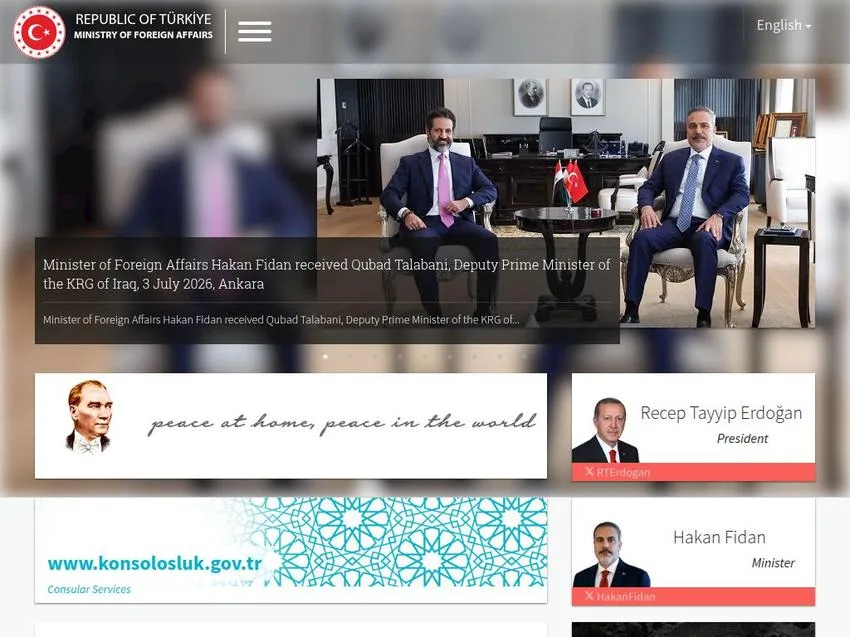
The ministry formulates and carries out the foreign policy of the Republic of Turkiye. Its portfolio covers bilateral relations, multilateral organizations, international security, economic and cultural diplomacy, treaty law and protocol, together with the protection of the interests of Turkish citizens and companies abroad. Policy work still follows the maxim of Mustafa Kemal Ataturk, Peace at Home, Peace in the World.
A minister assisted by deputy ministers leads the organization, and directorates general divide the work by region and by theme. The unit responsible for EU affairs, which manages accession related business with the European Union, has been part of the ministry since 2018. Headquarters occupy a large complex on Dr. Sadik Ahmet Street in the Balgat quarter of Ankara.
From Balgat the ministry directs 262 diplomatic and consular missions, a network it describes as the third largest maintained by any country. Embassies, consulates general and permanent delegations to bodies such as the United Nations, NATO and the European Union make up the total. The ministry also arranges the Antalya Diplomacy Forum, a gathering of heads of state, ministers, diplomats and researchers held each year on the Mediterranean coast, and it has hosted rounds of talks between warring parties as part of its mediation work within the United Nations and the Organisation of Islamic Cooperation.
Consular work
Several million Turkish citizens live outside the country, most of them in Western Europe, and their paperwork forms the bulk of consular demand. Missions issue and renew passports, record births, marriages and deaths, prepare powers of attorney and other notarial documents, and assist citizens who face arrest, accident or disaster far from home. A consular call center in Ankara answers questions at any hour and routes callers to the responsible mission, while an online consular portal handles appointments and application tracking. Fees, appointment rules and document checklists differ from post to post, and each embassy and consulate keeps its own pages linked from the central directory.
Foreign travelers meet the ministry mainly through its electronic visa system, which processes short stay applications online for eligible nationalities. Turkish consulates handle work, study and other long stay categories.
Training and research
Two internal institutions support the career service. The Diplomacy Academy prepares newly recruited officers for their first postings and runs mid career courses, including programs attended by diplomats from partner states. The Center for Strategic Research produces analyses of regional and global questions and publishes academic work on foreign policy.
The site also keeps a memorial section for members of the foreign service and their relatives killed in terrorist attacks, most of them during the 1970s and 1980s.
The English language site
The English section presents official positions as they develop. Press releases and statements from the minister and the spokesperson appear almost daily, joined by background files on subjects that range from Cyprus, the Aegean and regional conflicts to energy, water and counterterrorism, and by a documented dossier on the events of 1915. A synopsis page sets out the main lines of Turkish foreign policy, and reference pages list every foreign minister and every Turkish government since 1920, along with a short institutional history. Transcripts of the spokesperson's answers to press questions join the news stream after each briefing.
Practical content sits beside the policy material. Visitors find contact details for the headquarters, a directory of foreign missions accredited in Turkiye, visa guidance for foreign nationals, advice pages for Turkish citizens traveling or living abroad, and announcements of entrance examinations for the diplomatic service. Requests under the right to information law can be lodged through the site, and RSS feeds carry new items as they appear.

Business address
Republic of Turkiye Ministry of Foreign Affairs
Dr. Sadik Ahmet Cad. No: 8, Balgat,
Ankara,
Ankara
06520
Turkey
Contact details
Phone: +90 312 292 10 00