From conquest era medrese to republican university
Istanbul University counts its founding from 30 May 1453, one day after the Ottoman capture of Constantinople, when Mehmed II ordered higher instruction organized in the city. Teaching began in the form of a medrese, and the schools endowed at the Fatih mosque complex, followed later by those of Suleyman the Magnificent, formed the core of Ottoman higher learning in the capital for four centuries. The university seal carries the date 1453.
A modern counterpart appeared in the nineteenth century. Public science lectures opened in 1863 under the name Darulfunun, the house of sciences, but the school closed in 1871 and resumed durable work only in 1900 as the Darulfunun-u Sahane, with departments of theology, arts, mathematics, science and philology. A women's section opened in 1914, and teaching became mixed in the early 1920s. Under the republic the institution was reorganized once more: on 1 August 1933 the Darulfunun was dissolved and Istanbul University established in its place, following a review prepared for the government by the Swiss educator Albert Malche. Classes started that November.
The 1933 reform coincided with the flight of scholars from Germany, and refugee professors, among them the economist Fritz Neumark and the philologist Erich Auerbach, joined the new faculties. Their seminars shaped Turkish law, economics, medicine and the humanities for a generation.
The Beyazit campus
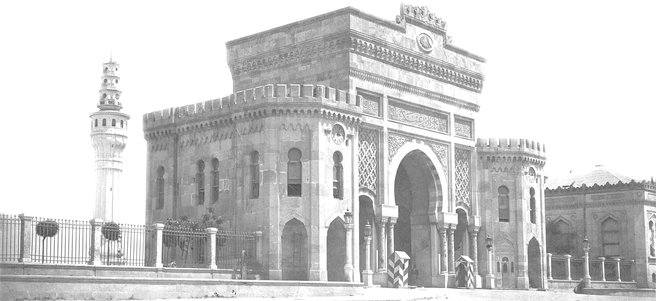
The main campus occupies the grounds of the Ottoman Old Palace on the third hill of the historic peninsula, beside Beyazit Square. Its central building rose in 1865 and 1866 to plans by the French architect Bourgeois and housed the Ottoman Ministry of War from 1879, which explains the parade ground scale of the forecourt. The marble gate facing the square has become the emblem of the university, and the Beyazit Tower, a fire lookout of 1828 that stands within the grounds, remains one of the tallest historic structures in the old city. Ceremonies of the academic year, graduations and public lectures still use the main building and its nineteenth century halls.
Libraries and collections
The Rare Books Library preserves about 93,000 volumes in Turkish, Arabic, Persian and European languages. Its best known holding is the photograph collection of Sultan Abdulhamid II, 911 albums that record cities, schools, railways and public works across the empire at the close of the nineteenth century. An astronomical observatory active since the 1930s and museum collections in fields from zoology to the history of science extend the research base, and the university press publishes scholarly journals across the disciplines.
Nine campuses and distance learning
Law, letters, science, economics and theology, among other faculties, teach at or near the historic center, while the Istanbul Faculty of Medicine works from the Capa quarter, where it runs one of the largest university hospitals in the country. Aquatic sciences, communication, political sciences, business administration, pharmacy and dentistry are among the other faculties. In all, official figures count 112 academic units, faculties, institutes, schools and vocational schools, spread over nine campuses, along with more than seventy research and application centers. An open and distance education faculty, known by its Turkish initials as AUZEF, carries degree and certificate programs to large numbers of students far beyond Istanbul; it keeps its own application calendar and a separate telephone line at the rectorate.
Academic profile and alumni
Istanbul University lists seventeen faculties. About 58,800 students were enrolled in recent official counts, roughly 42,000 of them undergraduates and 16,000 postgraduates, taught by more than 4,300 academic staff. Graduates number close to one million, and more than 250 student clubs operate on the campuses. Admission to bachelor programs runs through the national university examination held each year, and daytime undergraduate places at Turkish state universities have carried no tuition fee since 2012, a rule that applies at Istanbul University as well.
In 2018 the institution was divided under a national law that split several large public universities. A new state institution, Istanbul University-Cerrahpasa, took over a group of faculties concentrated in engineering and the health sciences, while medicine at Capa, law, letters, science, economics and the other historic faculties stayed with Istanbul University.
Two Nobel laureates studied at Beyazit. Aziz Sancar, who took his medical degree at the Istanbul Faculty of Medicine, received the Nobel Prize in Chemistry in 2015 for work on DNA repair, sharing the award with Tomas Lindahl and Paul Modrich, and Orhan Pamuk, a graduate of the university's journalism institute, received the Nobel Prize in Literature in 2006. Alumni also include a president of the republic, several prime ministers and many of the scientists, judges and writers of the early republican period.
Exchange students arrive through Erasmus agreements, and an international student office manages the admission of degree students from abroad. Instruction runs mainly in Turkish, with some programs taught in English, and the university language center teaches Turkish to foreign students before they enter their programs. University clinics, continuing education courses and public lectures connect the institution to the city, and its gate remains a landmark of the Beyazit district.
Business address
Istanbul University
Beyazit Yerleskesi, Beyazit / Fatih,
Istanbul,
Istanbul
34452
Turkey
Contact details
Phone: +90 212 440 00 00