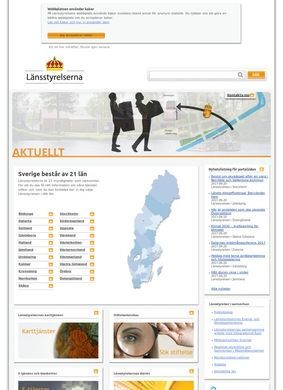
Lansstyrelserna is the shared online home of Sweden's 21 County Administrative Boards, the regional offices through which the Swedish central government does much of its day-to-day work. The portal at lansstyrelsen.se is built around one practical idea: you arrive, you pick your county from a dropdown, and you land on the sub-site that actually governs the place you live or work in. That routing step is easy to underestimate, because the boards are organised geographically, and almost everything a person needs from them is tied to a specific county.
How the county boards divide Sweden's state functions
Once you choose a region, the sub-site opens up into the real substance. Each county board handles state administration across a wide spread of policy areas, and the list is genuinely broad: environmental protection and permitting, land use and spatial planning, crisis preparedness, animal welfare, cultural heritage, social affairs, hunting and fishing licensing, and business permits. These are not abstract headings. A farmer checking what is allowed on protected land, a hunter sorting out a licence, a developer who needs an environmental permit, a household trying to understand local emergency planning: all of them end up here, because the county board is the body that decides.
Environmental permits, hunting licenses, business permits
The boards sit in an unusual spot in the Swedish system, and Lansstyrelserna reflects that without making a fuss about it. They operate on mandate from the Riksdag, Sweden's parliament, and from the national government, the Regeringen. Their job is to take national objectives and turn them into regional action, then coordinate between the central authorities above them and the municipalities below. So the site is doing two things at once. It serves the citizen who wants a permit, and it is the public face of a layer of administration that connects Stockholm-level policy to what happens on the ground in each county.
Regional administration between national policy and local action
The depth lives in the individual county pages. Each one carries its own news, its own regulations, the permit applications relevant to that area, e-services for handling matters online, and public consultation documents when a decision is open for comment. This is the part that rewards a visit. A national-level summary can only ever tell you what the boards do in general terms, but the rules on shoreline development, the dates for a consultation, or the specific form you need will differ from one county to the next, and the sub-site is where those differences are spelled out.
County pages with regulations and e-services
That structure explains why the front page of Lansstyrelserna is deliberately spare. It is a gateway, not a destination. The work of presenting regulations and accepting applications is pushed down to the regional level, which is the correct place for it given how the boards are organised. Someone who only skims the landing page and leaves might conclude there is not much here, but one click into a county page changes that picture fast. The content sitting behind that county selector is substantial.
Swedish and English versions for different audiences
Lansstyrelserna is published in both Swedish and English, which widens its usefulness beyond residents who read Swedish. The English provision is worth knowing about for anyone moving to Sweden, running a business with Swedish operations, or researching how the country administers things like environmental permitting and land planning. It will not always match the Swedish pages line for line, since the operational detail and the live forms tend to be fullest in Swedish, but it is enough to orient yourself and to understand which board governs what.
The 21 boards cover the whole of Sweden, every square kilometre of territory and every resident. That completeness is part of what makes Lansstyrelserna a reliable starting point. There is no county that falls outside the system, so whatever part of the country a question concerns, there is a board responsible for it and a page that belongs to that board. For permitting and regulatory matters especially, going straight to the source here saves the guesswork of working out which authority holds jurisdiction.
It is worth being clear about what these boards are not. They are not a single national agency speaking with one voice, and they are not municipal government. They occupy the regional middle, carrying out state functions county by county, which is why Lansstyrelserna routes you through a county selector before showing you anything detailed. Once that is clear, the design of the site makes sense. The dropdown is not a hurdle; it is the whole logic of how Sweden splits this work up.
E-services and permit applications as primary tools
The most practically useful parts of Lansstyrelserna are the e-services and the permit applications, because those are the things people actually come here to do. Hunting and fishing licences, business permits, environmental applications: these run through the county boards, and the sub-sites are where the process begins. Anyone who has tried to figure out Swedish regional bureaucracy from the outside will appreciate having a single entry point that reliably leads to the right office, even if the path runs through that county selector first.
Following decisions through public consultation documents
There is a quieter audience too, the people who want to follow or influence decisions rather than just file paperwork. Public consultation documents posted on the county sub-sites are how the boards open certain decisions to comment, and they give residents, businesses and interest groups a formal way in. If you care about a planning question or an environmental ruling in your area, watching the consultation listings on your county's page is the practical way to stay ahead of it. Lansstyrelserna makes that material available without burying it, which counts for something in a system this layered.
How Swedish governance structures regional responsibility
Lansstyrelserna is also a sound reference for understanding how Swedish governance is structured, beyond any single transaction. Reading across the policy areas the boards cover gives a fairly complete picture of where regional responsibility lies, from cultural heritage protection to crisis preparedness. For students of public administration, journalists checking jurisdiction, or anyone simply curious about how a country of 21 counties divides its state functions, the breadth of what Lansstyrelserna documents is instructive on its own terms.
No independent reviews of Lansstyrelserna turn up in the usual places. That is not unusual for an official public-administration portal: people use it when they need a permit or a consultation document, not because they discovered it through a recommendation. The site does not need social proof to establish its authority; the county boards are the statutory bodies for this work, and Lansstyrelserna is where their public-facing functions live.
If you are a Sweden resident with a permit, licence or planning matter to sort out, the path is straightforward: go to Lansstyrelserna, select your county, and head into that board's e-services or permit pages to find the exact form and rules for where you are. People watching a local environmental or land-use decision should check their county's consultation documents directly. Anyone new to the country who reads English better than Swedish should start on the English version of the site to work out which board to approach before drilling into the regional detail. Lansstyrelserna routes you to the one office that can actually answer your question, and it covers the whole of Sweden without exception.