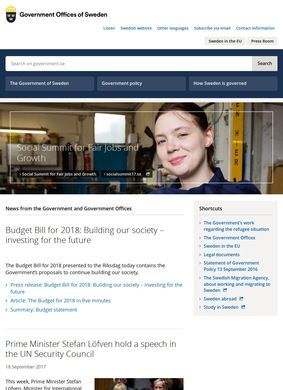
Someone trying to find the actual text of a Swedish government bill, or to confirm what position Stockholm holds on an EU file, usually starts by wading through news summaries and second-hand translations that never quite say what the original document said. That is the gap the Government Offices of Sweden fills. The site is the English-language portal of Regeringskansliet, the body that runs the country's executive branch, and it puts the primary material in front of you instead of someone else's paraphrase of it. For a researcher, a foreign correspondent, or a diplomat checking a detail before a meeting, that distinction is the whole point.
Primary documents from Swedish ministries
What you get is the working output of the Swedish state, published as it stands. Government bills, legislative proposals, white papers, committee directives, and reports sit alongside the formal communications the Government sends to the Riksdag, the parliament. These are not press blurbs about decisions. They are the decisions, in their own words, which is exactly what you want when accuracy matters more than speed. The Government Offices of Sweden is not a marketing shell over the real Swedish-language edition; it is a serious archive that treats English readers as a genuine audience, and that becomes clear within a few minutes of use.
The breadth is notable. The Government Offices of Sweden does not limit itself to finished legislation; it carries the working papers that precede a law as well, so you can watch a question move from a committee directive to a white paper and on toward a formal proposal. For anyone studying how Swedish policy is made, that paper trail is more valuable than the end result on its own, because it shows the reasoning rather than just the outcome.
The structure of the Government Offices of Sweden follows the structure of the government itself, which makes navigation easier than it sounds. All eleven ministries are represented, from the Ministry of Finance and the Ministry of Justice to the Ministry for Foreign Affairs, the Ministry of Health and Social Affairs, and the Ministry of Climate and Enterprise. You can move sideways into a ministry's own corner of the site, or you can come at the material from a different angle entirely.
Policy areas and document types
That second route is the useful one. Browsing by policy area lets you pull together everything touching, say, climate or social welfare without first knowing which ministry owns the file. Browsing by document type does the reverse, gathering all the bills or all the committee directives in one place. The Government Offices of Sweden gives you three entry points into the same body of work, and each one suits a different kind of question. A journalist on deadline and a doctoral student building a literature base will not use the site the same way, and they do not have to.
Press releases, speeches, and statements from the Prime Minister and individual ministers round out the current-affairs side of the Government Offices of Sweden. These carry the day-to-day positions: what a minister said at a summit, how the Government framed a new measure, which line it took on a contested question. Set next to the formal documents, they let you trace a policy from a minister's first public remark through to the bill that eventually lands in front of the Riksdag.
Constitution, laws, EU policy statements
Two things lift the Government Offices of Sweden above a simple news feed. The first is that it hosts the full text of Sweden's constitution and key laws in English translation. Anyone who has tried to read a Nordic statute through machine translation knows how quickly the meaning frays; an official rendering, prepared by the people responsible for the law, removes that doubt. For comparative-law researchers and for lawyers advising on cross-border matters, that single feature can justify the visit on its own.
The second is the dedicated section on Sweden's EU policy and its international commitments. Sweden's stance on a given European file is often reported in fragments across the press, and the official statement of position is the document that settles arguments. Having it in one place, in English, is a real convenience for Brussels watchers and for anyone tracking how a mid-sized member state lines up on the questions that move through the Council. The same goes for Sweden's wider international commitments, which the site presents as official statements of intent rather than commentary, so a reader can cite them with confidence. The Government Offices of Sweden treats this as a standing section, not a late addition, which tells you who the site is built for.
How Swedish government works
There is also a plainer, more introductory layer for readers who are not specialists. A "Government at a glance" section explains how Swedish government is put together: what the Prime Minister's Office does, how the ministries function, and where executive authority actually sits. A student new to the Nordic model, or a citizen who simply wants to understand the machinery, can start there and build up. It is a sensible piece of design, and it keeps the Government Offices of Sweden from being useful only to people who already know their way around.
The bilingual setup deserves a mention too. The Government Offices of Sweden runs in parallel with the Swedish edition at regeringen.se, and the English portal is not a token few pages but a substantial mirror aimed squarely at international audiences. That commitment is what separates a government site that wants to be read abroad from one that merely tolerates foreign visitors. No independent platform ratings exist for the Government Offices of Sweden, which is expected for an official government portal; it is not the kind of site that accumulates Trustpilot entries.
If there is a limit to flag, it is the obvious one: this is the Government's own account of itself. The material is authoritative for what the Government proposed, said, and enacted, but it is not the place to find independent scrutiny or opposition argument. That is not a fault so much as a boundary. You read the Government Offices of Sweden to learn what the executive did and how it justified it, then you go elsewhere for the critique. Used that way, the Government Offices of Sweden is close to indispensable.
The depth is the thing that stays with me. Plenty of governments publish a glossy English landing page and stop there. The Government Offices of Sweden goes the other way, surfacing the documents that most administrations bury or leave untranslated, and organising them so that a non-Swedish reader can actually work with them. The propositioner, the directives, the reports to the Riksdag: they are all here, and they are all reachable. For a primary-source question about Swedish governance, that is the quickest path to an answer that can be cited with confidence.