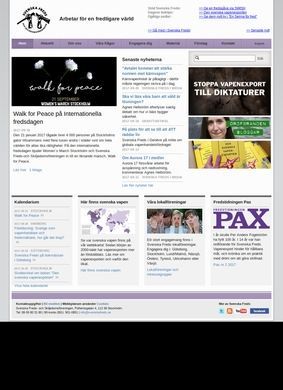
Sweden's oldest peace organization has been making the same argument since 1883: that disputes between states can be settled without bullets. The Swedish Peace and Arbitration Society, known at home as Svenska Freds, has carried that founding premise through more than a century of changing wars, and the site reflects an organization still arguing it in the specifics of 2026 policy. That longevity is the first thing worth knowing about the group, and the second is how concrete the current agenda has become. A movement that survives 140-odd years tends to drift into ceremony. This one has not.
Opposition to Swedish arms exports
The bulk of the work splits into a handful of clearly defined fights. Opposition to Swedish arms exports sits near the center, alongside disarmament and the abolition of nuclear weapons. These read less as slogans on the page than as ongoing positions tied to real legislation and real shipments. Someone reading to understand where a Swedish peace group stands on weapons sales will find the line drawn with very little hedging. The Swedish Peace and Arbitration Society does not soften the export question into something palatable to the defense sector, and that bluntness is part of why the positions are easy to take seriously.
Inside Nato membership and DCA debates
Beyond arms, the Swedish Peace and Arbitration Society has moved squarely into the questions Sweden has been forced to confront recently. There is analysis of NATO membership and of where Swedish military policy is heading now that the country has joined the alliance. There is scrutiny of the US-Sweden Defence Cooperation Agreement, the DCA, which gives American forces access to Swedish bases and which the Swedish Peace and Arbitration Society treats as a development worth watching closely. Coverage extends to the war in Ukraine and to the conflict in Palestine and Israel, and to youth and conscription policy, a topic that lands directly on the young people the group most wants to reach. The range is wide, but it holds together because every strand traces back to the same skepticism about armed force as a tool of state.
Peace academy courses and book circles
What gives the site weight beyond advocacy is the teaching and publishing it runs. The Peace Academy, Fredsakademin, offers digital courses and book circles. That mix points to an organization that treats knowledge-building as part of the job, alongside the campaign work. Book circles in particular require a slower, more deliberate kind of engagement than a petition drive. Someone curious about the intellectual case against militarization, beyond the activist case, has a genuine place to start with the Swedish Peace and Arbitration Society. It is a program that treats supporters as people who want to think, not simply sign.
Publishing through magazine and podcast
The publishing side of the Swedish Peace and Arbitration Society runs on several channels. PAX magazine carries the longer-form material, and a Peace Podcast handles the audio audience. Between the courses, the magazine, and the podcast, the Swedish Peace and Arbitration Society produces a steady stream of its own content instead of waiting for outside coverage to make its points. For an organization built on persuasion, that self-publishing capacity matters a great deal, and it is one of the more substantial parts of what the site offers. Few advocacy groups of this size sustain a magazine, a podcast, and a course catalogue at once.
Local peace chapters
There is also a network dimension. Local peace chapters operate across Sweden, giving the organization a presence in actual towns rather than only a Stockholm address. A program called Patryckare for fred, roughly Peace Advocates, gives members a structured way to apply pressure between the national positions of the Swedish Peace and Arbitration Society and the people willing to act on them locally. That combination of a central voice and a distributed membership is how the Swedish Peace and Arbitration Society has stayed relevant across generations.
The Swedish Peace and Arbitration Society is membership-based and donation-funded, and the site makes joining and giving the obvious next step. Donations run through a Swish number and through a dedicated subdomain set aside for support, stod.svenskafreds.se, a sensible separation that keeps the fundraising machinery apart from the editorial and campaign material. The financial model is the conventional civil-society one: members, donors, and the campaigns those resources pay for. Nothing about it is unusual, which is reassuring in its own way, since the money trail of a peace group is the kind of thing critics look at first.
Two campaigns for direct action
Two campaigns stand out at the moment. A petition under the banner Never Again Nuclear Weapons ties the abstract abolition argument to a single, signable action. A Stop the Occupation postcard campaign does something similar for the Palestine and Israel coverage, turning a position into a physical gesture a supporter can send through the mail. These are the kind of low-barrier entry points that membership organizations lean on, and the Swedish Peace and Arbitration Society uses them in the familiar way, as a first rung for people who are not yet ready to join but want to do something. The campaigns are specific, current, and tied to the larger positions, which keeps them from feeling like busywork.
Positioning ahead of the 2026 election
The most pointed material is the political positioning aimed at the 2026 Swedish election. The Swedish Peace and Arbitration Society is publishing policy positions meant to shape that contest, moving it from commentary into direct electoral pressure. That is a clear statement of intent: the group means to be a voice politicians have to answer to during the campaign, rather than a chronicler of arms-export figures after the votes are counted. An organization willing to put its name to election demands expects to be judged on outcomes, which is a riskier posture and a more honest one.
Taken together, the offering is substantial. A founding date of 1883, a teaching academy, a magazine, a podcast, local chapters across the country, named campaigns, and an explicit election agenda add up to an organization doing concrete, verifiable work across several fronts. The Swedish Peace and Arbitration Society is not trading on its age while standing still; the positions are specific enough to argue with, and the programs are wide enough to back them up. There is a coherence that many advocacy sites lack, where the courses, the publishing, and the campaigns all feed the same long-running argument. A reader who arrives via a business directory listing and follows the site through will find something substantive behind each section.
Where conviction meets public opinion
Where the picture gets harder to read is at the edge between conviction and consensus. The Swedish Peace and Arbitration Society has built its 2026 agenda on opposition to arms exports, skepticism of NATO membership, and resistance to the DCA, at exactly the moment Swedish public opinion has shifted hard the other way after the country's accession to the alliance. The depth of the programs is not in question. What stays unsettled is whether an organization holding that line, however principled and however well-resourced, can move a national debate that has largely decided against it, or whether the most thorough peace infrastructure in Sweden ends up arguing, with great precision and great patience, into a country that has stopped listening.