ASETA is a Spanish-language editorial site covering toll roads, motorways, tunnels, and bridges across Spain. It reads as a working newsroom for one fairly narrow beat: the state of paid road infrastructure and the people who drive on it. The homepage leads with an "Actualidad" feed of news and updates, and from there the content branches into opinion, analysis, and a set of practical guides aimed squarely at drivers who want to spend less at the toll booth. There is no shop, no booking engine, no login wall. What ASETA offers is text, organised by topic, written for a reader who actually uses these roads.
News on Spanish toll infrastructure
The news section is the spine of the whole operation. ASETA tracks developments in Spanish road infrastructure as they happen, which for this subject means things like changes to tolling on specific motorways, regional differences in how toll networks are run, and the slow churn of policy around who pays for what. One recurring thread is the geography of it all: pieces that break down which autonomous communities carry the most toll roads, how surface conditions vary from region to region, and what that means for someone planning a long drive. That regional framing is more useful than it first sounds, because toll coverage in Spain is genuinely lopsided depending on where you live. A national average tells a driver in Catalonia very little about what they will face on the road out of Barcelona.
Regional differences in toll coverage
Opinion and analysis sit alongside the reporting. Here ASETA steps back from daily updates to argue about pricing, usage patterns, and the politics of road charging. These are the pieces where a site like this either builds trust or loses it, since toll policy is the kind of subject where readers arrive with strong opinions of their own. The analysis tends to stay close to the practical question a driver actually cares about: whether a given toll is worth paying, and whether the alternative free route is a false economy once you count time and fuel. That keeps the opinion grounded rather than drifting into abstract transport theory. ASETA is not writing for policy academics; it is writing for the person who just got stung by a surprise charge on the AP-7.
Analysis of pricing and road policy
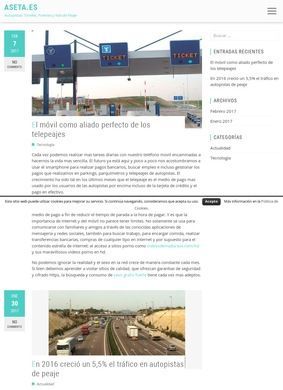
The most concrete material ASETA publishes is its run of practical guides. These are built around saving money on toll highways: when to use them, how to plan a route that cuts charges, and which tools help. ASETA also covers the technology side of toll collection in real detail, including the mobile apps that let drivers pay without stopping at a booth. That pairing of money-saving advice with a look at the payment apps is sensible, because the two questions tend to arrive together for anyone driving long distances regularly. A reader trying to cut costs on a Madrid-to-coast run wants both the route logic and the app that handles the billing without the queue.
Guides for saving money on tolls
What the guides do well is stay specific to Spain. The advice is not a generic "tolls are expensive, here is how to budget" template that could apply anywhere. It is tied to Spanish networks, Spanish regional quirks, and the payment systems actually in use on those roads. For a driver or a transport-policy follower in Spain, that local focus is the reason to choose ASETA over a general motoring outlet. The trade-off is obvious: the appeal is narrow. If you do not drive Spanish toll roads or follow the policy around them, there is little reason to visit, and ASETA makes no attempt to pretend otherwise.
Spain-specific route planning advice
Content carries a single credit line, the editorial byline "redaccion," which is the Spanish convention for staff-written pieces with no individual author named. That is normal for a small newsroom, though it does mean readers cannot follow a particular writer or weigh one contributor's track record against another. The voice across the site is consistent, which points to a tight team or a small number of contributors, but ASETA does not put names or faces to the work. Whether that bothers a reader probably depends on how much the byline matters to them versus the information itself.
Editorial transparency and contact information
On the question of who stands behind the site, there is very little to go on. The homepage offers no phone number, no email, and no postal address. For a pure reading resource that publishes news and guides, this matters less than it would for a business selling something, since a visitor does not need to contact ASETA to use it. All the same, the absence is worth noting. A reader who wanted to query a claim, correct an error, or ask about republishing would have no obvious way to do it, and that gap quietly limits how much accountability ASETA can claim. An outlet that publishes opinion on contested public policy usually benefits from a visible way to be challenged.
Limited public presence and external verification
Outside the site itself, ASETA has essentially no public footprint to speak of. A search for third-party coverage or user reviews of aseta.es returned nothing that clearly belongs to this outlet. The results that surfaced were other organisations sharing pieces of the name, from a cleaning company to a hotel to an unrelated software firm. That is not evidence against ASETA, but it does mean there is no external record to corroborate its standing, and the site has to be judged on the work alone. On that front the work is coherent, on-topic, and clearly aimed at a real audience with a specific need.
ASETA does one job and does it with focus: explaining Spain's toll roads to the people who use them, mixing daily news with analysis and money-saving guidance, while keeping the payment-technology angle in view so the practical advice stays current. The narrow scope is both its strength and its ceiling. Within that lane the content is purposeful and Spain-specific, which is what a frustrated toll-payer or a policy watcher would actually want. ASETA does not overreach, does not pad itself with unrelated content, and does not pretend to be a marketplace it is not.
The guides and the regional breakdowns are the parts most likely to bring someone back, since those answer questions a driver asks repeatedly on the same routes. The opinion pieces are the parts most likely to spark disagreement, which is healthy for a site covering contested policy. The site's real limitation is not the editorial scope but the absence of any external footprint or visible accountability structure. A reader who knows the subject will find ASETA useful and specific. A reader who does not know the subject has no easy way to calibrate how much weight to give it, which is a problem ASETA could solve with modest transparency and has so far chosen not to.