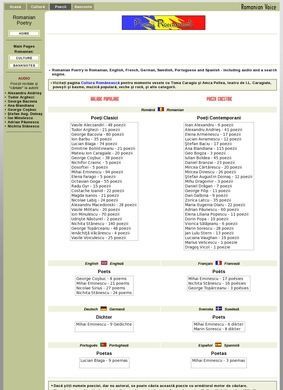
More than 1,600 Romanian poems sit in one place here, a good portion of them paired with audio recordings you can listen to. That number alone sets Romanian Poetry apart from the scattered scans and copy-pasted stanzas you usually find when hunting for verse in this language. The collection has been built up over roughly 28 years, with copyright running from 1994 to the present and credited to a single person, Radu Narcis Velicescu, which tells you this is a long personal labour and not a corporate content farm churning out filler.
Poets across the Romanian canon
The roster of poets is the heart of it. Mihai Eminescu is there, as you would expect, but so are Nichita Stanescu, George Cosbuc, Adrian Paunescu, Lucian Blaga, and Nicolae Labis, along with many others. That is a serious spread across the Romanian canon, covering the nineteenth-century Romantics through the harder, more clipped voices of the twentieth century.
Anyone who studied Romanian literature in school will recognise most of these names, and the breadth means Romanian Poetry works equally well for a casual reader chasing a half-remembered line and for someone who wants to sit with a poet's whole body of work over an afternoon. The mix of household names and quieter figures reflects a curator who cared about coverage, beyond the obvious greatest hits, and that care shows up in how many of the lesser-known poems are present and accounted for.
Seven languages and audio recordings
The multilingual presentation is one of the more useful features here. The poems are offered in seven languages, so the reach extends well past native speakers. A reader who grew up abroad with Romanian parents, a translator, or simply someone curious about a literature they cannot read in the original, all have a way in. Pairing translations with the audio is a smart move, because Romanian poetry leans hard on sound and rhythm, and hearing a poem read aloud carries something the page cannot. That combination is uncommon enough that Romanian Poetry deserves credit for it without any hedging.
The poetry section is one room in a larger house. Romanian Voice, the parent site, bills itself as a cultural insight on Romania, and it spreads into music of several kinds (traditional and folk, rock, carols, and vintage recordings), theatre, stories, humor, and folklore. There are even pictorial galleries of Romanian banknotes and passport designs, the sort of oddly specific detail that betrays a real collector behind the project. None of this dilutes the verse on offer; it sits alongside it, and a visitor who wandered in for Eminescu may well leave having listened to old recordings or browsed a gallery of currency they never knew existed.
Romanian Poetry is built in the spirit of the early web: function over polish, deep over slick. There is no sign that it chases trends or rebuilds itself every couple of years to look fashionable. For some visitors that will feel dated, and they should know it going in. For the people who use it most, it reads as stability, an archive that has stayed put and kept growing while flashier projects came and went.
From archive to living community
One concrete sign of that durability is how the site behaves as a citable source. Individual poem pages are directly linkable, each with its own stable address. It means a teacher can point a class straight at a specific text, a forum user can drop a clean link without caveats, and a search engine can index the work properly. The poetry subdomain also answers at its own address (poezii.romanianvoice.com), so there is more than one stable door into the same material, and neither one feels likely to vanish.
That linkability has translated into real-world use. On Reddit, the r/romanian community references Romanian Poetry organically as a place to send people looking for verse in the language, and individual poems get shared there in conversation. That is the sort of endorsement no one was paid for; users telling other users where to go. A third-party site-analysis tool also flags the site as safe to browse with no active threats reported, which is worth noting for anyone wary of older domains they do not recognise and might otherwise hesitate to open.
Formal ratings on the usual platforms are absent: no batch of Google stars, no Trustpilot scores. A cultural archive of this kind rarely collects that sort of feedback, so the absence says little about quality one way or the other. The organic word of mouth from a community of actual Romanian speakers is a more meaningful measure here than a star average pulled together by strangers would ever be.
Ownership and design limitations
It is not all praise, and a fair review has to say where the project comes up short. The clearest practical limitation is ownership transparency. Beyond the copyright line naming Radu Narcis Velicescu, there is no contact channel visible on the landing page or the poetry section. If you spot a translation error, want to suggest a missing poem, or need to ask permission to reuse something, there is no obvious route. For a personal archive maintained across nearly three decades this is understandable; the creator is under no obligation to field inquiries. Even so, Romanian Poetry could open that door with very little effort, and the absence is noticeable to anyone who wants to engage rather than consume passively.
The other thing to set expectations on is design. A visitor arriving from the current web, used to responsive layouts and heavy interactivity, should know that Romanian Poetry is a plainer, text-first experience. That is not a knock on the content, which is the reason to come, but it is fair warning so nobody arrives expecting a modern app and leaves disappointed by the wrapper instead of judging what is inside it.
Set against the depth on offer, those are modest complaints. A collection of this scale, maintained by one person across nearly three decades and offered free in seven languages with audio, is a rare thing on the open web. The trade-off is plain: you give up gloss and a direct line to the curator, and in return you get one of the fullest Romanian poetry archives anywhere online, with the canon largely intact and the obscurer names filling in the gaps around it.
Weighing it all, Romanian Poetry comes across as a serious, generous resource that has quietly earned the trust of the people it serves. The verdict is positive, with eyes open about the vintage build and the limited contact options. Romanian Poetry rewards a slow visit far more than a quick glance, and it keeps giving once you settle in and start clicking through the names. Pick a poet you half-remember, open one of their poems, and play the audio alongside the translation in whichever of the seven languages you read best: that single act will do more than any summary to confirm whether Romanian Poetry belongs in your bookmarks.