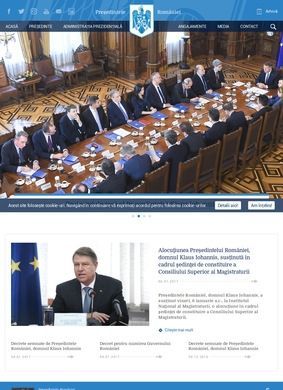
The President Of Romania website carries a channel that lets an ordinary citizen send a message straight to the head of state, filed under a section plainly called Write to the President. For an office that can feel remote from daily life, that direct line is the most striking thing on the site, and it sets the tone for everything else: this is a public institution putting its work, and a way to reach it, out in the open.
The President Of Romania website is the official home of the Presidential Administration, the institutional face of the office and not a personal or campaign page. It names Nicusor Dan as the sitting President and Mirabela Gradinaru as First Lady. The footer marks it as the site of the sitting Presidential Administration, with archived versions from earlier administrations kept available.
That archival habit is worth pausing on. It means the public record does not get wiped clean each time the occupant of the office changes, so the statements, decrees and agenda of a previous presidency stay retrievable side by side with the current one. Plenty of government sites simply overwrite themselves and erase their own history; keeping the older versions is the more responsible choice, and it quietly makes the President Of Romania site more useful to anyone studying how the office has behaved over time.
Those archived earlier administrations are a gift to anyone doing serious historical or political work. Being able to compare how successive presidencies presented themselves, worded their statements, or set their priorities is the kind of continuity most institutional sites destroy with every redesign, and preserving it turns the site into a small archive of the office, not a snapshot of whoever holds it now.
What the presidency publishes online
The office and its official record
The core of the President Of Romania site is the President section, which sets out the role and duties of the office and then backs them with primary documents instead of descriptions of documents. The official agenda sits here. So do decrees. So does the National Defense Strategy, a multi-year policy text and not a press summary of one.
Recent activity is logged as well, including participation in a NATO Summit and meetings with EU ambassadors. For anyone tracking what the office is doing week to week, that running record is the kind of thing that usually reaches the public filtered through a reporter. Here it is available unfiltered, in the office's own words.
This is where the site proves its worth as a reference. A researcher, a journalist, or a student of Romanian government can read the actual decrees and the strategy text instead of a secondhand account. Primary sources, published by the body that issued them, carry an authority that news write-ups cannot match, and a document like the defense strategy is the sort of thing people cite for years. Having it hosted at the source, in full, removes any question about whether a copy circulating elsewhere has been trimmed or paraphrased.
The published decrees and the official agenda are the part that turns the site from a promotional page into a record. A decree is a legal instrument with real effect, and having the actual text available, in place of a journalist's summary, matters to lawyers, academics and citizens who want to check what was signed. The agenda does something similar for accountability, showing where the office's attention has actually gone.
The logged recent activity, the NATO Summit appearance and the meetings with EU ambassadors, also signals that the site is kept current rather than left to drift, which is the minimum a reader should expect and more than some state pages manage.
A look inside the Presidential Administration
A second section of the President Of Romania website opens up the Administration itself. It lists departments and advisors, and it leans into institutional transparency, setting out how the office is organized and who does what. Bodies that sit close to the presidency appear here too, among them the Supreme Defense Council and the Orders Chancellery, which handles state decorations.
The same section documents the Cotroceni Palace and its museum, the historic seat of the office. Treated as institutional and historical background, that material gives a reader context for where the presidency operates and what the building holds, rounding out an understanding of the institution beyond whoever currently occupies it.
For anyone trying to grasp how the Romanian presidency is actually structured, this part of the President Of Romania site is more informative than most textbook summaries, because it comes straight from the institution describing itself. The transparency framing amounts to more than decoration, too. An office that publishes its departments, its advisors and the councils attached to it is easier to hold to account than one that keeps its wiring hidden, and laying that structure out in public counts as a genuine democratic gesture, even if a modest one.
Media, statements and writing to the President
The Media section of the President Of Romania site is built for people who follow the office closely. It gathers press releases, official statements and speeches, and messages, alongside a photo and video gallery. There is a defined press-accreditation procedure for journalists who need to cover events in person, which signals that the site is meant to serve the working press, not the casual reader alone.
Then there is the citizen channel already mentioned, the Write to the President feature. Together, the Media area and that message function turn the site into a two-way surface. The office pushes out its formal communications, and the public has a defined route back in, which is more than many state institutions bother to build.
That channel deserves scrutiny for what it represents and what it does not. A defined way for a citizen to message the head of state is a genuine democratic touch, though no website can promise that any single message reaches the President in person or draws a reply. Taken as a formal intake rather than a private hotline, it still beats having no public channel at all.
Publishing speeches and statements in full, in one place, is genuinely useful to anyone who wants the exact wording instead of a paraphrase. Political speech gets quoted selectively all the time; a reader who can pull up the complete text is in a far better position to judge what was actually said. The gallery and the press materials serve the same documentary end, and the whole thing is organized cleanly by function, so finding the agenda, a decree, or the latest statement takes very little hunting.
Weighed against the Wikipedia entry on the Romanian presidency, or against a general news aggregator, the President Of Romania site is slower to skim and offers no analysis of its own. Those alternatives will summarize a decree or a summit faster, and they will place events in a wider context the official site never attempts. What they cannot do is hand over the primary text: the complete National Defense Strategy, the speeches as delivered, the decrees as issued.
For a reader who needs the source and not the summary, the President Of Romania site is the one worth opening, precisely because it is the place publishing the originals.