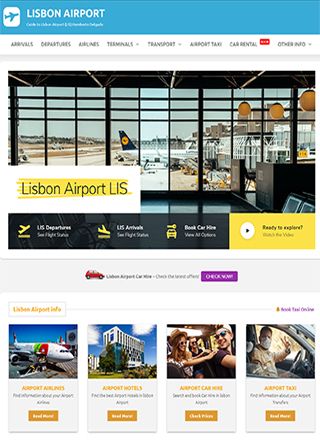
You have a connection in three hours and two terminals to choose between. That is the exact situation lisbon-airport.com was built to resolve, and it handles that particular problem with more granularity than most airport-guide sites bother to provide. Terminal 1 and Terminal 2 at Lisbon Airport (officially Humberto Delgado Airport, IATA code LIS) serve different carriers, and the physical distance between them is not intuitive. The site maps which airlines use which building, a detail that arriving drivers and connecting passengers need before they enter the terminal, not after. Getting the terminal wrong on a tight connection at Lisbon Airport costs time that a schedule built with no margin cannot absorb.
Terminal selection and airline routing
The homepage carries a clear disclaimer upfront: lisbon-airport.com is a third-party information portal, not operated by the airport authority, and the official operator is at lisbonairport.pt. That framing shapes how every section of the site should be read. This is a preparation resource. Its value accrues in the 48 hours before travel, not in the 15 minutes before boarding. That distinction between pre-trip research and live operational data runs through the entire site, and the site is consistent about it.
Ground transport options
Ground transport gets more coverage than a summary list. Taxis, the Lisbon metro, bus connections, and car rental all appear with booking links attached. The taxi-versus-metro comparison from Lisbon Airport into the city centre is addressed directly, not glossed over. The metro requires a short walk from the terminal, and the fare difference against a taxi can be significant depending on destination and time of day. At peak hours neither option is obviously preferable; the guide lays out both without defaulting to one. The pre-trip decision made with that comparison in front of you tends to be a better one than the decision made on tired feet with a phone battery at four percent and a queue forming behind you.
Taxi versus metro comparison
Procedural depth is one of the site's more substantive qualities. Check-in timelines, security screening, biometric identification, customs, baggage claim, VAT refund procedures, and visa requirements each get their own coverage. The VAT refund section is detailed for a reason: the process at Lisbon Airport involves specific paperwork, a particular desk in the departure hall, and a queue that is easy to miss if you have not read about it before arrival. Once you are past security, that window is effectively closed. The guide covers it at the stage of the itinerary where the information is still actionable.
Procedural requirements at each stage
Inside the terminals, coverage extends to lounges, duty-free zones, food and beverage options, parking structures, and nearby hotels. The per-terminal breakdown is more careful than a generic overview would be, which is appropriate given that Terminal 1 and Terminal 2 at Lisbon Airport are not interchangeable for every carrier. A weather section rounds out the practical content. Its footprint is small, but for a traveller packing light for a short trip where Lisbon's climate differs significantly from the departure city, it is a useful inclusion rather than filler.
Inside the terminals
Skytrax gives Lisbon Airport 3 stars, scored across facilities, comfort, cleanliness, shopping, food and beverages, staff service, and security and immigration. That places it solidly in the middle tier of European airports by that measure. The score is consistent with what passenger reviews describe across several platforms: Yelp's Aeroporto de Lisboa listing holds 366 reviews, and Tripadvisor, Airmundo, and AirlineQuality each contribute additional volume. The recurring complaints across those sources converge on the same structural features: congestion during peak periods, long walks between gates and baggage claim, and service quality that varies by day and terminal.
What passenger ratings reveal
Those ratings describe the physical airport, not this website. The relevance is that lisbon-airport.com does not soften the Skytrax result or editorially distance itself from it. A 3-star hub is a 3-star hub: the walks are long, congestion is periodic, and connection buffer times are not negotiable. Presenting that without hedging is one of the more substantively useful things the site does. A traveller who arrives expecting a best-in-class European hub will have a different experience than one who has read the Skytrax context beforehand.
How the site addresses Skytrax findings
A phone number and a physical address at Alameda das Comunidades Portuguesas in Lisbon are accessible from the footer. For a third-party informational portal, that level of identification is uncommon. Many travel-aggregator sites offer no identifiable presence at all. The contact details here belong to whoever operates the guide; they cannot resolve a delayed flight or a lost bag, and the site does not imply otherwise. Its framing is consistent about where the guide's reach ends and where the official Lisbon Airport operator begins.
For real-time gate changes in the final hour before a flight, the airline app or the official airport source will have fresher data than any third-party feed. No third-party guide should be the final check on a time-sensitive departure, and lisbon-airport.com does not claim otherwise. That alignment between stated scope and actual capability matters here, because travel-information sites that overreach on their own authority tend to fail at exactly the wrong moment.
Real-time data limitations?
The real-time arrivals and departures tracker is the page most likely to be pulled up mid-journey. Its accuracy depends on the feed powering it, and feed latency during irregular operations is an inherent limitation of third-party data. Within those limits, lisbon-airport.com covers its intended scope coherently: terminal selection, ground transport trade-offs, procedural requirements, and honest reporting of what a 3-star airport delivers during peak hours. The contact address in Lisbon gives the site more of a grounded identity than most comparable guides bother to establish, and the homepage disclaimer sets expectations accurately from the first line.