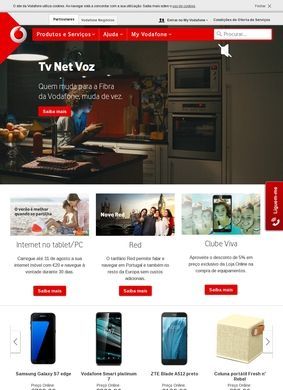
Someone signs a lease in Porto, collects the keys, and finds the flat has no internet and the previous tenant walked off with the router. That is the exact gap Vodafone Portugal is built to close. The consumer arm of the operator puts fiber, mobile, and television in front of that new arrival, and before a single contract is signed it lets them type in the street address and see whether fiber is even available on that block.
Vodafone Portugal is listed in this business directory as a full-service telecom and, increasingly, an energy retailer too. Coverage across Portugal still changes street by street, so the internet-coverage checker near the top of the site does real work instead of decorative work. The catalogue behind it is wide, and for a carrier the size of Vodafone Portugal it needs to be. There are mobile tariffs and plans, fixed and fiber broadband, mobile internet for people who want a connection without a fixed line, smartphones and other devices, and eSIM products for anyone activating a line without a physical card.
The site pulls these together into fiber-and-mobile bundles a household can assemble on its own, choosing a broadband tier and stacking mobile lines on top.
On the mobile side the tariffs and plans run across the usual tiers, with eSIM activation for newer handsets and separate mobile-internet packages for tablets, laptops, and anyone who wants data without a home line. Devices are sold outright or folded into a plan, so a customer replacing a cracked phone can spread the cost across the monthly bill instead of paying for it in one hit. It is a full menu, and the ordering flow keeps it legible rather than overwhelming.
Television arrives through Vodafone TV PLAY, delivered as a streaming layer instead of another set-top box to commit to, so a subscriber watches on screens they already own. One offer reaches outside telecoms altogether: Energia Vodafone Repsol, a co-branded deal that sells household electricity next to the phone bill. That mix tells you who Vodafone Portugal is chasing, a Portuguese household that would sooner buy internet, mobile, TV, and now power on one account than run four separate relationships with four separate providers.
Bundles, tariffs, and the tools around them
Bundle configurators and the coverage checker
The fiber-and-mobile bundle configurators are the heart of the shopping experience. A visitor picks a broadband tier, adds mobile lines, and watches the monthly package assemble in front of them, with the coverage checker gating the fiber step so nobody orders a service their address cannot physically carry.
That single gate prevents the most common frustration in home broadband, paying for a speed the line will never reach. A store locator points anyone who would rather handle things in person toward physical Vodafone Portugal shops, and once a customer is signed up there is an account portal for viewing and paying bills, plus order-status tracking to follow a new line or a new handset through fulfilment.
Someone who orders a phone online can see where it is instead of phoning to ask. The self-service side, in other words, is built out properly and not left as an afterthought.
A social tariff and a phone trade-in
Two features stand out for pointing away from the upsell. A social tariff gives low-income households a cheaper internet option, a real public-interest inclusion and the kind of thing a carrier is not always eager to put where people can find it. For Vodafone Portugal it sits in the catalogue as a named product instead of being buried in fine print. The device trade-in program takes an old handset in part-payment against a new one, and network-portability assistance helps a switcher keep the phone number they already have when they cross over from another operator.
None of these is exotic for a carrier this size, but each one is present, reachable, and described in plain terms, which counts for something when the alternative is a maze.
Clube Viva, Vodafone Happy, and the account side
Loyalty runs through two named programs, Clube Viva and Vodafone Happy, which hang rewards and perks off an existing subscription. For a customer already paying every month, they are a reason to stay put instead of shopping around at renewal.
The rest of the account experience is the ordinary machinery of a large telecom done competently. The bill viewer, the order tracker, the portability desk, and the loyalty perks all sit behind a single login. Vodafone Portugal clearly wants the whole relationship, phone and home and increasingly energy, inside one dashboard, and for a household that values a single point of contact that consolidation is a genuine convenience rather than a gimmick.
Fala connosco and the support routes
Support is where the picture turns mixed. There is a "Fala connosco" section, a WhatsApp channel, live webchat through a tobi assistant, a full help and support portal, community forums, an FAQ library, and a "Provedor do Cliente," a customer ombudsman, for escalations that stall at the normal desk. That is a lot of doors into the company.
What the landing content does not put in front of you is a plain phone number or an email address. Vodafone Portugal routes contact through those digital channels and the store network instead. For an operator this large that is a deliberate choice, and the ombudsman route is a real point in its favour, because it gives a stuck customer somewhere formal to escalate. Even so, a person who simply wants to phone a human has to hunt for the way to do it.
Outside the company's own pages, the mood sours quickly. On Trustpilot, Vodafone Portugal carries a score of about 1.2 out of 5 across roughly 550 reviews, with complaints that call the service poor and inefficient and accuse it of failing to honor contract terms. A number that low, drawn from a sample that size, is not background noise, and it deserves real weight in any decision a shopper makes here.
The rest of the outside signal is softer and more divided. A Tripadvisor Portugal travel forum thread and separate reviews of a specific Vodafone Shop in Lisbon include a complaint about roaming support. On Reddit, the r/PortugalExpats crowd splits down the middle: some praise the data allowances and overall value, others tell newcomers plainly to avoid it.
Glassdoor ratings exist as well, but those are staff scoring their own workplace, around 4.2 for work-life balance and 4.0 for diversity and inclusion, which tells a paying customer nothing about how their own contract will be handled. No Yelp or BBB listing turned up for the Portuguese operation.
Set those employee scores aside and the customer-facing verdict rests almost entirely on that Trustpilot figure. It is not a flattering one, and the specific charge behind it, that the company does not stick to the terms it agreed, is the sort of complaint a prospective customer cannot afford to shrug off. Value and data allowances are worth little if the contract turns adversarial later.
So the honest read lands split down the middle. The product range and the self-service tools Vodafone Portugal has built are strong, the social tariff and the ombudsman are the marks of a company that answers to a regulator, and the coverage checker quietly saves people from ordering fiber their street cannot deliver. Against all of that sits a genuinely poor public rating that Vodafone Portugal has to live with, and a support design that keeps the phone out of sight when many customers most want it.
A new arrival setting up a first household connection in Portugal could reasonably put Vodafone Portugal on the shortlist, with one condition firmly attached. Run the coverage checker for the exact address first, and ask the sales channel directly how the contract ends and what it costs to leave, well before any papers change hands, because that is precisely where the loudest complaints cluster. Go in with those two answers in hand and it is a defensible choice. Skip them, and you are betting that a 1.2 rating got it wrong.