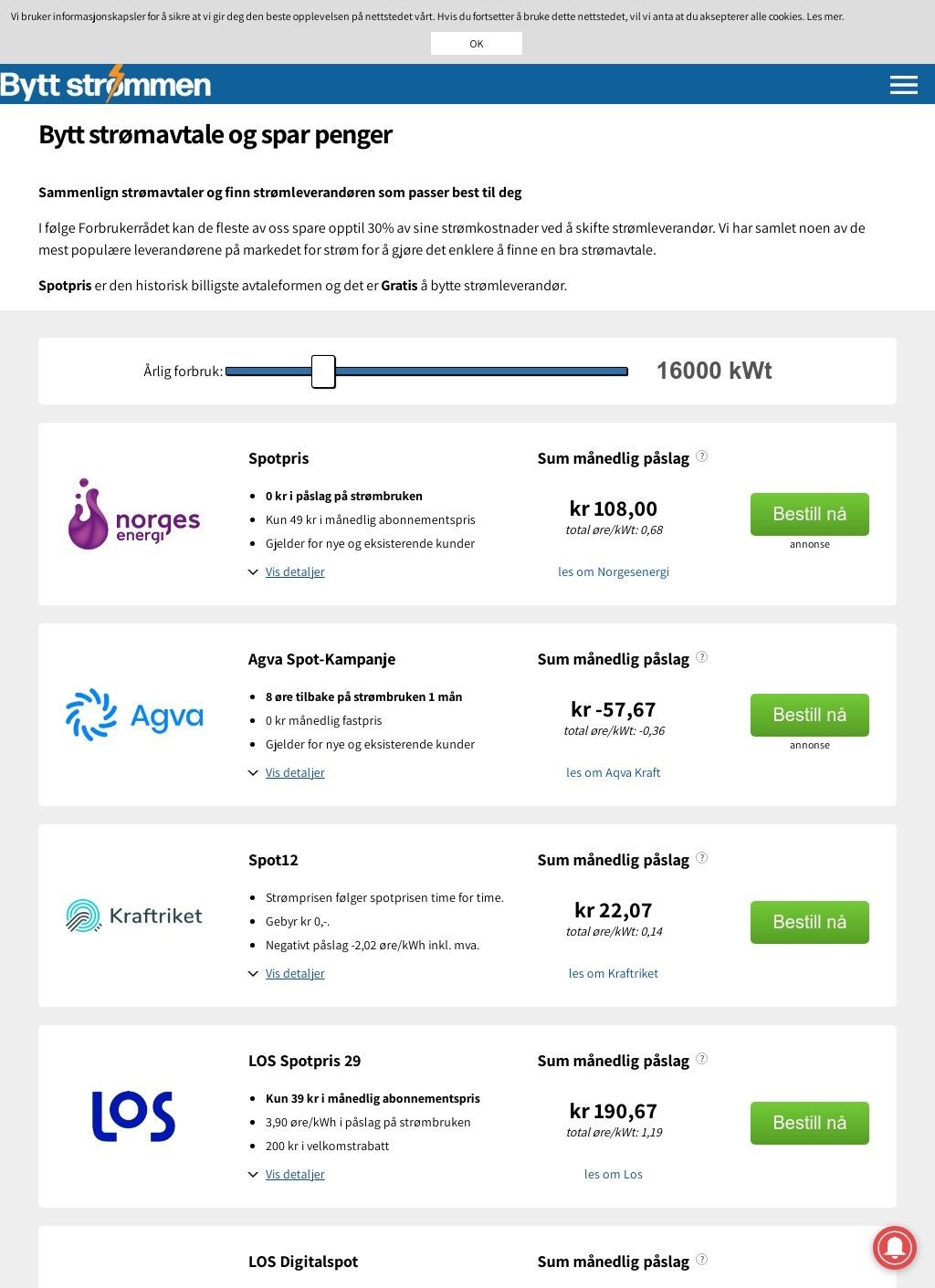
A Norwegian household opens its electricity bill, sees a number that has crept up again, and wonders whether the supplier it signed with two years ago is still the cheapest option. That is the exact moment Byttstrommen.no is built for. The site gathers electricity contracts from across the Norwegian market and lines them up so a consumer can see the spread between what they pay now and what someone else is charging. Switching costs nothing, the platform points out, and it puts a figure on the upside: savings of up to 30 percent for people who move off a stale tariff.
How the comparison tool works
Run by Effektiv Markedsforing AS, Byttstrommen.no stays independent of any single supplier, which is the whole point when the comparison only has value if it is even-handed. The list of providers it covers is long and genuinely Norwegian: Fortum, Tibber, Klarkraft, Agva Kraft, Fjordkraft, NEAS, Vest-Telemark Kraftlag, Rauland Kraft and more. That breadth is the part that inspires the most confidence, because a comparison tool that carries only three big names is really just a referral page in disguise. Here the roster is wide enough to make the exercise meaningful.
Provider coverage across Norway
The comparison itself is organised around the three contract types Norwegian buyers actually choose between: spot price tied to elspotpris, a variable rate, and fixed-price deals. Anyone who has tried to read these contracts cold knows the categories blur together in marketing language, so sorting them cleanly is useful work. Byttstrommen.no also breaks things down by elspotpris region, with Midt-Norge among the areas covered, which reflects how Norwegian electricity pricing really behaves. The country is not a single market, and a tool that ignores regional spot zones would mislead people in the north or the west.
Contract types organized by region
What lifts Byttstrommen.no above a bare calculator is the supporting material. Each provider gets an individual profile page with the contract details laid out, so a user can move from "this one looks cheap" to "here is what I would actually be signing." That second step is where a lot of switching decisions go wrong, and giving it room on the site is a sensible choice.
Provider profiles and contract details
There are also educational articles, and they go into the mechanics rather than skating over them. The pieces on how electricity pricing works and on grid fees, the nettleie that quietly inflates a bill regardless of which supplier you pick, address the thing many comparison sites conveniently ignore. A consumer can shave the energy portion of a bill and still be surprised by the grid charge, so explaining that distinction is honest. Rounding it out are tips on cutting consumption, which is the one lever a household controls no matter what contract it holds.
Educational content on electricity pricing
The audience is clear and Byttstrommen.no stays in its lane: Norwegian residential consumers, content written in Norwegian, no attempt to be all things to everyone. That focus shows in the way providers are grouped and the way the articles are pitched. It reads like something built by people who understand how a Norwegian power bill is constructed, not by a generic comparison-site template dropped into a new locale.
Focus on Norwegian residential consumers
On the matter of getting in touch, Byttstrommen.no is sparse. An email sits in the footer, post at the byttstrommen domain, and that is the whole of it. There is no phone number, no postal address, and no extended contact section. For a tool that is mostly self-service this is not a dealbreaker, since the entire interaction is a consumer comparing contracts and clicking through to a supplier. Still, it is worth flagging. A user who hits a problem or wants to ask whether a particular regional tariff is current has only one slow channel, and the lack of any company address keeps the operator at arm's length. A comparison service trades on being trusted, and a fuller about-and-contact section would help that case.
Limited contact options and transparency
On independent opinion, there is little to report. A search for Byttstrommen.no specifically turned up no notable third-party reviews. What came back was noise: ratings for unrelated Norwegian sites like bytt.no and blivakker.no, plus the platform's own internal provider pages. So the verdict here rests on the substance of the site itself, not on a chorus of user testimony. That is a fair caveat, because a young or low-profile comparison tool earns confidence partly through what others say about it, and that evidence is simply not there yet.
Is independent verification available?
Weigh it all and the picture is reasonable. The comparison covers real ground, the provider list is broad and recognisably Norwegian, the contract types are sorted the way buyers think about them, and the articles teach rather than sell. The 30 percent savings claim is the kind of headline number that should be treated as a ceiling, since the actual gain depends on the contract you are leaving and the region you live in. But the structure underneath the claim is sound. The limited contact footprint and the absence of any independent reviews are the two things holding Byttstrommen.no back from a clean recommendation.
Running your first comparison
If you suspect you are overpaying and want to see the full field of Norwegian suppliers in one place, Byttstrommen.no is worth the half hour it takes to run a comparison. Start by checking which elspotpris region you fall under, since that drives everything else, then read the full provider profile for any deal that looks cheap. The footer email is the one route Byttstrommen.no gives you if a tariff detail is unclear, so use it early, not after a contract is already signed.