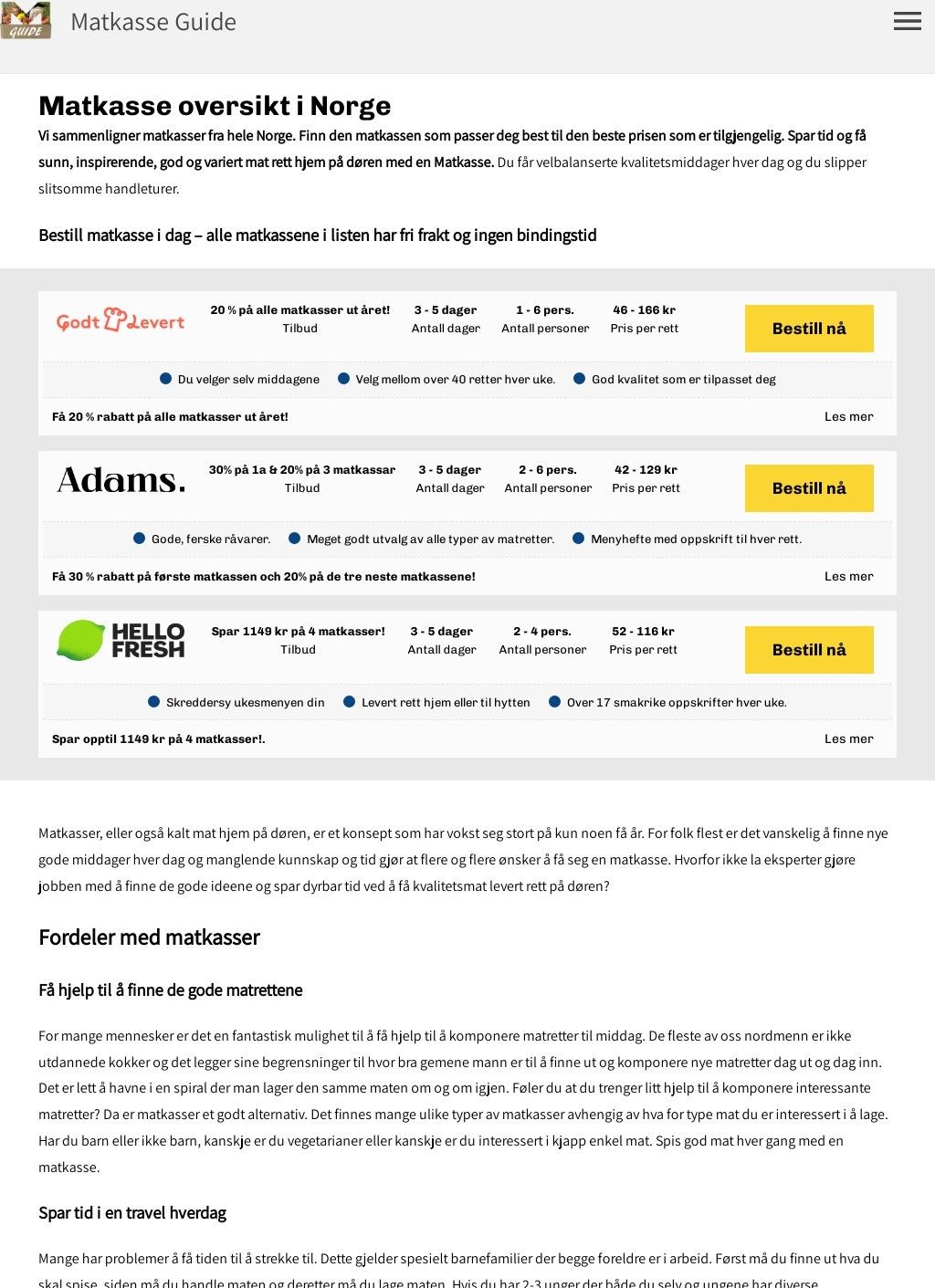
Adams Matkasse, GodtLevert, HelloFresh, Kokkeloren, and Nettmat each get their own profile on Matkasse.guide, broken down by what they charge, how much menu choice they give you, and how delivery works. That is the spine of the site: a Norwegian comparison platform built around the meal box, or matkasse, services that actually operate in the country right now. If you have ever stood in a kitchen wondering whether a weekly box of pre-portioned ingredients is worth the price over just shopping yourself, Matkasse.guide is the kind of page that tries to answer the question.
Provider profiles with pricing and delivery details
The provider profiles are the strongest part. Instead of a single ranked list with a star slapped on each name, the site pulls apart pricing tiers, the variety of meals on offer week to week, and the delivery terms, which is exactly the information that decides whether a service fits a household or not. HelloFresh and Adams Matkasse are well known names in Norway, and putting them side by side with smaller operators like Nettmat and Kokkeloren gives a reader a fairer sense of the field than any one company's own marketing would. The detail is specific enough that you could shortlist two services and move on, which is the whole point of a comparison resource.
Comparing established brands with smaller operators
A nice touch, and one a lot of comparison sites skip, is the section devoted to services that no longer exist. Den Gronne Kassa, Kolonial.no, and MatKomfort are all logged as discontinued. Anyone who half-remembers a brand they saw advertised a couple of years back can check here and learn it has folded, rather than chasing a dead signup page. Keeping a graveyard of former providers is a small sign that someone is actually maintaining the content rather than letting an old list rot. It also quietly tells you the market is volatile, useful context for a category where companies come and go fairly often.
Tracking discontinued meal box services
Beyond the head-to-head profiles, Matkasse.guide breaks things down by location. Oslo, Bergen, Stavanger, Trondheim, and other cities get their own guides, which is sensible because delivery coverage and timing are not uniform across Norway. A service that runs smoothly in central Oslo may have patchier reach in a smaller city, and a guide that acknowledges that is more honest than a national overview pretending geography does not matter. For someone outside the big urban centres, the city pages are probably the first thing worth opening.
City guides for local delivery coverage
Around the comparisons sit the supporting pieces: comparison articles, FAQ sections, and editorial notes on why a meal box might suit a given household. The benefit-of-meal-boxes angle has been written many times across the internet, but it rounds out a site that otherwise risks reading like a spreadsheet. The FAQ in particular catches the questions a first-time buyer has but does not know how to phrase. Whether the editorial notes add much depends on how much hand-holding a reader wants; a confident shopper will skip straight to the pricing tables.
Editorial articles and FAQ for new buyers
The site is run by Effektiv Markedsforing AS and is upfront that it tests most of the services it features but may take compensation from providers. That disclosure deserves credit. Affiliate arrangements are normal in this corner of the web, and pretending otherwise would be the bigger red flag. A reader should still keep the incentive in mind when a service is praised, since "we tested it" and "we are paid when you sign up" can both be true at once. Matkasse.guide does not hide the tension, which is about as much as you can reasonably ask of a comparison platform that has to fund itself somehow.
Funding model and affiliate disclosures
On reachability, there is an email address listed, but no phone number and no physical address. For a content and comparison site that is not unusual, and a buyer is far more likely to contact the meal box company directly than the guide that pointed them there. Still, a little more transparency about who is behind the editorial choices, beyond the company name, would strengthen trust in the recommendations.
Limited transparency on editorial leadership
As for outside reputation, a search for opinions about Matkasse.guide itself mostly surfaces reviews of the meal kit services it covers, not of the guide. There is no independent body of feedback to lean on when judging the site's track record. The site asks readers to trust its testing and its rankings, yet there is little external confirmation of how reliable those verdicts have been over time. It does not make the content wrong, but it does mean the credibility rests almost entirely on the quality of the pages themselves and on the honesty of the disclosures.
For a Norwegian shopper weighing up a meal box, Matkasse.guide is a genuinely useful starting point, and the range of providers covered on Matkasse.guide is broad enough to reflect the real market. The provider breakdowns are detailed, the city-by-city coverage respects how delivery actually works, the discontinued-services section saves wasted clicks, and the affiliate disclosure is handled honestly. Against that, Matkasse.guide is a site with an admitted financial stake in the services it ranks and no independent reputation to corroborate its judgements. The reasonable approach is to use its tables to build a shortlist, then check each provider's own current terms before paying for anything.