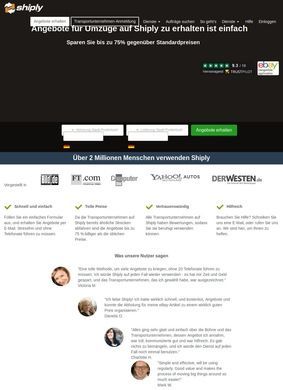
The prices are the part that grabbed attention first: a one-bedroom move from Berlin to Vienna listed at around 400 euros, a three-bedroom run from Munich to Madrid at roughly 1,200. Those are the kind of numbers that come out of competition, and competition is the whole engine here. Umzug is the German moving section of Shiply, which works as a reverse-auction marketplace. You describe what needs shifting, where it starts, where it ends and when, and independent transport firms bid for the job. The lowest or best-suited quote wins, and the page exists to channel relocation work into that bidding pool.
Services covered by Umzug
What the Umzug section actually covers is wider than a flat or house move, though it handles those across one to six bedrooms and beyond, with packing and unpacking offered when asked. There is Firmenumzug and Bueroumzug for offices and businesses, plain furniture transport, bulky-item handling for the awkward pieces that do not fit a normal load, and household appliances. It also stretches into vehicle transport for cars and motorcycles, plus small van hires that come with a driver for the lighter jobs. That spread means a student moving a single room and a company clearing an office floor are both pointed at the same mechanism, which is a sensible way to keep one platform useful to very different people. A removal job, in Umzug terms, can be almost any size, and the bidding board adjusts to fit.
Scale of the platform
The scale claim behind it is over 1.9 million users, and the platform name has turned up in German press and on outlets like Bild and FT.com. Numbers like that tell you the marketplace has liquidity, which matters more in this model than in most. A quoting board with few bidders gives you no real choice. A busy one is what produces those competitive figures in the first place. So the size behind Umzug is what makes the price promise believable, and it is the reason a posted job tends to draw several quotes rather than sit unanswered.
Requesting a move online
The way a request flows is worth spelling out, because it changes how you should approach the page. You write up the move, set the date, and wait for transport firms to come to you, which inverts the usual chore of phoning round for estimates. Instead of you chasing prices, the prices chase you. For someone organising a relocation around a hard moving date, that shift in effort is the quiet selling point of Umzug, and it is easy to underrate until you have done the old way once.
Comparing service quality across providers
It can, and the honest answer sits in how this is built. Because the actual moving is done by whichever independent firm wins your job, the experience swings on that one provider, not on Umzug itself. MoveBuddha makes exactly this point, noting that service quality is variable depending on the transport company you end up with. Umzug supplies the matchmaking and the rating system; the person carrying your sofa down three flights is someone the platform vetted but did not employ. That gap between who you book through and who actually shows up is the central thing to understand before posting anything.
Checking provider ratings
That is where the rating layer does real work. The provider reviews attached to each bidder are the closest thing you get to a guarantee, and I would lean on them hard before accepting any quote, since a low number from an unrated newcomer is a different proposition from a slightly higher one from a firm with a long, clean history. Read those, message the bidder through the system, and the model can pay off. Skip that step and the cheapest bid is just a gamble with your furniture.
Reviews across major platforms
On wider reputation the signal is loud. Trustpilot carries something close to 71,867 reviews at a five-star overall mark, with MoveBuddha separately counting over 62,000 of them at five stars. Reviews.co.uk shows roughly 43,728 reviews. The picture is not uniformly glowing, and that is worth saying plainly: PissedConsumer logs around 335 reviews at about 3.5 stars, and there is a BBB profile tied to an address in Middletown, Delaware. Read together, you get a platform with enormous positive volume and a real minority of unhappy customers, which is roughly what you would expect from a marketplace channelling huge numbers of individual moves through hundreds of separate firms.
Contact and support options
Contact is the one area where Umzug asks you to trust the system instead of a phone line. The landing page shows no phone number, no email, no street address. Everything routes through the quoting and messaging tools, with a general help section living on the broader Shiply site. For a marketplace this is defensible, because the meaningful conversation is between you and your chosen mover, not between you and a head office. Anyone who wants a human voice to call before committing money will find that absence a genuine drawback, and it is fair to weigh it that way.
German language localization
The German-language coverage is more than a translated shell, which counts for something real. The terms Umzug uses are the ones a German mover would actually type into a search box, Sperrgut and Haushaltsgeraete and Kleintransporte among them, and the example routes lean cross-border, which fits a service that handles moves out of Germany into Austria and Spain as readily as across one city. The page clearly knows who it is talking to, and it goes well beyond bolting a dictionary onto an English site and calling it localised.
Reading listed prices correctly
One practical note for first-timers. The competitive prices on screen are real listed jobs, not promises, so they should be read as a sense of the going rate, not a quote you can claim. Your own figure will depend on your route, your date and how many firms feel like bidding. Treat the Berlin and Munich examples as a ballpark and you will not be caught out. That is a small thing, but it is the difference between using Umzug well and being surprised by it.
Where this leaves a person depends on temperament. If you want a fixed, named firm with a published quote and a number to ring, a traditional outfit such as Umzugscompany gives you that certainty and a single accountable party from the first call to the last box.
Umzug trades that certainty for choice and, usually, a lower bill, asking you to do the vetting yourself through the ratings instead of paying for it in the headline price. For a flexible mover who reads the provider history carefully and is comfortable comparing several bids, that trade is a good one, and the prices on display suggest it often works out. For anyone who would rather hand the whole thing to one company and stop thinking about it, this marketplace puts more of the work back on your shoulders than a direct booking would.
Business address
Shiply