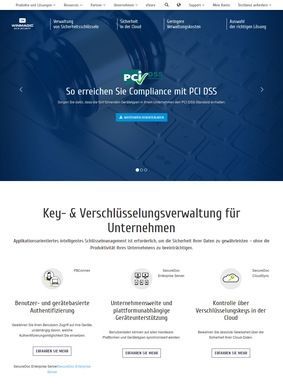
Twenty-nine years is an unusual number to open with, but it frames almost everything about WinMagic Germany. The company started in Canada in 1997 and has kept selling encryption software ever since, outlasting a long list of vendors that got bought, rebranded or quietly wound down. By its own count it has shipped more than 5 million licenses across over 80 countries. Whether that history gives a German buyer a concrete reason to choose it over fresher alternatives is the honest question, and the answer comes out mixed.
SecureDoc and MagicEndpoint products
The German presence is part of a global operation rather than a separate product line, so what WinMagic Germany puts on offer is the full catalogue aimed at organisations that need to protect data on endpoints. Two products carry the load. SecureDoc is full-disk encryption for Windows, macOS and Linux, with centralised key management and pre-boot authentication that can require more than one factor before an operating system even loads. MagicEndpoint is the newer pitch: passwordless login and multi-factor authentication that ties a user's identity to the physical hardware through the device's TPM chip. One addresses data at rest on the disk; the other controls who gets access to that disk in the first place.
SecureDoc is the older and better-understood product, the kind of full-disk encryption that has been a fixture of corporate security policy for years. MagicEndpoint reads as the company's move to stay relevant as the industry shifts toward passwordless logins and hardware-bound identity. The pairing has a natural logic: a shop already running SecureDoc has a clear upgrade path into the authentication side without bringing in a second vendor.
The technical detail on the listing goes deeper than a marketing page usually bothers with. WinMagic Germany lists support for cloud-hosted, on-premise and air-gapped deployments, which is directly relevant because the buyers it targets often cannot place anything in a third-party cloud. Enterprise passkey rollout, Linux device onboarding and encryption, and professional deployment services round out the offering for organisations that want managed rollout and not a self-guided install.
Compliance credentials for government suppliers
Two compliance markers deserve specific attention for the intended audience. The cryptography is FIPS 140-3 validated, and there is explicit support for CMMC 2.0, the framework that ties US defence contractors to defined security standards. These are not decorative claims. A government supplier or a firm in a supply chain touching US federal requirements checks for exactly this before a product makes any shortlist, and they explain why WinMagic Germany still appears in conversations about hardened endpoint security. Air-gapped support is a similar indicator: most mainstream tools do not work in deliberately isolated networks, so building for that environment points to real experience with defence and government clients.
Target industries across sectors
The industries named cover a wide spread: government, financial services, healthcare, legal, education, manufacturing and retail. That breadth can look like a vendor trying to be everything to everyone, but encryption and device authentication are genuinely horizontal needs, so the list is defensible. A hospital and a bank have different regulatory paperwork and the same underlying problem of laptops leaving the building. Professional deployment services are a quieter but meaningful part of the package: centralised key management and pre-boot authentication are exactly the sort of thing that goes wrong when a stretched IT team tries to roll out across thousands of machines without support.
Customer and employer reputation signals
This is where the picture becomes harder to read, and where WinMagic Germany asks for more trust than the third-party signals quite support. On G2 it holds 3.7 out of 5 across only seven reviews, a sample too small to say much either way. PeerSpot puts it at 7.0 out of 10, and Gartner Peer Insights carries reviews for SecureDoc without a clear aggregate surfacing in search. None of that is damning, but none of it amounts to a strong endorsement either. It is the profile of a product known inside a narrow professional circle and largely invisible outside it.
The employer-side numbers are less flattering and worth factoring in, because they hint at the health of the organisation behind the software. Glassdoor sits around 2.7 out of 5 with roughly a third of staff saying they would recommend working there. RepVue scores WinMagic Germany at 2.5 out of 5 for product-market fit and places it near the bottom of its software list, 2184th out of 2316. These are not customer reviews and do not tell you the encryption itself is unreliable. They do paint a picture of a company running more on legacy position than forward momentum, and a buyer counting on active roadmap development and long-term support should account for that.
Contacting WinMagic Germany
Contact is practical enough for an enterprise software sale. WinMagic Germany keeps a Contact page, demos can be scheduled directly, and existing customers reach support through a separate portal. No phone number or postal address appears on the landing page, which is unremarkable for a B2B vendor whose buyers arrive through sales conversations rather than walk-in traffic.
What the German presence includes
One thing the German angle does not clarify is how localised the offering actually is. The listing points to a global product reaching this market, not to a distinct German team, German-language support, or local data handling spelled out on the page. A buyer specifically looking for a German vendor or German-language deployment help will find the listing quiet on all of that.
Evaluating WinMagic Germany for your needs
Put it together and WinMagic Germany lands in a cautious middle position. It has a credible, technically detailed encryption and authentication product with the compliance credentials its target buyers need, and nearly three decades of operation behind it. Against that, the outside reputation is limited, the employer scores are weak, and there is no clear account of what makes the German presence distinct beyond access to the same global catalogue. A security team with FIPS or CMMC requirements driving the search has good reason to put WinMagic Germany on an evaluation list. A buyer without those specific compliance drivers would be wise to compare it carefully against better-known names, and to push hard on support commitments and roadmap transparency during any product demo.