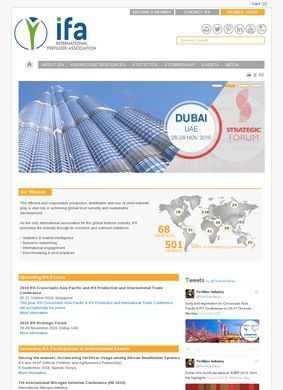
If mineral fertilizers really account for roughly half of the food the world grows, who keeps the data and standards for the entire sector? That is the gap the International Fertilizer Industry Association fills. It is the single global trade body for the fertilizer industry, gathering around 500 members across some 80 countries, and the membership spans the whole chain: producers, traders, distributors, and agronomists. Reading through what the Paris-based not-for-profit publishes, you get the sense of an organisation that has been the default reference point for this field for a long time, and the site is built to serve that role.
IFASTAT and the Science Program
The most immediately useful thing here, at least for anyone who works with numbers, is IFASTAT. This is the data and market-statistics platform, and it gives the rest of the site its weight. Production, consumption, trade flows: the International Fertilizer Industry Association is positioned to hold figures that individual companies or national bodies could not assemble alone. Around it sits a Science Program that covers crop nutrition datasets and research into emerging fertilizer products, pushing the offering past pure record-keeping and into the territory of where the industry is heading next.
Data platform for production, consumption, trade flows
Two strands stood out as I worked through the structure. The first is the Protect and Sustain Certification, an industry sustainability standard that the International Fertilizer Industry Association administers. A certification scheme is a real commitment, because it means the body is willing to define what good practice looks like and then hold members to it. The second is the Sustainable Fertilizer Academy, which handles professional development and training. Put together, these show the association is not content to be a statistics shop. It wants to shape how people in the sector are taught and how plants are run.
Certification, training, professional development
There is also a forward-looking layer. The IFA Cultivate Challenge and the Innovation Hub are framed as innovation initiatives, the sort of programmes meant to surface new ideas and new entrants in a field that can otherwise feel slow to change. Whether those initiatives produce lasting results is something only time and the participants can answer, but their presence tells you the International Fertilizer Industry Association is paying attention to where the industry could go as much as where it has been.
Protect and Sustain Certification standards
For people who simply want to keep current, the Resources section pulls together publications, webinars, podcasts, infographics, and videos. That mix matters because the audience is not uniform. A plant engineer, a policy researcher, and a distributor will each reach for a different format, and having short visual explainers alongside denser publications widens who can actually use the material. It is a practical choice, and one that a lot of technical bodies overlook.
Sustainable Fertilizer Academy programs
The networking side runs through the annual conferences and the regional Crossroads meetings. These are where a global membership turns into actual contact, and for an industry whose value chain crosses so many borders, the regional angle is worth noting. A producer in one part of the world faces different regulatory and logistical realities than one elsewhere, and meetings pitched at a regional level can address those specifics in a way a single global event cannot.
How does the association foster innovation?
What ties all of this together is a stated mission built around food security. The International Fertilizer Industry Association leans on the point that fertilizers underpin a large share of global food production, and that framing runs through the way it presents its work. It would be easy to dismiss that as positioning, except the supporting machinery is real: the data platform, the certification, the academy, the research program. The mission and the output line up, which is more than can be said for plenty of organisations that talk about purpose.
Resources for different audience formats
If you want a picture of who actually serves the agri-input and agrochemical sectors at a global level, the International Fertilizer Industry Association is close to unavoidable. The breadth is genuine, from raw statistics to sustainability standards to training, and it connects a membership wide enough to make the association the connective tissue of the trade. The material assumes a working knowledge of the field, so a casual visitor may find the early going dense, though that is a fair trade for depth aimed at professionals.
Regional Crossroads meetings and annual conferences
The harder question is what you bring to it. The International Fertilizer Industry Association clearly rewards anyone who arrives with a specific need, whether that is a trade figure, a certification pathway, or a research dataset. A producer weighing the Protect and Sustain route will find concrete ground here; so will a researcher chasing crop nutrition data, or a newcomer using the academy to get up to speed. The site does a lot, and most of it is substantive. Decide which part of this large operation answers the problem you walked in with, and the International Fertilizer Industry Association will likely have something worth your time.