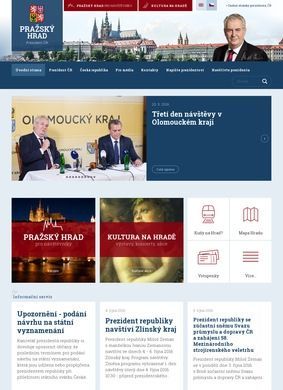
Planning a visit to Prague Castle before setting foot on the hill is genuinely useful, and the official Prague Castle site makes that possible. It covers ticketed entry to the historical buildings, opening hours that shift with the season, current closures for individual sights, and the practical mechanics of getting a ticket in hand. Prague Castle draws crowds from every continent, and the site treats that fact seriously: it reads as a working visitor portal first, a ceremonial presentation second.
Tickets and opening hours
The ticketing section does the site's most useful work. Access covers a cluster of buildings that most travellers come for: St. Vitus Cathedral, St. George's Basilica, the Old Royal Palace, Golden Lane with Daliborka Tower, and the Castle Guard Exhibition. Each of these has its own character, and the site treats them as a set you move through across a single visit. The Picture Gallery at Prague Castle is listed alongside as its own attraction. A first-time visitor can read this and build a clear mental map of what a day inside the walls includes, which is harder than it sounds when a monument spans this much ground.
Guided tours and audioguides
For people who want more than a map and a ticket stub, there are two routes. Professional guided tours can be arranged by phone, by email, or in person, giving groups and solo travellers flexibility in how far ahead they plan. The in-person option is particularly relevant, since plenty of arrivals decide on a guide only once they are standing at the gate and sizing up the queue.
Arranging professional guides
The audioguide rental is the detail that impressed me most on the practical side. It runs to 96 stops, with recordings covering both the exteriors and interiors of the buildings across Prague Castle. That is a serious amount of recorded material, enough to go well past the headline facts into the parts of the complex a rushed visitor would otherwise walk straight through. Whether 96 stops feels like a gift or an overwhelming amount depends on how much time a person has budgeted, and the site is honest enough to let you weigh that yourself.
Audioguide with 96 stops
Beyond tours, Prague Castle hosts concerts and cultural events within the complex, so the grounds are presented as a living place rather than a static heritage site. The information is framed for someone deciding what to attend, not for an academic reading about programming history. That framing runs through the whole site: it assumes a reader with a trip to plan.
Concerts and cultural events
Opening hours are stated plainly and by season. The general window runs 9:00 to 17:00 daily, narrowing to 9:00 to 16:00 in winter, with last entry at 16:40. Those numbers are what a visitor needs before anything else, and having them front and centre saves a lot of guesswork. The site also carries current closure notices for individual buildings, which is the kind of upkeep a visitor-facing portal has to maintain continuously to stay accurate. A cathedral or palace can close for a service, a restoration, or a state function, and a traveller who checks ahead avoids arriving to a locked door.
Seasonal hours and closures
Language coverage is unusually wide. Content is offered in Czech, English, German, French, Italian, Spanish, Chinese, Japanese, Korean, and Ukrainian. That spread is a deliberate response to who actually walks through the gates, and it puts the site ahead of plenty of national monuments that stop at two or three languages. The Information Centre in the Third Courtyard gives the same orientation in person for anyone who arrives without having read a word of it beforehand.
Language options across the site
One thing to keep in mind is that Prague Castle remains an active presidential seat as well as a public attraction. Prague Castle is the working seat of the Czech head of state, and that dual role shapes how the place operates. The site presents the heritage and cultural side openly, but the rhythm of a functioning seat of government sits underneath everything, which is part of why the closure notices here deserve more attention than similar notices on other sites.
Active presidential seat
There is no significant independent review presence for the official Prague Castle site itself as a web resource; searches surface visitor opinions of the monument rather than the site. That is expected for an official government portal of this scale. The depth of the audioguide and the breadth of languages both point at a primary goal of getting a diverse, international stream of visitors smoothly through a genuinely complicated place. The Picture Gallery and the Prague Castle events listings widen the scope past the cathedral-and-castle checklist that many would otherwise treat as the whole experience.
What the site cannot fully resolve is the gap between a clean set of hours on a screen and the reality of a monument that answers to a calendar of state events no website can predict in full. The closure notices are there and kept current, yet they are reactive by nature: they tell you a building is shut today, not whether a ceremony three weeks out will close the very thing you came to see. Prague Castle as a physical place is always slightly ahead of any official description of it, and that is the one uncertainty a visitor still has to carry up the hill, unsolved.