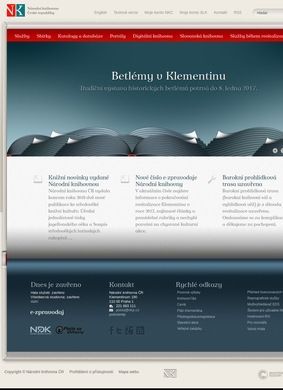
Oldest printed materials in the Czech language sit inside the same institution that runs this site, and that single fact explains what the National Library of the Czech Republic is for. It is the country's national repository, charged with keeping and giving access to the written record of a culture. Its home is the Clementinum in Prague, a Baroque complex that has held books for centuries, and that history is written into the depth of the collections.
Research materials and access routes
Most of what the site points to is research material. There are general collections and specialised ones: historical manuscripts, early printed books, and those earliest Czech printed texts that any scholar of the language eventually has to consult. A reader who needs the original object can use the on-site reading rooms and study spaces. A reader who only needs the text, or who is working from another country, can go through the public catalogue and the licensed electronic databases and digital libraries the institution maintains. The two routes, physical and digital, are treated as equal paths to the same holdings, and that balance is more candid than libraries that digitise a token fraction and call it access.
The Slavonic Library specialisation
One department deserves singling out. The Slavonic Library, housed within the National Library of the Czech Republic, gathers materials for Slavic studies, which makes the National Library of the Czech Republic a reference point well past the Czech lands. Anyone whose work touches Slavic languages, history, or literature has reason to know it exists. It is a genuine specialism, not a shelf relabelled to look like one.
Digitising fragile originals
The library runs a cultural heritage digitisation programme, the slow work of turning fragile originals into something a person can read on a screen without handling the paper. For a collection that includes manuscripts and incunabula, that work pulls in two directions at once: it protects the object and it widens who can study it. The programme is ongoing rather than finished, which is the realistic state of any such effort given the scale involved.
Public programming beyond study
Beyond the catalogues and the databases, the National Library of the Czech Republic puts effort into bringing people through the door for reasons other than study. The site lists exhibitions, lectures, guided tours, concerts, and virtual tours for those who cannot come in person. The concerts are an unusual touch for a national library, and they fit the Clementinum, which is as much a monument as a workplace. The virtual tours extend the same logic that drives the digitisation: if the building and its contents cannot travel, let the view of them travel instead.
Library without barriers initiative
Accessibility gets its own named effort. The "Library without barriers" initiative is aimed at visitors with disabilities, and the fact that it carries a distinct identity points to a standing commitment, not a line in a policy document. For an institution operating inside a protected historic complex, where physical adaptation is rarely simple, that is worth noting.
Who uses this institution?
The audience the National Library of the Czech Republic describes for itself is broad: researchers and students, academic institutions, and the general public, served both in person and through its digital resources. That breadth is consistent with what a national library is supposed to be. The National Library of the Czech Republic is neither a closed scholarly fortress nor a tourist attraction wearing library clothes. It tries to be both the deep archive and the open door, and the range of what it lists supports the claim.
A practical detail the site does flag is seasonal operation. Summer hours apply from late June through late August, and that window includes a maintenance shutdown period. Anyone planning a research visit in that stretch should check the schedule before going, because a closed reading room during a maintenance break is a wasted trip. A small thing, but exactly the small thing a visitor needs to know in advance.
Public reviews of the National Library of the Czech Republic on general platforms turn up a limited number of entries, which is unsurprising for an institution whose primary users are researchers and professionals. The Clementinum complex itself draws more general public commentary, largely positive, though much of it focuses on the Baroque Hall as a tourist draw rather than on the library's holdings or services. There are no visible complaints about access or collections in what is publicly indexed.
What comes through across the whole offering is an institution doing several jobs that pull in different directions and refusing to drop any of them. It guards rare originals, some of them the oldest of their kind in the language. It builds digital access so the originals can stay protected. It opens its halls for concerts and tours, and it works to let people with disabilities use a building that was never designed for them.
The National Library of the Czech Republic is consulted because it holds what almost nobody else holds, and the site reflects an organisation aware that holding the material is only half the obligation. The other half is making sure the right person can reach it, whether that person is in a Prague reading room or reading a digitised page from somewhere else entirely. The early Czech printed books are the anchor; everything around them is the apparatus built to keep them usable.