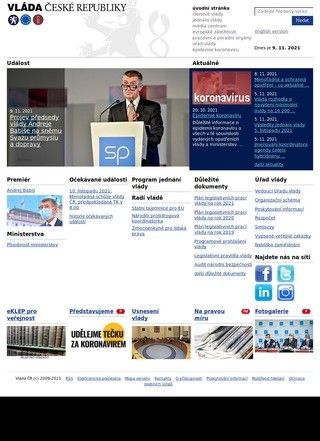
Every time the cabinet meets, the outcome goes up under the label Vysledky jednani vlady, a plain record of what was decided that day. That running log is the spine of the portal run by the Government Of The Czech Republic, and it is what sets the site apart from a news feed: the decisions arrive without a middleman to summarize or reshape them first.
The address is vlada.gov.cz, the online home of the executive branch. The Government Of The Czech Republic sorts its portal into a small set of clearly named sections. Vlada covers the cabinet. Media centrum holds news releases, meeting results, and press briefings. Pracovni a poradni organy lists the working and advisory bodies. Urad vlady is the Office of the Government, the administrative apparatus behind the ministers, and Statni sluzba deals with the civil service. Nothing about the taxonomy asks a visitor to guess where a thing lives.
That clarity is easy to undervalue until you have tried to find a specific ruling on a government site that buries everything three clicks deep. Here the top level tells you most of what you need before you commit to a page.
How the news and the documents sit together
Two kinds of material dominate the Government Of The Czech Republic site, and they pull in different directions in a useful way. One is time-stamped news: what the Prime Minister did this week, which diplomatic meetings happened, what came out of the last cabinet session. The other is the slower, reference-grade material that does not change from one day to the next. A reader gets both without leaving the domain.
The current cabinet is led by Andrej Babis, and coverage of the Prime Minister's activity runs through much of the front-facing content on the Government Of The Czech Republic site. That includes international work such as V4 meetings and cooperation on Ukraine reconstruction. It is the kind of coverage a national wire service also produces, except here it comes straight from the office doing the work.
The trade-off is worth naming. A primary source reports its own actions in its own words, so the tone is favourable to the government by default. A careful reader treats the Government Of The Czech Republic account as the authoritative statement of what was decided and looks elsewhere for how well it is working. As a factual baseline, though, it is hard to beat, because the body publishing it is the body that acted.
The media centrum feed
Media centrum is where the daily churn lives. Press briefings, formal news releases, and the outcomes of government meetings all funnel through it, which makes it the section a journalist would open first.
Because the government publishes its own account of each session, the feed doubles as a primary source: a reporter can quote the cabinet's stated result and then go looking for reaction elsewhere. There are also public event announcements, including open days at the Hrzansky and Lichtenstejnsky palaces, which is a small human touch on an otherwise procedural page.
Policy documents on the record
Look past the news feed and the reference layer turns out to be deeper than expected. The Government Of The Czech Republic publishes its Legislative Rules, a Legislative Work Plan for 2026, the Ethics Code of the Government, and the Government Policy Statement. These are the documents that tell you how the executive is supposed to operate and what it has committed to, and having them posted openly is worth more to a researcher or a lawyer than any amount of news copy.
They get cited in academic work and legal argument, which is exactly why a stable, official place to read them counts for something. When the Government Of The Czech Republic hosts its own Legislative Rules, there is no question of which version is current or authentic.
A map of the cabinet and its ministries
The part of the Government Of The Czech Republic site that pays off for ordinary users is the cabinet map. Every minister has a profile, and each profile links out to the ministry that person runs. The full spread is there: Interior, Labour and Social Affairs, Regional Development, Health, Finance, Defence, Justice, Foreign Affairs, Industry and Trade, Transport, Education, Agriculture, Environment, and Culture.
That structure turns the portal into a switchboard. Someone who does not know which body handles a given question can start at the top and follow the branch down to the right ministry. It is a genuinely practical function, and it saves a person from typing half-remembered agency names into a search engine and hoping for the best.
The cabinet profiles are more than a formality too. A minister's page gives a name, a portfolio, and the route to the ministry, which is exactly what a citizen or a foreign counterpart needs when they want to know who is responsible for a decision. The Government Of The Czech Republic keeps this layer tidy, and tidiness in an org chart is not a given.
The site also reaches past the core ministries to related initiatives. It links to nasiukrajinci.cz, the portal coordinating support for Ukrainian refugees, which shows the executive pointing outward to programs it backs rather than pretending everything must live under one roof. Pracovni a poradni organy fills in the rest, cataloguing the advisory and working groups that most people never think about until they need one.
For anyone tracking who holds which post right now, the Government Of The Czech Republic keeps this current, which is the whole point. Cabinets change. A profile page that reflects today's composition is more useful than an encyclopedia entry that lags by months.
Who reaches for it and how it reads
The audience splits cleanly. Journalists come for Media centrum and the meeting outcomes. Researchers and legal professionals come for the policy documents and the legislative plan. Businesses come to understand which ministry governs their sector and what the current cabinet intends to do. The general public comes to find a name, a decision, or an event. The Government Of The Czech Republic manages to serve all four without forcing any of them through the same narrow door.
An English-language toggle widens that reach considerably. A foreign correspondent, an investor, or a scholar who does not read Czech can still get at the structure and the headline decisions, and site search covers the rest. The English version is unlikely to mirror every Czech document line for line, but its presence changes who can use the resource at all. That single toggle is one of the more consequential choices the Government Of The Czech Republic has made about who the portal is really for.
The writing is what you would expect from an executive branch: measured, procedural, occasionally dry. That is the correct register. A person visiting the Government Of The Czech Republic wants accuracy and currency, not personality, and the site keeps its focus on delivering the record cleanly. The plain sectioning helps here too, because dry material becomes tedious fast when it is badly organized, and this is organized well.
Set it against the site of the Chamber of Deputies, the parliamentary counterpart, and the division of labour becomes clear. That body documents what the legislature debates and votes; the Government Of The Czech Republic documents what the executive proposes, decides, and administers. A reader chasing a bill's passage through parliament belongs at the legislative site, while a reader who wants the cabinet's own decisions, the ministers behind them, and the policy documents that frame them is in the right place here.
For the executive half of the Czech state, this portal is the source the others are measured against, and it does that job with little wasted motion.