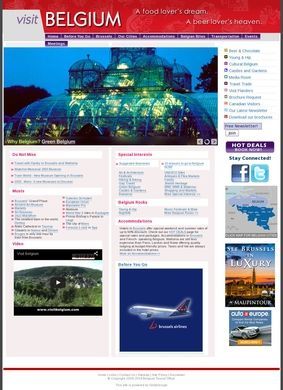
Visit Belgium opens by asking a single question: which of the country's three regions do you want, Wallonia, Brussels, or Flanders? Pick one, and the site sends you straight to that region's own official tourism board. That routing is the whole idea of the place, a national front door that sorts arriving travellers before pointing them deeper.
It is a gateway, not a travel agency. Visit Belgium does not sell a hotel or a package. It points a visitor at the authority that runs tourism for the region they chose, and then steps back.
The landing page sets the tone with a short welcome: "Welcome to Belgium! We're delighted that you have chosen us for your next holiday. Discover our surprising regions and let yourself be seduced by all Wallonia, Brussels & Flanders has to offer. Select your destination and start your..." The copy is warm and a shade florid, and it closes, fittingly, by telling the reader to select a destination and begin.
The intended reader is easy to picture: someone in the early, undecided phase of planning a Belgian holiday, still weighing the regions against one another before booking a thing. For that person, Visit Belgium carries a specific value a plain search does not. It guarantees the next click lands on a real regional tourism authority and not a lookalike travel site dressed up to seem official.
A gateway split into three regions
Belgium organises its tourism regionally, and Visit Belgium is built directly around that fact. Each of the three regions keeps its own tourism authority: Wallonia has VISITWallonia, the north is served by the Tourist Office for Flanders and Brussels, and the capital sits behind visit.brussels. The portal's job is to get a traveller to the correct one of those three without making them guess which body covers where.
That model earns its keep once you see how differently the three regions present themselves. Someone drawn to the medieval Flemish art cities is planning a different trip from someone heading for the forests of the Ardennes in Wallonia, and a blended national feed would serve both of them badly. Visit Belgium avoids that trap by refusing to flatten the country into one generic stream and instead moving each visitor toward the region-specific material that suits their plan.
There is a quiet efficiency to the approach. A first-time visitor rarely knows that Belgian tourism is run in three parts, and the portal spares them from learning the administrative map before they can start reading about beaches, battlefields, or breweries.
Aggregation is the entire service, and it is a more useful one than it first appears. The three regional boards each keep deep, separately branded sites, and a traveller who does not already know their names would struggle to find all of them and to tell the official ones from imitators trading on the same keywords. Visit Belgium collapses that whole search into a single trustworthy hop, which is the plainest reason to begin here.
Wallonia, Brussels, and Flanders as separate doors
Treating the three regions as separate doors is the sensible call for a country arranged this way. The Wallonia board covers the French-speaking south and its countryside; the Flanders and Brussels office covers the Dutch-speaking north and the historic centres; and the capital is handled on its own bilingual terms. A single national site would have to paper over three genuinely distinct tourism operations, and Visit Belgium sidesteps that by handing off cleanly to each of them.
The language line runs through the whole arrangement, French in the south, Dutch in the north, both in the capital, and a portal that ignored it would push very different audiences down one undifferentiated funnel.
The payoff for a traveller is reaching an official source fast. Whatever a given regional board publishes, its events, its routes, its seasonal advice, sits one step beyond the portal instead of behind a layer of national marketing that would only have to send them onward anyway.
How the portal serves a trip planner
As a planning tool, Visit Belgium is best understood as a first stop, the page a traveller opens before deciding whether the trip is about canals and Flemish paintings or hiking and quiet river valleys. It lays out the shape of the country, three regions and three authorities, then routes the reader to the right one and gets out of the way.
The obvious limit follows from the design. The depth is not held here. Visit Belgium keeps the regional overview and the hand-off, while the itineraries, the listings, and the fine practical detail all live on the regional boards it links to. Anyone hoping to plan a whole trip inside one site will need to follow those links, which is exactly how a gateway is meant to work.
What Visit Belgium gets right is knowing what it is. It does not pad itself out with thin national listings that would duplicate the regional boards and age badly. It stays a router, and a router that sends people to authoritative regional sources is worth consulting precisely because it does not pretend to be the destination.
A larger portal might try to host everything itself, the bookings, the reviews, the listings, and end up a stale mirror of the boards it draws from. The gateway choice avoids that decay. Because the real material stays with the authorities who maintain it, whatever a visitor eventually reaches is as current as those boards keep it, which is the strongest practical argument for starting at a router of this kind.
None of this makes the portal a place to linger. It is a threshold, and the measure of a good threshold is how quickly it moves you through. On that test it does its job, sending a would-be visitor onward with a clear sense of the three-way choice ahead.
The welcome and the select-your-destination step
The core interaction is small but well judged. A visitor reads the welcome, picks Wallonia, Brussels, or Flanders, and is passed onward. That one choice does the work of a whole navigation menu, and it matches how most travellers approach Belgium, by region before anything else. For a country whose appeal is genuinely split three ways, turning that split into the primary control is a tidy piece of design, and Visit Belgium leans on it without cluttering the page.
Lonely Planet's Belgium coverage offers more inspiration and more opinionated picks, the ranked sights and ready-made itineraries a router like this one deliberately skips. What Visit Belgium offers instead is proximity to the source: a straight line to the country's own regional boards rather than a publisher's editorial shortlist, a launch pad to open before the real planning starts on the Wallonia, Flanders, or Brussels pages themselves.