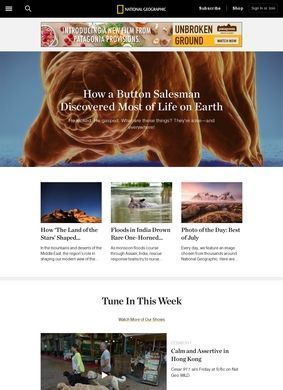
The yellow-bordered magazine most people picture is now one node in a sprawling Disney-owned media operation, and the website makes that scope obvious within a single scroll. National Geographic publishes across six editorial verticals: Health, Science, History and Culture, Environment, Travel, and Animals. The current homepage pushes a print issue, so the magazine still anchors the brand, but the site around it has grown into something closer to a full content network than a periodical with a web presence.
Editorial verticals across six subjects
The reporting runs deeper than headline aggregation. National Geographic produces long-form features and investigative pieces, photo essays that lean on the photography the brand built its name on, video documentaries, podcasts, and interactive graphics. Educational crash courses sit alongside the journalism, which signals an intent to teach as much as to report. A reader who lands looking for one shark article can fall into a chain of related science and conservation pieces without much effort, and the breadth of subject matter is genuinely wide with each section carrying real weight.
From subscriptions to guided expeditions
National Geographic does not hide that it is a commercial enterprise. Print and digital magazine subscriptions are sold directly, and the site routes interested readers toward National Geographic Expeditions, the guided cruise and adventure-travel arm that turns editorial wanderlust into booked trips. That pivot from article to itinerary is handled openly, which is more honest than burying the upsell.
Behind the shop and streaming tie-ins
The commerce does not stop at travel. Shop Nat Geo sells branded merchandise, Nat Geo Maps offers cartographic products that tie back to the organization's long history of mapmaking, and there are live events plus museum visits for people who want the brand in physical form. Streaming gets its own lane: the site links out to Disney+ for series like "Secrets of the Bees" and "Sharkfest," so the documentaries are positioned as a gateway to a paid platform rather than free watching on-site.
A separate kids site
For families, kids.nationalgeographic.com runs as a separate destination built around educational children's content, which keeps the younger material out of the way of the main editorial flow. It is a sensible split, and it means a parent can point a child at a walled section without worrying about what else is one click away.
Underneath the storefront sits the part that distinguishes this operation from a pure media company. National Geographic Society's conservation mission is promoted through donation options, and the nonprofit framing is woven into how the site presents its science and environment work. Whether a visitor reads that as mission or as marketing will depend on their own priors, but the funding pitch is at least placed in the open next to the journalism it supports.
Careers and social media reach
Careers live under a "Work at Nat Geo" section, and the social footprint is about as complete as a publisher's can be: Instagram, Facebook, Twitter/X, YouTube, TikTok, LinkedIn, and even Reddit. A newsletter signup sits on the homepage for anyone who wants the editorial pushed to them rather than going looking. The spread across platforms fits an organization whose photography and short video translate well to feeds, and it explains how National Geographic stays visible to people who never open the magazine at all.
What the site does well is keep all of these arms legible at once. The journalism, the subscriptions, the expeditions, the shop, the maps, the streaming tie-ins, and the donation appeals coexist without the editorial reading like an extended advertisement, and the navigation lets a visitor pick a lane and stay in it. The trade-off is density. Someone arriving for a single quiet read has to step past a fair amount of commerce and cross-promotion to get there, and that noise is the price of a brand this diversified putting everything under one roof.
Reference tool for curious readers
The educational layer changes who the site is for. Between the crash courses, the kids' subdomain, and the explanatory graphics, National Geographic functions as a reference for students and curious general readers as much as a magazine for subscribers. That dual role (teaching tool and consumer brand) is unusual to hold together, and the site manages it without either side obviously starving the other. Anyone browsing a business directory of media publishers would be hard pressed to name another organization holding both functions at this scale.
Where travel writing meets sales
Travel coverage is where the editorial and the commercial blur most. The Travel vertical reads as genuine destination journalism, yet it sits a short hop from the National Geographic Expeditions booking funnel, so inspiration and sale share a corridor. A reader can take the writing on its own terms or follow it to a paid trip, and National Geographic leaves that choice to the visitor without forcing the handoff.
The question worth carrying away is less about whether the content is good (the depth and the photography answer that plainly) and more about what a given visitor came for. National Geographic is trying to be several things to several audiences on a single domain, and for the most part it pulls that off without any one arm visibly dragging on the others.