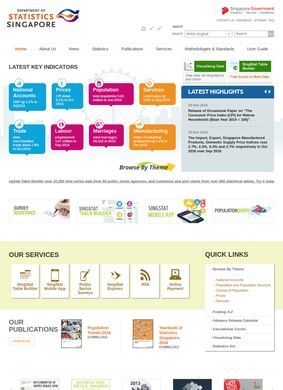
Someone needs the latest inflation figure for Singapore, or the resident population count, or a clean breakdown of household income by decile, and they need it in a form they can actually cite. That is the moment the Department Of Statistics Singapore becomes the place to land. Known in short as SingStat, it is the country's national statistical office under the Singapore Government, and it carries the numbers that government agencies, researchers, journalists, and ordinary curious people end up needing. Where a quick web search throws back secondhand summaries and out-of-context charts, this is the primary record those summaries are built from.
Singapore's official statistics office
The coverage at the Department Of Statistics Singapore is broad in the way a national statistics office has to be. Data themes run across Economy and Prices, Industry, Trade and Investment, Population, Households, and Society. That spread means a single visit can answer both an economist's question about trade flows and a sociologist's question about household composition. The figures are official, which is the whole point: when a number comes from the Department Of Statistics Singapore, it sits at the top of the credibility chain for anything about the country.
Inside the SingStat Table Builder
The tool that does the heaviest lifting is the SingStat Table Builder. It opens up more than 2,500 customisable datasets, pulled together from 70 public-sector agencies, and behind those datasets sit over 150,000 individual data series. The number matters less than what it means in practice: you are not stuck with whatever pre-baked table an editor decided to publish. You pick the variables, the time range, and the slices you want, and you build the table you need. For anyone who has ever had to reverse-engineer a chart because the underlying figures were locked away, that kind of access changes how the work gets done.
How do SANDRA and BITE differ?
Then there is SANDRA, an AI-powered semantic search assistant from the Department Of Statistics Singapore that takes plain-language questions and runs them against the statistical database. It is a sensible answer to a real problem, since a first-time visitor rarely knows the exact table name or series code for what they are after. Being able to ask in ordinary words and get pointed to the right data lowers the wall that big statistical portals usually put up. The Business Insights Tool for Enterprises, BITE, goes the other direction: dashboard-style analytics aimed squarely at business users who want trends and indicators packaged for decisions, not a raw export to wrangle.
Researchers get their own door. The Anonymised Microdata Access Programme, AMAP, hands over unit-record microdata under controlled conditions, which is the level of detail serious academic and policy work depends on. Aggregate tables tell you what happened on average; microdata lets you study the distribution behind the average, the outliers, the interactions. That the Department Of Statistics Singapore runs a formal programme for it, with controls attached, points to an office that takes both research utility and respondent confidentiality seriously. Alongside that sit sampling services for household surveys and the machinery for running national surveys with public participation, the unglamorous groundwork that makes the headline figures trustworthy in the first place.
A quieter but genuinely important part of the work is the classification standards. The Department Of Statistics Singapore publishes and maintains the country's official national standards: SSIC for industry, SSOC for occupations, S-COICOP for consumption, plus educational, trade, and environmental classifications. These are the reference frameworks that let one dataset talk to another and let Singapore's numbers line up against international ones. The SSOC Search tool makes the occupational classification directly searchable, which saves real time for anyone coding survey responses or building a compliant dataset. International data dissemination standards are upheld across the Department Of Statistics Singapore, so the figures travel beyond the country's own use.
Explaining statistics for everyday readers
For people who are not statisticians, the Department Of Statistics Singapore puts effort into explanation rather than leaving the public to guess. The "Let Us Explain" infographic series takes topics that get tossed around loosely in conversation, inflation, shrinkflation, trade, household income, and lays them out in a form a general reader can follow. Shrinkflation in particular is the kind of thing everyone has noticed at the supermarket and few can define precisely, so seeing the national statistics office address it directly is a smart use of the platform. It treats the public as an audience worth informing in their own right. That instinct gives the Department Of Statistics Singapore a public face that most national offices never bother to build.
The Department Of Statistics Singapore does not pretend that all statistics are settled and final. It carries Experimental Statistics, which are figures still being developed and tested, and it is upfront about labelling them that way. A less careful office would quietly fold provisional numbers into the main tables; flagging them lets users judge how much weight to place on them. There is also a dedicated stream for Singapore's Sustainable Development Goals data, tracking the country against the UN framework, and a body of International Statistics for comparative reference, so a user can set Singapore's figures next to other countries without leaving the Department Of Statistics Singapore. That comparative layer is easy to overlook, because so many questions about a country only make sense against a benchmark.
From experimental data to global comparisons
Taken together, the audiences served are wide: policymakers who need the official basis for decisions, government agencies that feed and draw on the same data, researchers after microdata, businesses watching indicators, and the general public looking for a straight answer. What is striking is how differently each group uses the same underlying material. A policymaker pulls a series from the Table Builder, a business opens BITE, an academic applies through AMAP, a student reads "Let Us Explain", and a casual visitor asks SANDRA a question in plain English. One body of data, several front doors, each shaped to a different level of expertise.
The Department Of Statistics Singapore is, in the end, infrastructure. It is not a site people visit for entertainment or browse on a whim; it is where you go when you need the real figure and you need it sourced properly. The depth on offer, 2,500-plus datasets, 150,000-plus series, 70 contributing agencies, is the kind of scale that only a national statistical authority can assemble and keep current. For Singapore, this is the spine that data journalism, academic research, and public policy all lean on, and the tooling has been built with awareness that its users range from professional statisticians to people who just heard the word shrinkflation and wanted to know what it actually meant.
One detail that says a lot about the priorities here: the classification standards and the microdata programme are given the same prominence as the flashier AI search and dashboards. An office chasing attention would push SANDRA and bury the SSIC documentation. Putting both forward, the practical reference plumbing and the modern query tools, is the mark of a place that understands its actual job is to stay useful across decades. The Department Of Statistics Singapore reads as built for the analyst who will return to it a hundred times, and the data series sitting under the Table Builder will still be there, consistent and comparable, when they do.