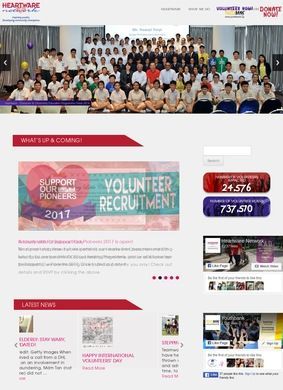
Heartware Network is a Singapore-registered charity, established in 2000 and holding Institution of a Public Character status, that channels young volunteers into community service. The programs are built around youth doing the actual work: tutoring children, visiting elderly residents, running literacy sessions. Its stated mission is to ignite values, character and skills in young people so they go on to create impact, and the site frames almost everything through that lens, treating the young volunteer as much as the beneficiary as the point of the exercise.
That framing is worth noticing, because it shapes how the whole operation is described, from the program names down to the way success is measured.
The IPC status matters more than it might look. It means donations are tax-deductible, and that Heartware Network meets a governance bar Singapore sets for public-facing charities, which is a stricter test than simply being registered as an entity. For anyone weighing whether to give time or money to Heartware Network, that standing is a real starting point, not a self-awarded label. It does not vouch for how well any single program runs, but it does say the organisation has cleared a public accountability threshold, which is more than an unregistered group asking for donations can claim.
Programs built around youth volunteering
The work sorts into a few clear streams, each aimed at a different stage of a young person's involvement. Heartware Network runs them as a progression, moving someone from a first volunteering shift through leadership and eventually into mentoring the next intake. That structure is deliberate, and it is more thought-through than the open-ended volunteer sign-up many charities settle for.
Youth development and support for pioneers
Youth Development is where Heartware Network starts most volunteers. It covers tuition programs for disadvantaged children, support for the elderly, and literacy initiatives, the hands-on service that gets people through the door and into contact with the communities being helped. Running alongside it, the Support Our Pioneers Programme directs help toward elderly beneficiaries, the older generation Singapore refers to as its pioneers.
Between the two, Heartware Network keeps a clear focus on the people it says it serves: disadvantaged children, elderly residents, and low-income families. There is nothing vague about who benefits, and that specificity is a point in its favour. A charity that can name its beneficiary groups plainly is usually one that knows what it is doing on the ground.
Leadership, entrepreneurship and Youthbank
Past the first shift, the programs get more ambitious. Under Youth Leadership, Heartware Network trains community champions and builds practical skills, and Youth Entrepreneurship runs business mentorship through Youth Business Singapore, a concrete, named partner. The idea is that a volunteer does not simply turn up and leave, but grows into someone who can lead a project and later coach the people coming up behind them. That progression is the sort of thing many volunteering programs claim and few actually structure, so having named tiers for it counts for something.
The connective tissue across all of it is Youthbank 4.0, a central portal that matches volunteers to opportunities. That portal is the piece that makes the rest workable at any scale, because a charity built on volunteering lives or dies on how easily a willing person can find something useful to do on a free afternoon. Heartware Network putting a matching system at the centre is a sound design choice, the kind of infrastructure a lot of smaller charities never manage to build and end up improvising with spreadsheets and group chats.
A portal like Youthbank also lets Heartware Network scale without the coordination collapsing, since a new volunteer can self-serve into an opportunity instead of waiting on a coordinator to place them by hand. For an organisation whose whole model depends on turning goodwill into scheduled hours, that piece of plumbing is arguably the most important thing on the site.
Version numbering it, at 4.0, also hints that the tool has been rebuilt more than once, which is a small sign the charity treats it as core infrastructure and keeps investing in it.
How it presents itself and how it is seen
The Heartware Network site is current and maintained, carrying recent statistics and blog posts, so this is a live operation and not a dormant page that someone forgot to take offline years ago. How it comes across on contact and on outside review is a more mixed matter, and the two sides pull in noticeably different directions.
Reaching the network
Contact is straightforward, which counts for a lot with a charity asking for money and time. Heartware Network lists a full street address in Singapore, a phone number, and a contact page, with the address specific down to the unit number.
Social channels are plentiful too, with Instagram, TikTok, Facebook, LinkedIn, YouTube and Telegram all linked from the site. For a charity like Heartware Network that depends on recruiting young volunteers, being reachable across the platforms those volunteers already spend their days on is exactly the right instinct, and it suggests an outfit paying attention to how its audience actually communicates.
A physical address that specific also lets a would-be volunteer or donor confirm the organisation exists somewhere real, which quietly does more for trust than any mission statement.
What the outside ratings say
Independent feedback is sparse, and what exists is less flattering. On Glassdoor, which collects employee reviews rather than beneficiary or donor opinion, the ratings for Heartware Network sit low, landing somewhere between 1.5 and 2.5 out of five across different snapshots of the same company page, drawn from a couple of dozen reviews. Those speak to what working there is like, not to the quality of the community programs, and the distinction is worth holding onto before anyone reads too much into the number.
It is a common trap to treat any low score attached to a charity's name as a verdict on its mission, when a Glassdoor page is really a staff survey. Still, a rating that low across two dozen employees is not nothing, and a prospective volunteer or job applicant would be right to ask what sits behind it first.
The wider public record is scarce. The Heartware Network Facebook page carries only two reviews and no settled rating, and there is nothing resembling a large body of feedback from the volunteers or families the work touches. So the outside picture is small, and the sharpest part of it points squarely at staff experience rather than at what beneficiaries received.
That leaves a genuine tension worth sitting with. The mission of Heartware Network is clearly stated, the programs are specific and named, the contact details are open, and the charity is registered and active, all of which reads honestly and well. Set against that, the only third-party voices currently on record are low-scoring employee reviews, and there is almost no independent word from the young volunteers or elderly and low-income beneficiaries the work is meant to reach.
Whether those low staff ratings signal something that touches the programs themselves, or simply reflect the ordinary strain of running a lean charity on tight funding, is the question this listing cannot settle on the evidence in front of it. A donor comfortable with the registration and the clear mission might give and never notice a problem; a job applicant reading the same page would be wise to weigh the employee scores harder, because those reviews are speaking directly to them. The two visitors are looking at the same organisation and should walk away with different amounts of caution.