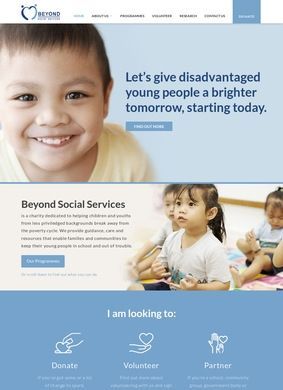
Family Circles, the peer-support groups that sit at the centre of Beyond Social Services, are a good place to start, because they tell you what kind of charity this is. Instead of running a relief office where families queue for handouts, Beyond builds small circles of neighbours who already know each other and helps them pool support, advice and small sums of money. Beyond works out of 26 Jalan Klinik in Singapore and describes its method as asset-based community development, which in plain terms means it starts from what a poor neighbourhood already has rather than what it lacks. That single choice colours almost everything else on the site.
Programmes reaching families and youth
The numbers it reports are not small for a community charity: more than 3,000 families and around 7,500 young people from disadvantaged backgrounds. Those figures give the programme list some weight. There is the Community Tabung, a pooled fund that members draw on; Health Competence work aimed at helping families manage their own wellbeing; and a Community Enabler Fellowship that reads like an attempt to train local residents to lead instead of bringing in outside professionals. Bakers Beyond teaches baking and related skills, while Community Theatre and the Arts and Sports Interest Groups give young people something to belong to.
I find the Tabung the most interesting of the lot, since a fund that the community itself administers is harder to run well than a grant scheme, and Beyond is honest enough to present it as ongoing work rather than a finished success. Taken together, these programmes show an organisation that prefers building local capacity to delivering services from above.
Comparing ways to get involved
Engagement is laid out in three plain modes. You can donate, volunteer as an individual or bring a group, or partner as an institution, covering schools, government bodies, welfare organisations and other community groups. An organisation that lists government and welfare bodies among its regular partners is operating inside Singapore's social-services network, not at the edge of it. Donations route through the giving.sg platform, the standard channel for registered Singapore charities. Beyond also runs a CRM portal at a separate subdomain for staff and volunteers, the kind of back-office tooling a smaller outfit often skips.
Employee reviews across platforms
On Glassdoor, Beyond holds 4.6 out of 5 across 23 employee reviews, with everyone who left a rating saying they would recommend it. That is a strong internal verdict for a non-profit where pay rarely competes with the private sector. Indeed carries a much larger pool of 183 employee reviews, though the score was not visible in what I could access, so I will leave that number alone. A couple of ratings on Carousell sit at the top of the scale, but with only two data points there is not enough there to read.
Set against that, a listing on asiafirms drew four reviews that came out mixed, including at least one unhappy volunteer account. One sour note among generally warm feedback proves little on its own, yet it is worth noting, because the gap between how staff rate a place and how an occasional volunteer experiences it is exactly the seam where community organisations tend to fray. A model built on residents leading residents lives or dies on the quality of those local relationships, and an outsider dropping in for a day may simply not see the part that works. What Beyond cannot do is make that one account disappear, and a careful reader will weigh it.
Contact details are easy to find and complete. A phone line, a general email and the physical address all sit on the site, and the Facebook and Instagram profiles are linked too, so anyone wanting to check the organisation's recent activity has somewhere to look. For a body asking the public for money and time, that openness is the baseline, and Beyond clears it without fuss.
What do outcomes actually show?
What the site does less well is convey outcomes. The programme descriptions explain method and intent clearly, and the participant numbers are stated up front, but a visitor looking for evidence of what changes for those 3,000 families, beyond the activities themselves, has to take a fair amount on trust. That is a common shortfall in the charity sector and not unique to this one. Still, for an organisation that has chosen a harder, slower model than straight relief work, the absence of plainly reported results is the thing I kept circling back to. A donor wants to know that the method moves the numbers, and Beyond states the inputs more confidently than the outcomes.
As a registered charity with a coherent philosophy, deep roots in one Singapore neighbourhood and a genuine network of institutional partners, Beyond is clearly an organisation with real depth behind it. The asset-based approach is more demanding than the giving model most donors picture, and there is something to respect in an outfit that picked the harder road. The staff reviews are warm, the institutional backing is real, and the programme scope is broader than most neighbourhood charities manage. The gap in the public-facing case is outcome evidence, and that gap is the honest limit of what the site can settle for a prospective donor or volunteer. Go in expecting to ask direct questions about results, and Beyond gives you enough to make those questions worth asking.