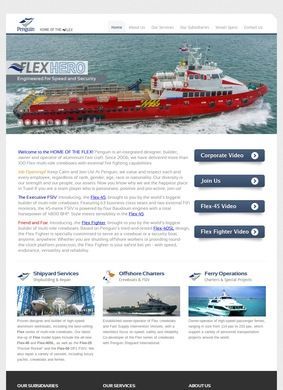
A crew has to reach an oil platform sitting miles offshore, fast, in a swell, and the helicopter is either booked solid or grounded by weather. That is the job a crewboat exists for, and designing, building and running those boats is what Penguin International Limited does. The Singapore company builds aluminium high-speed craft, owns them, and charters them out to the offshore energy industry in some of the busiest and roughest waters going. It works both ends of the trade, as the yard that makes the boat and the operator that sends it out to earn.
What the company builds and runs
The business stands on three legs: a pair of shipyards, a fleet chartered abroad, and a home fleet working Singapore's own waters.
Each is a separate operation, and together they explain how Penguin can call itself the world's largest builder of IMO-registered aluminium commercial vessels, which is the self-description the site puts up front. That claim is the company's own, and worth reading as a claim, but the structure behind it is concrete enough to weigh.
Shipyards in Singapore and nearby Batam
The shipyards are the foundation. Penguin runs aluminium shipbuilding and repair yards in Singapore and across the strait in Batam, Indonesia, which is a sensible division of labour: Singapore for the engineering and high-end work, Batam for the lower-cost hull fabrication that eats up hours.
A yard that both builds and repairs also keeps its own chartered boats serviceable without handing the work, and the margin, to a competitor. For a company that owns the vessels it sells passage on, that is a real operational edge, and it is the kind of vertical setup a customer can reason about.
The Global Fleet for offshore charter
The Global Fleet is the earning side. These are oil-and-gas crewboats and armored security vessels put out on charter, managed from ship-management offices in Kuala Lumpur, Dubai, Port Harcourt and Takoradi. That list of cities tells you where the money and the risk are.
Port Harcourt and Takoradi sit on the West African coast, where offshore oil and piracy overlap, and where armored vessels are a working requirement. A firm with offices in Dubai and two West African ports is chasing the charter market at its hardest and most demanding, and being physically present in those places, with people and boats, says more than a sales page ever could.
Vessels with names and a home fleet
A shipbuilder is only as convincing as the boats it can point to. Here the site names them plainly, and named models can be checked against class registers and charter records by anyone who cares to look.
Named craft, from Flex Fighter to Pelican Peace
The crewboat range carries model names like FLEX FIGHTER MAX, FLEX-42X and FLEX-40X, and there is a hybrid oil-and-gas crewboat called Pelican Peace. Naming specific hulls and classes counts for a lot, because anyone in the industry can verify whether a FLEX-42X exists and who is running one.
It puts the claims on the water where they can be tested. Penguin is willing to be specific about its products, which is more than many asset-heavy operators bother to be.
Electric ferries across Singapore's piers
The home fleet is a different bet altogether. Penguin runs pure electric passenger ferries for inter-island transport from several Singapore piers, among them a 200-passenger battery vessel, and they have been in daily service for a while now. Putting its own electric ferries into passenger service moves the firm onto the public-facing side of the water, well away from crewboats off West Africa.
For a yard best known for fast aluminium workboats, a fleet of battery-powered commuter ferries is a genuine change of direction, and operating them itself means it has to live with whatever it builds, every sailing, in front of paying passengers.
Standing and what can be checked
One thing that lends Penguin real credibility is that it is a public company. Its shares trade on the Singapore exchange under the ticker BTM, and it discloses a company registration number on the site, both of which put its finances and its very existence on the public record in a way a charter customer can independently confirm.
A contact page exists as well, though no phone number, email or street address surfaced on the pages that were checked. That is a small oddity for an operator of this size, and a would-be charterer would have to work through the contact form to get past it.
Outside reviews are scarce, and most of what exists points inward rather than at the product. A Facebook page for Penguin Shipyard International shows 92 percent of a small pool recommending it, off ten reviews. A second company page carries no ratings at all. Past that, the material is employee feedback: Glassdoor holds mixed staff reviews with no clear aggregate score, and JobStreet lists an overall employee rating of 2.8. No Google, Trustpilot or customer-review platform rating specific to the company came up in the search.
So the shipbuilding story Penguin tells is solid and checkable, and the doubt sits somewhere else. Employee reviews are a weak proxy for whether the boats perform, but a 2.8 staff rating and mixed Glassdoor sentiment are the loudest independent signals on offer, and there is almost nothing from the actual charter customers to set beside them. A shipyard's real reputation should live in whether its clients charter again, and that is exactly the evidence missing here.
Whether the wider world simply does not review commercial shipbuilders, or whether the silence is itself the answer, is something a charterer would have to weigh on their own.