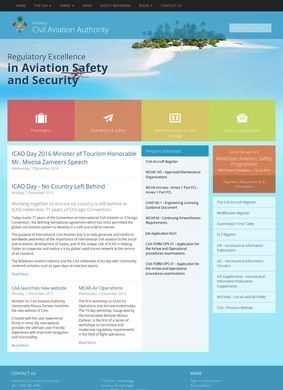
Every airline that flies over the Maldives, every drone that lifts off above an atoll, and every pilot who holds a Maldivian licence answers to one regulator, and the Maldives Civil Aviation Authority is it. The site reads exactly like what it is: the working desk of a national safety regulator, where the documents that govern flight in Maldivian airspace get published, revised, and handed out. There is no marketing gloss, and there should not be. What you get instead is the body of rules and the channels to comply with them.
Regulations and safety circulars
The spine of the whole thing is the regulatory library. The Maldives Civil Aviation Authority issues the Maldives Civil Aviation Regulations, known as MCARs, alongside a parallel set of Civil Aviation Requirements, the CARs, and the site is where both live. Air Safety Circulars sit with them. If you operate, crew, or maintain anything that flies in the country, these are the texts that decide what you may do, and pulling the current version straight from the regulator instead of a third-party reprint avoids the problem anyone encounters who has cited a clause that had quietly been superseded.
Aircrew licensing and certification
A large share of what the Maldives Civil Aviation Authority does is the certification of people. Aircrew licensing runs through here: the programmes for issuing, renewing, and validating the credentials that let someone legally sit in a cockpit or perform a regulated aviation role. The site lays out what each licence demands and how to apply, the kind of practical scaffolding a working aviator returns to repeatedly rather than reads once. Certification is the slow, paperwork-heavy backbone of safety, and putting the requirements and the application route in the same place reduces the gap where mistakes usually creep in, between knowing the rule and acting on it.
AviatorsNG platform for digital applications
What moves this past a simple document store is AviatorsNG, the online platform the Maldives Civil Aviation Authority points professionals toward for licensing and certification services. Instead of paper passed across a counter, the intent is a digital route for applications and the records that go with them. A platform like this lives or dies on whether it stays in step with the regulations published a click away, and a regulator hosting both under one roof at least has no excuse for letting them drift apart. For a licensee, the difference between an online submission and a counter visit is measured in days and travel across water, so moving certification onto a portal is not cosmetic in this geography; it is the part of the service that respects the user's time.
Oversight and appeals processes
Around the licensing core sit the oversight functions. Airworthiness and flight operations both fall to the Maldives Civil Aviation Authority, meaning it is the body that decides an aircraft is fit to fly and that the way it is flown meets the standard. Appeals and exemptions get their own processes too, so an operator who disagrees with a ruling, or who needs formal relief from a specific requirement, has a defined path instead of a dead end. That structure struck me as quietly reassuring; a regulator that only ever says yes or no, with no room to contest a decision or to seek an exemption on stated grounds, would be a worse one. The Maldives Civil Aviation Authority leaves that room.
Unmanned aircraft approval channel
Drones get explicit treatment, more current than a lot of aviation regulators manage. Operators who want to put an unmanned aircraft in the air can apply for flight approval directly through the site. In a country built from hundreds of low-lying islands where aerial survey and photography are genuinely useful, a named official channel for drone clearance is a convenience and a safety measure at once, since the alternative is people flying without telling anyone. Tourism, resort construction, and marine work all generate demand for drone footage, and a clear approval path keeps that activity inside the system instead of pushing it underground. The Maldives Civil Aviation Authority chose to name that channel rather than leave it implied, and that choice tells you something about how it wants to be dealt with.
The authority also looks outward to passengers, beyond the industry it regulates. Passenger information resources serve the travelling public, the people who never read a regulation but still benefit from one office being accountable for how safely they move through the air. It is a reminder that the regulator's remit ends not at the airline's hangar but at the person in seat 14C, and the Maldives Civil Aviation Authority builds for that person too.
Underneath all of this sits the investigative function, the part that gives a safety regulator its teeth. The Maldives Civil Aviation Authority handles accident and incident reporting and runs the investigations into what went wrong. That role is the reason the rest of the apparatus exists: rules without a body to examine failures and feed lessons back into those rules are just text. The Maldives Civil Aviation Authority closes that loop by owning both the regulations and the inquiries that test them.
Day to day, the site also carries the unglamorous but necessary material. Downloadable forms cover the applications and submissions an operator or licensee actually has to file, which is the sort of friction a regulator can either ease or aggravate, and collecting them in one shelf eases it. There is documentation supporting the various processes, operational statistics for anyone tracking the sector's numbers, and a news stream for changes and announcements. None of it is flashy, and the statistics in particular will matter far more to a researcher, a journalist, or an operator planning a route than to a casual visitor. By posting that data and those updates openly, the Maldives Civil Aviation Authority lets the people it regulates see the same numbers it works from.
The audience is as broad as the function demands. The Maldives Civil Aviation Authority serves aircrew and licensees, drone operators, airlines and air transport operators, and the ordinary travelling public, each finding a different door into the same building. As the competent authority under ICAO standards for Maldivian airspace, the Maldives Civil Aviation Authority is the country's single point of contact with the international framework that keeps aviation interoperable across borders, which is why its publications are the ones operators are bound to follow.
So the honest assessment is that this is a reference site doing a reference site's job. It will not entertain anyone, and a first-time visitor with no aviation stake may find it dense and procedural. For the people the Maldives Civil Aviation Authority is built for, though, the value is direct: the governing regulations, the licensing routes, the drone approvals, and the reporting channels, all issued by the authority that sets and enforces them. The depth on offer through the Maldives Civil Aviation Authority is the depth of the source itself, not a summary of it.
A pilot, an operator, an airline planner, or a drone flyer working in the Maldives has no real alternative; the rules, the licences, and the reporting all run through this one office. The Maldives Civil Aviation Authority rewards a visitor who knows what they came for, and offers little to one who does not. The published record is consistent enough to use as a working reference, and the Maldives Civil Aviation Authority has clearly built the site for people who treat it as one.