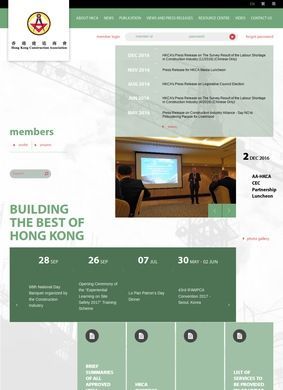
Hong Kong Construction Association is the trade body that speaks for contractors who build Hong Kong, from firms pouring tower foundations to small outfits handling repairs and alterations. Membership splits along clear lines: building contractors working on large structures, civil engineering firms tackling infrastructure, and RMAA companies that do repair, maintenance, alteration and addition work. That three-way breakdown tells you immediately who the organization is for, and it shapes almost everything else on the site.
Council structure and history
The governance side is laid out without much ornament. A Council sits at the top, supported by standing committees, and the structure reads the way you would expect from a body that has to represent competing interests inside one industry. Anyone trying to understand who holds influence in Hong Kong's contracting world can start here and get a usable picture. The site also walks through the association's history and its stated commitments to the trade, which gives context to why Hong Kong Construction Association exists and what it claims to stand for.
Members' project portfolio by sector
The part of the site worth returning to is the Members' Project Portfolio. Organized by sector (Building, Civil Engineering, RMAA, and a catch-all Others category), it functions as a public record of completed works by member firms. For a researcher, a journalist, or a client trying to vet a contractor, this is genuinely useful material. You can see what a company has built instead of taking a sales pitch at face value.
How sector categories divide the industry
The sector split does real work. Someone looking for a civil engineering specialist is not wading through small maintenance jobs, and a property manager after an RMAA firm is not staring at megaproject infrastructure. The categories map cleanly onto how the industry divides itself, which sounds obvious until you meet a resource that gets it wrong.
Behind the curated project record
What the portfolio amounts to, in practice, is a curated record across the whole membership rather than a single firm's marketing page. Hong Kong Construction Association puts its name behind every listing, which lends the record a degree of accountability. That said, the section is only as current as its last update, and the value depends on member firms keeping their submissions fresh. For anyone leaning on it heavily, that limitation is worth keeping in mind.
Industry representation and networking benefits
Beyond the portfolio, Hong Kong Construction Association presents itself as a membership platform offering industry representation and networking. For a contractor in Hong Kong, that representation is the core draw: a single voice that can engage on policy, standards and the shared concerns of an industry where individual firms rarely have the standing to be heard alone. The networking angle follows naturally, since the same membership that gives the body its voice also puts firms in the same room.
Who this resource does not serve
It is worth being clear about what this is and what it is not. Hong Kong Construction Association is an industry organization, so the content is institutional in tone and aimed at members and industry watchers more than at the general public. A homeowner looking to hire someone for a kitchen renovation will not find a consumer-friendly hire-a-builder tool here, and that is not the point of the place. The site reflects that focus honestly, and it does not pretend otherwise.
For its intended audience, the resource is solid. The membership categories are spelled out, spanning large building contracts, civil and infrastructure works, and the smaller maintenance and alteration projects that keep the city's existing stock standing. That spread is consequential because it shows Hong Kong Construction Association is more than the club of giant contractors. The smaller RMAA operators have a seat, which broadens the picture of who the body represents and makes its claim to speak for the industry more believable.
Is the portfolio kept current?
If there is a criticism, it is that an institutional site like this lives or dies on how actively it is maintained. The structure is sound and the categories are right, but the practical worth of Hong Kong Construction Association as a reference depends on member firms feeding it current project data and on the association keeping its committee and council information up to date. A static archive is far less valuable than a living one, and that is the standing question with any membership body that publishes member-supplied content.
On outside reputation, a search turns up no meaningful volume of independent reviews on the major platforms. That is not unusual for a trade association whose members are businesses rather than consumers, but it does mean you are working from the published record alone. What is there is consistent with what Hong Kong Construction Association says about itself: a serious body doing the unglamorous coordination work that an industry needs, and a site that supports that role without dressing it up in promotion.
Industry professionals will get the most from Hong Kong Construction Association. Civil engineers and building contractors weighing membership will find the representation and networking case made plainly, and anyone researching the structure of Hong Kong's construction sector gets a clear map of the players and how they are grouped. The project portfolio gives clients and observers a verifiable record of what member firms have built, which is harder to come by than you might think. For anyone outside the trade, Hong Kong Construction Association is not built to guide a casual visitor toward hiring a builder, and treating it as a consumer resource would miss what it is for entirely.