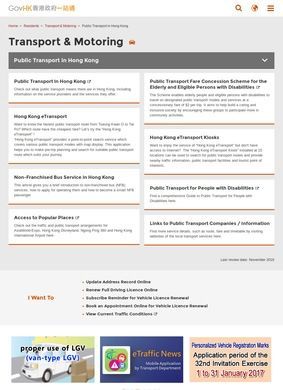
HKeMobility is what gives this government portal its day-to-day usefulness: a multi-modal journey planner that handles transit, driving and walking, with barrier-free routing for step-free paths. It pulls real-time estimated arrival times for buses, minibuses, trams, the MTR and ferries, feeds live traffic from roughly 980 cameras, and shows parking availability across around 700 car parks. That is a lot of moving data sitting behind one app link, and the page treats it as the practical front door to everything else.
HKeMobility journey planner
What the portal does is consolidate. The transport scene here is fragmented across many operators, and Public transportation in Hong Kong pulls the threads together: the MTR rail network, franchised and non-franchised buses, green and red minibuses, trams, ferries (cross-boundary services included) and taxis. For each mode the page points outward to the operator that runs it, where routes, fares and timetables live. So it functions less as a database and more as a switchboard. You arrive knowing you need a ferry schedule or a bus fare, and you leave on the right operator's site.
Operator links and switchboard model
That switchboard model has an obvious strength and a quieter weakness. The strength is coverage: every significant mode accessible through Public transportation in Hong Kong is accounted for, which is no small thing in a city where a single trip might chain together a minibus, a rail line and a tram. The weakness is that the page is only as current as the links it carries. A government index that hands you off to a dozen operator sites is making a bet that those sites stay accurate and reachable, and the portal cannot vouch for what happens once you click through.
Content for residents, commuters, visitors
The page is built for residents, commuters and visitors, and the material genuinely flexes for all three. A daily commuter wants live arrival times and camera feeds. A long-term resident wants the concession scheme and licence renewals. A visitor wants a single trustworthy place to understand a transport system that can look bewildering from the outside. Many official sites quietly underserve two of those three reader types. Public transportation in Hong Kong tries to hold all three at once, and for the most part the layout does not buckle under that demand.
Fare concessions and accessibility guidance
Where Public transportation in Hong Kong stops being a mere index is the policy material, and this is the part travellers tend to overlook. The Public Transport Fare Concession Scheme is explained here: residents aged 60 and above and eligible persons with disabilities can travel on designated modes at concessionary rates, surfaced in the hot searches as the "$2 flat rate or 80% discount" line. There is also guidance on non-franchised bus service licensing and applications, the kind of thing a tour operator or a school running its own coach would need and would struggle to find elsewhere. Accessibility information for people with disabilities sits alongside it, tied back to the barrier-free routing in the app.
The journey planner is where the portal moves from listing information to solving a problem. Live traffic from around 980 cameras and parking data for some 700 car parks are the sort of feeds that need constant maintenance to mean anything, and a static page could never carry them. By routing that work into a dedicated app, the portal keeps its own pages stable while the volatile, minute-by-minute data lives where it can be updated. Real-time arrival estimates spanning buses, minibuses, trams, the MTR and ferries cover nearly every mode a person would queue for, and the inclusion of walking and driving in the same search means the planner can handle the messy reality of a trip that is half public transit, half on foot.
Multilingual support for ethnic communities
The language support deserves more attention than it usually gets. Beyond English, Traditional Chinese and Simplified Chinese, the material is available in eight further languages: Bahasa Indonesia, Hindi, Nepali, Punjabi, Tagalog, Thai, Urdu and Vietnamese. That list is not decorative. It maps onto Hong Kong's ethnic minority communities, and it means a domestic helper from the Philippines or a worker from Nepal can read fare and concession rules in a language they use day to day. Plenty of official transport sites elsewhere stop at the national language plus English. Public transportation in Hong Kong reaches considerably further, and for the people it serves that difference is the gap between guessing and knowing.
The portal also folds in adjacent services that are not strictly about getting on a bus but sit naturally next to transport admin: vehicle and driving licence renewals, appointment booking, and flight information. None of these is the headline, and the page does not pretend otherwise. They read as sensible shortcuts for someone already browsing Public transportation in Hong Kong on the way to sorting out a bigger question.
One thing the page does quietly well is restraint. It would be easy for a government portal covering this much ground to drown the reader in notices and sub-sections, but the offering stays close to what a person needs to act: pick a mode, find the operator, plan the trip, check whether a concession applies. The non-franchised bus licensing guidance is tucked where the people who need it will look without cluttering the path for everyone else. That editorial discipline is rarer in public-sector sites than it should be, and it is a meaningful part of why Public transportation in Hong Kong functions as a usable hub instead of a wall of links.
Judged on what it sets out to do, Public transportation in Hong Kong performs well as a starting point. The architecture is honest about its own limits: it does not try to be the MTR's timetable or the taxi fare table, it routes you to where those things are maintained. For a visitor planning a first week, or a resident sorting out a concession card, the combination of the journey planner, the fare scheme explanation and the multilingual reach covers the questions that come up most.
Link freshness determines reliability
Still, heavy reliance on outbound links is the thing that nags. A consolidation page lives or dies by the freshness of what it consolidates, and what determines whether Public transportation in Hong Kong holds together is not how cleanly it lists the modes but whether every one of those operator links still lands on accurate, current fare and schedule data when someone in a hurry taps through. That is the part a single visit cannot confirm, and it is where the structure either delivers or quietly fails the commuter standing on a platform.