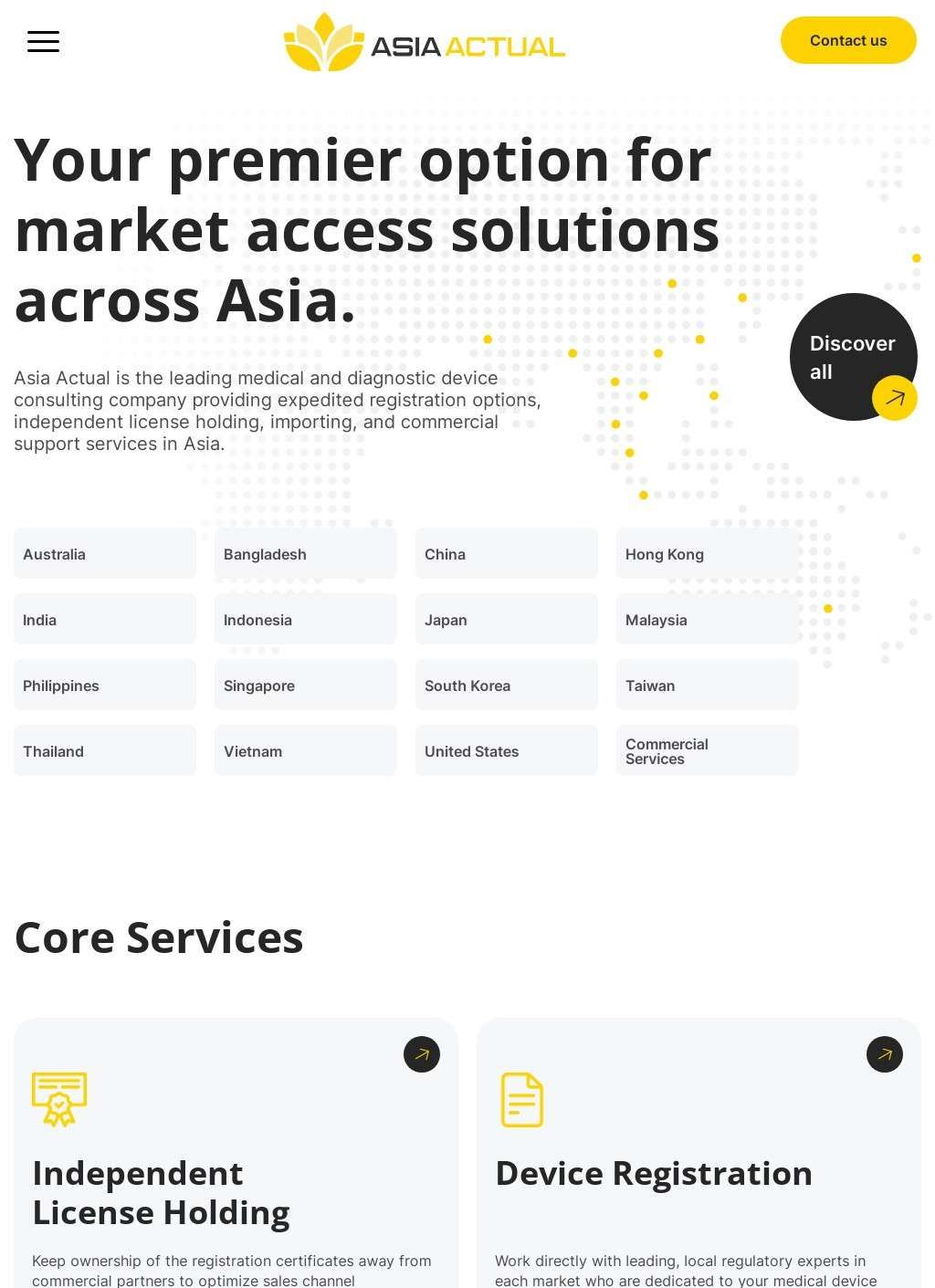
Asia Actual fills a narrow but critical gap for medical device makers trying to sell in Asia without a local licence, a local entity, or any grip on how Vietnamese or Indonesian regulators handle the paperwork. Asia Actual answers that question with a fairly specific job description: it is a regulatory consultancy that gets medical devices and IVD products registered and kept legal across 16 Asia Pacific markets, running from China and Japan down through Singapore, Thailand, the Philippines, and on to Australia and New Zealand. The firm operates out of Austin, Texas, with staff in major Asian capitals, and the work it describes is the unglamorous machinery behind market access: registration filings, renewals, customs clearance, and the ongoing reporting that keeps a product on the shelf.
Independent license holding
The piece of the Asia Actual offering that draws the most attention is independent license holding. Instead of letting a local distributor hold the registration certificate, Asia Actual holds it on the manufacturer's behalf, which keeps the regulatory approval separate from the commercial relationship. A manufacturer who falls out with a distributor in South Korea or China can otherwise find its product registration held hostage. Holding the certificate at arm's length protects the intellectual property and leaves the maker free to switch sales channels without re-registering from scratch. It is a narrow service, but it solves a problem that has burned plenty of exporters, and the site is clear about why it exists.
Device registration and customs clearance
Around that sit more conventional services. Device registration is handled with local regulatory experts for the initial submission, then maintenance and renewals. Post-market vigilance work covers the obligation that does not end once approval lands. Importing and customs clearance comes with per-shipment expense reporting, which any logistics-minded client will want to see spelled out. Asia Actual also offers commercial support for sales-channel disputes and a separate US Commercial Services line. The geographic spread is the headline though: covering Bangladesh, Sri Lanka, Hong Kong, Taiwan, Malaysia, and India alongside the bigger markets is a wide remit, and each of those jurisdictions has its own device rules that do not map neatly onto each other. Asia Actual makes no effort to downplay how complicated the patchwork is, which is a better sign than a consultancy pretending 16 countries operate on one framework.
Published regulatory guides and expertise
On the question of whether Asia Actual knows its subject, the published material leans the right way. The firm puts out annual regulatory summaries for 2023, 2024, and 2025, maintains a CMDE Medical Device-Specific Registration Guidelines resource and a glossary, and references a proprietary framework it calls R.O.S.E. Reference content of that sort is a reasonable proxy for competence, since a firm publishing a China CMDE guideline is at least working with the actual regulatory texts day to day. The consulting staff is described as bilingual with an average of 21 years of industry experience. That last figure is a claim the site makes about itself, so it reads as positioning more than proof, but it is at least a specific number instead of a vague boast.
Client testimonials build credibility
Credibility gets a useful lift from the named clients. The site carries testimonials attributed to companies including Penumbra and IceCure Medical Ltd, and named references from real device firms are worth more than anonymous praise because those names can be checked and the companies have reputations of their own to protect. The Asia Actual website includes an About Us section, a staff directory, a client list, a careers page, and a news feed, which together point to an established operation. A careers page in particular points to an organisation actively hiring people, not a one-person front.
Review ratings across platforms
Outside opinion is limited. Asia Actual carries a Birdeye profile with five reviews and a 4.6-star rating, plus two reviews on Best of the Web with no score attached, and a Glassdoor presence with employee feedback. Five reviews is not much of a sample, and a 4.6 average across that few is encouraging without being conclusive. No Google, Trustpilot, or Yelp footprint turned up. For a business-to-business regulatory firm that profile is not surprising, since satisfied clients in this field rarely write public reviews, but it does mean a prospective customer has limited independent data to weigh against Asia Actual's own polished case studies.
Contact transparency is where the picture gets murkier. The Austin headquarters address turns up through third-party listings, and Asia Actual clearly operates from offices across Asia, but the homepage did not surface a direct phone number or a named contact. A consultancy whose entire pitch is navigating bureaucracy and shielding clients from channel risk ought to make reaching it effortless, and on the evidence here that first step is less obvious than it should be. For a firm asking manufacturers to entrust it with their regulatory certificates, the path from a listing to a real person ought to be impossible to miss.
Pull it together and Asia Actual looks like a focused, knowledgeable firm with a genuinely useful niche service, real client names, and a steady stream of published regulatory content. Set against that is a public track record too small to confirm the impression and an entry point that is harder to find than the stakes warrant. The independent licence-holding model is exactly the service that wins loyal clients and exactly the service that goes badly wrong if the holder is anything less than rock solid. With only five outside reviews to weigh, a careful manufacturer cannot settle from what Asia Actual publishes whether that reliability holds in practice.