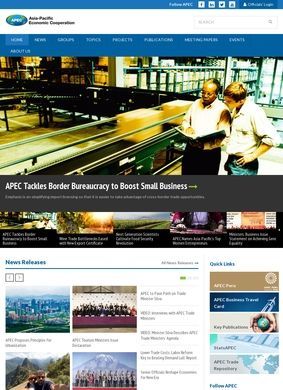
Policy Support Unit research that sits on this site gets cited in trade-ministry briefings, and finding it open to anyone is the first sign that the Asia-Pacific Economic Corporation runs its web presence as a working reference rather than a glossy front for an institution. The forum brings together 21 member economies across the Pacific rim, from the United States and China to Japan, Russia, Australia and Canada, and the site is built around the documents those economies produce together. Meeting calendars, ministerial statements, news releases and sector studies are all here, organized by the same program areas the forum negotiates inside.
Trade and investment standards
Start with the trade and investment material, because that is the heart of what the organization does. The pages cover automotive standards, the digital economy, intellectual property, customs procedures and the slow work of aligning regional regulations so a product cleared in one market does not have to clear an entirely different bar in the next. None of this is light reading, and the site does not pretend otherwise. What it gets right is putting the technical detail within reach instead of burying it behind a request form or a paywall, which is more than a few intergovernmental bodies manage.
Economic cooperation across sectors
Beyond trade, the economic and technical cooperation strand stretches across energy, health, tourism, telecommunications, support for small and medium enterprises, and programs aimed at women's economic participation. That breadth tells you something about how the Asia-Pacific Economic Corporation defines its remit: it treats cross-border commerce as inseparable from the conditions that let people take part in it. A researcher chasing a single thread, say SME development in member economies, will find working-group output and project records, not a press summary that stops at the headline. The depth is uneven across topics, which is honest enough given that some working groups simply publish more than others.
Capacity building with technical assistance
Capacity building runs alongside the policy work, with project funding and technical assistance documented for economies that need help implementing what the forum agrees. There is also a structural reform and competition policy track, plus a food security and agricultural development program. The food security pages are the clearest example of how the site connects a broad goal to specific, fundable projects, though a casual visitor could easily miss them because they sit a few clicks deep. The navigation rewards people who already know roughly what they are looking for more than it guides newcomers.
Inside the forum's structure
The governance section repays attention before going hunting for documents, because the forum's structure shapes how everything is filed. Senior Officials do the preparatory work between leaders' meetings. The Secretariat, based in Singapore, handles daily operations. The Policy Support Unit produces the research and analysis, and a long roster of sector-specific working groups feed into ministerial meetings. Once that map is in view, the way the site sorts its publications starts to make sense, and the Asia-Pacific Economic Corporation pages become much easier to navigate. The trade-off is that the structure is presented as the organizing logic, so a reader who does not care about which body produced what has to absorb some of that scaffolding regardless.
Economic scale of member economies
The numbers the forum represents put the scale of all this in context. Roughly 3 billion people live in the member economies, and together they account for about USD 57.5 trillion in GDP, close to 59.4 percent of global output. Those figures are not decoration. They explain why a standards-alignment decision or a customs-harmonization push out of Asia-Pacific Economic Corporation carries real consequence that a smaller bloc could not generate. The site does a reasonable job of letting the data speak without over-narrating it, presenting the statistics where they belong and moving on.
How the host-economy model works
For currency, the rotating host-economy model gives the site a natural rhythm. Each year a different member hosts the cycle of meetings, and the current and upcoming host activities get their own space, so the calendar and news releases stay tied to whatever the forum is actively working through. That makes the Asia-Pacific Economic Corporation site genuinely useful for tracking live developments instead of functioning as a static archive of past statements. The flip side is that the front-of-site emphasis can shift heavily toward the host's program, which means the steadier, year-round research can feel less prominent than it deserves to be in a given cycle.
Who uses this resource
Trade analysts, policy researchers, journalists covering Pacific economic relations, academics, and businesses trying to read where regional rules are heading will all find something concrete here. A student writing about intellectual property frameworks or digital-economy governance in the region can pull primary material straight from the source instead of relying on secondhand summaries. The Asia-Pacific Economic Corporation is not trying to be a general-audience portal, and it does not soften its language for one. That is a fair editorial choice for a body whose audience is mostly specialists, even if it leaves a curious outsider doing more work to get oriented.
If there is a real limitation, it is in presentation rather than substance. The Asia-Pacific Economic Corporation publishes a great deal, and the volume can overwhelm. Search and topic filtering help, but cross-referencing a single policy thread across working groups, ministerial statements and Policy Support Unit research still takes patience. Someone who knows the forum's vocabulary will move quickly; someone arriving cold will spend time learning the layout before the content opens up. Clearer entry points for non-specialists would help, the equivalent of a plain explainer that points to where the detailed documents live.
What the Asia-Pacific Economic Corporation site does well, it does without fuss. It hosts the actual output of a forum that shapes trade conditions for a large slice of the world economy, keeps that output current through the host-economy cycle, and makes primary documents available without gatekeeping them. The research is credible because it comes straight from the bodies that produced it, and the breadth across trade, cooperation, capacity building and reform reflects a serious mandate carried out in the open.
As a destination for primary material on Asia-Pacific economic policy, the Asia-Pacific Economic Corporation is hard to beat, and for anyone working in or writing about regional trade it is close to essential. The reservation is purely practical: this is a resource that asks visitors to meet it on its terms, with its structure and its specialist vocabulary, and it does little to ease a newcomer in. Come knowing what to look for and the Asia-Pacific Economic Corporation pages reward generously. Come browsing, and the impression left is of an institution talking mostly to people who already speak its language. That is an acceptable bargain for the specialists it is built for; for everyone else, it is the cost of admission to one of the better-stocked archives on Pacific economic affairs.