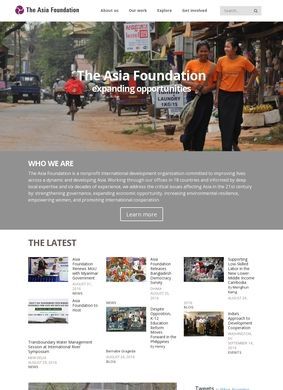
Founded in 1954 and headquartered in San Francisco, The Asia Foundation is a nonprofit international development organization with more than seven decades of program work across the Asia-Pacific. That longevity has consequences for what the site contains: this is not a startup pitching an idea. It is a body with a long record behind it and a clear account of where it puts its money and people. The work is organized into five areas, each treated as a distinct line of effort with its own targets and geography.
Governance and law
The first of those areas is governance and law, and it gives the clearest sense of how The Asia Foundation operates. The focus is on strengthening democratic institutions, supporting parliaments, building rule of law, backing civil society groups, helping run elections, and improving the day-to-day contact between citizens and the governments meant to serve them. None of that produces a quick headline. It is slow institutional work, the kind that takes years to show results, and the fact that The Asia Foundation names these specific targets instead of gesturing at "democracy" in the abstract tells you something useful about how it thinks.
Building democratic institutions
Economic development is handled as a separate track, aimed at inclusive and open economic governance, trade, and private sector growth. The pairing of governance with economics is sensible, because the two problems tend to feed each other: weak institutions hold back markets, and unaccountable markets hollow out institutions. Women's empowerment forms a third area, and environment and climate a fourth, both of which cut across the others in practice. The fifth is regional cooperation, which fits the organization's reach, since The Asia Foundation operates in South, Southeast, and East Asia and is positioned to work on problems that ignore national borders.
Economic development and regional work
What keeps these five areas from reading as a tidy list of buzzwords is the delivery model. The Asia Foundation works through local partner organizations in the countries where it runs programs. That is a deliberate choice, and a consequential one. An outside group flying in experts and flying them out again tends to leave little behind. Routing the work through local partners means the knowledge and the relationships stay in place, and it means the agenda is shaped at least partly by people who live with the results. It also makes The Asia Foundation harder to characterize as a foreign imposition, because the partners doing the work are local.
Local partner organizations
Alongside the field programs, the site carries a substantial body of published research. The Asia Foundation conducts and publishes policy research, which is one of the more verifiable things an organization like this can do, since a report either withstands scrutiny or it does not. This output supports a second function: technical assistance to governments and to civil society. The combination is worth noticing. Research without a route into practice tends to sit on a shelf, and assistance without research behind it tends to be improvised. Pairing the two is the more demanding approach, and it is the one The Asia Foundation has chosen.
Research and technical assistance
There is also a quieter, older strand of the work that is easy to overlook. The Asia Foundation distributes books and educational materials, and historically it has moved hundreds of thousands of volumes a year. In an era when most development conversation has shifted to digital tools and data, a books program sounds almost quaint. It is not. Physical educational material still reaches places that patchy connectivity does not, and a program that has run at that scale for this long says the organization is willing to keep doing unflashy things that work, rather than chasing whatever the current fashion happens to be.
Books program
Funding is laid out plainly, which is not always the case with groups in this field. The Asia Foundation is supported primarily by the U.S. government, with additional money from other bilateral donors, foundations, and corporations. A reader should take that on board honestly. Heavy reliance on a single government donor shapes what an organization can take on and what it tends to avoid, and anyone reading the program areas through that lens is reading them correctly. To the organization's credit, the dependence is not hidden. The mix of donors is stated, and a careful visitor can weigh the program claims against who pays for them.
Funding sources
The geographic footprint backs up the breadth of the program. The Asia Foundation employs staff in offices across multiple Asian countries, in addition to its San Francisco headquarters and a Washington, D.C. office. Offices on the ground are not a small detail. They are the difference between an organization that understands a country and one that visits it. A standing presence across the region also makes the local-partner model credible, since you need people in place to find good partners, vet them, and stay accountable to them over time.
Geographic presence across Asia
Set against the wider field, The Asia Foundation occupies a particular position. It is not a grant-making foundation that writes checks and walks away, and it is not a think tank that only produces papers. It is an operating organization that runs programs, publishes research, and provides technical help, all in the same regions, over decades. The five program areas are coherent, the delivery through local partners is a real commitment and not a tagline, and the research and assistance reinforce each other. The books program adds a thread of continuity that ties the present work back to the organization's origins in the 1950s.
Operating model and program coherence
The site does what an organization of this age and scope should do: it states what the work is, names the areas, describes how the programs are delivered, and is upfront about who funds them. A visitor researching development work in Asia, weighing a potential partnership, or simply trying to understand who shapes policy across the region will find enough concrete substance here to form a real judgment. The Asia Foundation gives a reader material to evaluate rather than a glossy impression, and the breadth of the program means most people arriving with a specific question about governance, trade, women's standing, the environment, or regional ties will find a relevant body of work waiting.
The one thing The Asia Foundation cannot resolve for any reader is the basic tension that runs through this entire kind of work. The local-partner model and the long institutional record point one way, toward independence and depth. The donor mix, weighted heavily toward one government, points another, toward the question of whose priorities ultimately set the agenda. The organization is honest about both, and publishing that honestly is itself a form of accountability. Readers who want to understand development work in Asia have enough here to decide whether The Asia Foundation belongs on their list of credible sources, without needing to look further for that initial read.