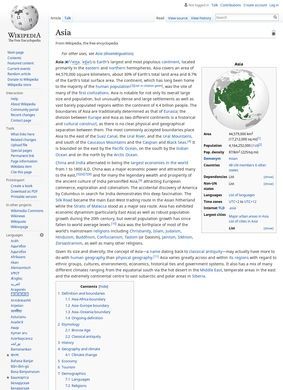
Someone trying to get a fast, reliable grip on a continent that holds roughly 4.7 billion people, about 60 percent of everyone alive, needs a starting point that is broad without being shallow. Wikipedia: Asia answers that need by opening with the hard figures (a land area of 44,579,000 square kilometres) and then working outward into the geography, history, politics, and culture that those numbers only hint at. Wikipedia: Asia reads as a hub more than a single essay, sending readers down to sub-articles on East Asia, South Asia, Southeast Asia, Central Asia, and Western Asia, and on to individual country pages from there.
Physical geography and disputed borders
The geographic spine of Wikipedia: Asia does real work. It maps the major mountain ranges, including the Himalayas, alongside the deserts, river systems, and climate zones that divide the continent, and it does not duck the awkward parts. The Europe-Asia border, which has been argued over on cultural and historical grounds for centuries, gets treated as the contested line it is, with the competing frameworks laid out, instead of being smoothed into a tidy answer. That willingness to flag disagreement is one of the things that makes the entry trustworthy on a subject where neat answers are usually wrong.
History from prehistory to independence
History is where Wikipedia: Asia stretches longest, and reasonably so. The narrative runs from prehistoric human migrations through the ancient river-valley civilizations of the Indus, the Yellow River, and Mesopotamia, then on through the medieval expansion of Islam, the Mongol conquests, the colonial era, and the wave of independence movements that followed the Second World War. It is a lot of ground, and the article paces it as a connected story rather than a pile of dates, with links out whenever a reader wants to stop and go deeper on any single thread.
Economic weight and geopolitical tensions
What separates Wikipedia: Asia from a general encyclopedia summary is how much measurable detail sits under the writing. There is a list of Asian sovereign states and territories, comparisons drawn from democratic indices, and frank notes on the geopolitical tensions that are still live. The economic section puts numbers to Asia's share of global GDP, its energy consumption, and its renewable energy capacity, which gives anyone studying the region's weight in the world economy something concrete to cite.
Religion and language diversity
The cultural and demographic coverage in Wikipedia: Asia is similarly granular. Religion gets handled across Hinduism, Buddhism, Islam, Christianity, Taoism, and Confucianism, and the article works through the continent's language families and the regional variation that any single label flattens. There is even an etymology section that traces the word "Asia" back through Latin and Greek to older sources, the kind of small scholarly aside that tends to reward a curious reader. A climate change section rounds this out, addressing regional heatwave vulnerability, disruption to the water cycle, and the degradation of coral reefs.
Checking the sources behind claims
Sourcing is the quiet strength running underneath all of it. Inline citations link out to peer-reviewed papers, books, and institutional data, so a claim that looks surprising can be chased to its origin in a click or two. For a student or a writer who has to defend a statement, that traceability matters more than any single sentence the article happens to contain. The references do the structural work; remove them and the claims have nothing to stand on.
Multilingual access under open license
A few practical features widen who can use Wikipedia: Asia. The whole article is available in multiple languages through interlanguage links, so a reader more comfortable in another tongue is not locked out. Everything is released under the Creative Commons Attribution-ShareAlike license, which means teachers, bloggers, and researchers can reuse and adapt the material legally as long as they credit it and pass the same freedom along. That openness is part of why the page works as a teaching resource and as a reference at once.
Weighing the open editing model
The open editing model behind Wikipedia: Asia is the obvious thing to weigh. Because anyone can change the text, the article is rarely finished and occasionally carries the marks of an argument in progress. The flip side is that the most-read pages, and an entry on the largest and most populous continent is squarely among them, attract heavy scrutiny and quick correction, and the citation requirement keeps unsupported claims from sitting unchallenged for long. A careful reader checks the sources anyway, which is exactly the habit the page is built to encourage.
A doorway to subregional pages
For depth on any one country or subregion, Wikipedia: Asia is a doorway, not the destination. Its job is to give the continent-wide picture and then hand readers off to the specialised pages where the detail lives. Used that way, as the top of a tree rather than a complete account on its own, the article is hard to beat for orienting yourself fast. The list of sovereign states alone makes a useful index for anyone mapping out further reading.
Balancing coverage across subregions
One thing worth saying plainly is the proportion. With a continent this size, no overview can be even-handed about every region, and Wikipedia: Asia makes sensible choices about what to summarise and what to delegate. East Asian and South Asian history get fuller treatment in the main text, while smaller subregions lean harder on their own pages. That is a defensible call, though a reader chasing Central Asia specifically will spend more time following links than reading the parent article. The article is built on the assumption that readers will follow links, and for Central Asia that assumption does most of the heavy lifting.
The citation trail
Pull up Wikipedia: Asia expecting a clean entry point with the receipts attached, and that is what is there: the figures up top, the contested borders named as contested, the history laid out as a connected sequence, and a citation trail under nearly every claim worth checking. The sub-article links and the multilingual versions do the rest of the work of pointing a reader onward.