Nearly 2.4 million scholarly articles sit on arXiv.org, all free to read, and the great majority of them were posted before any journal had finished judging them. That single fact explains most of what the site is and why working scientists check it almost reflexively. It is a preprint repository: a place where a researcher uploads a manuscript and the world can read it within a day, long before the slow machinery of peer review delivers its verdict. The papers are not vetted for correctness. They are checked for scope and filed under the right subject, and that is the whole of the gatekeeping.
Nine subject areas from physics to economics
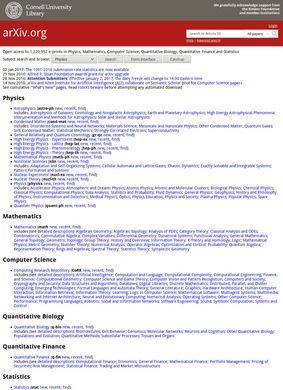
The archive splits into nine primary disciplines, and the spread is worth spelling out because it tells you who actually lives here. Physics is the founding territory and still the largest, broken into astrophysics, condensed matter, general relativity, high-energy physics, quantum physics and several more. Alongside it sit Mathematics, Computer Science, Quantitative Biology, Quantitative Finance, Statistics, Electrical Engineering and Systems Science, and Economics. Each of those is cut again into specialized subject classes, so a reader arriving at arXiv.org does not land on a vague pile of computer science papers but can drop straight into a narrow corner of it. The taxonomy is dense, and that density is the point: people come looking for a specific thread, not a general browse.
From daily new submissions to mailing lists
Daily listings of new and recent submissions are the part most telling about how arXiv.org is really used. Every weekday a fresh set of papers appears in each subject area, and a large number of researchers treat that listing as a morning habit, the way other people skim headlines. You can read the day's arrivals in your field, follow the ones that look relevant, and ignore the rest. arXiv.org also lets you subscribe to mailing lists by subject, so new submissions arrive without you going to fetch them. For anyone trying to keep pace with a fast-moving topic, that flow changes the daily rhythm of staying current in a way that no static index of resources could replicate.
Search by author or title
Search on arXiv.org runs across the full archive, and it is built for the kind of querying scholars actually do. You can hunt by author, by title, by abstract, or by subject class, and the advanced search lets you combine fields across the metadata rather than throwing keywords at a single box. This is the difference between a tool aimed at academics and one aimed at casual visitors. The interface at arXiv.org assumes you know roughly what you want and gives you precise levers to find it, which is appropriate for an audience that is usually chasing a particular citation or a particular author's recent output.
Submitting manuscripts in LaTeX format
Submitting is the other half of arXiv.org, and the workflow is shaped around how these documents are written. An account holder uploads a manuscript, and because so much of physics and mathematics is typeset in LaTeX, the site supports that format directly and provides help documentation for getting the formatting right. The submission guidelines lay out what the moderation process expects, which is essentially that the paper belong to a recognized field and fall within the basic scope of the archive. There is no judgement on whether the science is correct. That responsibility stays with the reader, and seasoned users know to treat a preprint as a claim awaiting scrutiny, not a settled result.
That moderation-not-review distinction is the thing most worth understanding before relying on anything here, and arXiv.org has never pretended otherwise. A paper on the site has cleared a check for subject classification and scope compliance, nothing more. Plenty of what gets posted will later be revised, corrected, or quietly abandoned, and some of it never passes peer review at all. None of that is a flaw in the service; it is the service working as designed. The whole model trades the safety of vetting for the speed of open distribution, and it asks the reader to bring the critical judgement that a journal would otherwise supply.
Funding through Cornell and outside donors
The funding arrangement is unusual enough to be worth knowing, since it shapes the open-access promise. arXiv.org is operated by Cornell University and kept running through a mix of money from the Simons Foundation, member institutions that pledge support, and individual donors. There is no paywall, no subscription, no charge to read or to submit. That structure is the reason a graduate student in a poorly funded department reads the same papers, on the same day, as a professor at a wealthy one. It is also a quiet argument about who scholarly literature should belong to.
Account registration exists, but only to manage submissions and subscriptions. Reading requires nothing: no login, no profile, no tracking gate between a visitor and the full text of millions of papers. That openness is consistent across the whole experience of using arXiv.org and is, frankly, rare for a resource of this scale. The help documentation is geared toward people preparing a paper, covering submission steps and the LaTeX details that trip up first-time authors, so a newcomer to the upload process is not left guessing.
What arXiv.org does not try to be is also instructive. It is not a discussion forum, not a social network for academics, not a ranking engine that tells you which papers are important. It hosts, it organizes, it distributes, and it stays out of the way. The closest arXiv.org comes to curation is the subject classification itself, which is genuinely useful precisely because it is conservative and stable. A reader who learned the category structure years ago can still navigate it now, and that consistency is part of why the site has become infrastructure for so many fields.
For someone outside research, arXiv.org can feel austere, even forbidding. There is little hand-holding, the design is plain, and the documents themselves are technical to a degree that assumes domain knowledge. That is a fair description, not a complaint. The site is built for the people who need it, and it serves them with very little friction. Plain-language summaries of discoveries belong elsewhere; the discoveries themselves, in the author's own words, on the day they were released, are here. The daily new-submissions page, refreshing across every one of those nine disciplines, is the clearest picture of what arXiv.org really is: a running record of work in progress, posted as it happens.