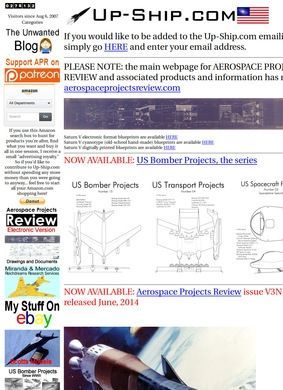
Up-Ship.com is a web resource for aerospace history, built around historical blueprints, engineering drawings, and small-run publications about aircraft and spacecraft that were designed on paper long before any of them reached a runway or a launch pad. The audience it wants is narrow, and it does nothing to hide that: aviation enthusiasts, aerospace historians, working engineers, and collectors who care about proposals, prototypes, and programs that history mostly filed away. A casual visitor will bounce. Someone chasing the design record of a cancelled bomber will settle in.
The Up-Ship.com material sorts cleanly into two piles. One half is printed and digital publications organized into recurring titles and series; the other is technical drawings and blueprints sold in physical and electronic formats. Both lean hard toward machines that existed as concepts and test articles far more than as production fleets, which is the whole point of the place and the reason its catalog looks like nothing a mainstream aviation shop would stock.
Aerospace Projects Review and its spin-off series
The flagship publication is a magazine called Aerospace Projects Review, issued by volume and number, with V3N4 named as one installment. It gathers research on aircraft and spacecraft concepts that were proposed, sketched, argued over in engineering departments, and then shelved before metal was ever cut. A periodical built entirely around unbuilt aerospace is an unusual thing to sustain, and Up-Ship.com treats the magazine as the spine that the rest of the catalog hangs from.
Two named series extend that same editorial instinct into tighter subjects. Each takes a single class of aircraft or weapon and goes deep instead of wide, which is the pattern a serious researcher tends to want from source material, and the discipline shows in how narrowly each title is scoped.
A close look at Stagger Around and the AGM-129
Stagger Around is a series on military aircraft, and the installment the site flags digs into the AGM-129 Advanced Cruise Missile, a stealth weapon whose development history barely surfaces in general reference works.
This is exactly what the operation exists for: one specific program, followed closely, written for readers who already understand why the AGM-129 mattered to Cold War deterrence. Up-Ship.com makes no move to soften or broaden it into a general-interest aviation title, and that discipline is part of what gives the catalog credibility with the people it targets.
The US Bomber Projects run
A separate US Bomber Projects series applies the same method across proposed bomber designs, the paper airplanes of strategic aviation that competed for funding and lost.
Set the magazine, Stagger Around, and this bomber series side by side and Up-Ship.com adds up to a compact, coherent publishing catalog built around one clear throughline, sharper in focus than the typical single-topic hobby site. The trade-off is blunt. If proposed bombers and canceled missiles hold no interest for a visitor, none of this will change their mind, and the site is honest enough in its framing not to pretend otherwise.
Blueprints from Saturn V to the Air Drawings set
The documentation half of Up-Ship.com is where the site turns most concrete, because here a visitor is looking at specific drawings of specific machines. The headline item is a set of Saturn V blueprints, the rocket that carried Apollo crews toward the Moon and still the largest launch vehicle most people can name. These come in three forms: electronic files for screen work and reference, cyanotype prints in the classic blue-line style, and digitally printed copies.
Giving a buyer the choice between a working digital file and a physical cyanotype suited to framing is a genuine strength, since the two formats answer completely different needs, one practical and one closer to a wall piece.
Around the Saturn V, Up-Ship.com stocks a wider library of historical aerospace project documents and drawings, the sort of archive that rewards a buyer who arrives already knowing the part number or airframe they are hunting. This is a catalog for the informed, not a gift shop, and the pricing split across cyanotype, print, and file assumes buyers who understand what each format is good for.
The Air Drawings series
The Air Drawings series covers early experimental aircraft, with the Bell X-1, the XP-83, the Bell X-2, and the Bell X-1D named among its subjects. These are the machines that charted the edge of high-speed and supersonic flight in the years after the war, and clean drawings of them are precisely what a scale modeler, a technical illustrator, or a historian would come looking for.
Up-Ship.com presents the series as a defined, named set instead of a loose scatter of scans, which makes the catalog easier to navigate and signals that someone has actually curated it.
The companion site move and reaching the people behind it
A real caveat sits in plain view. Up-Ship.com states that its main content has moved to a companion site, aerospaceprojectsreview.com, which leaves this address working partly as a hub that forwards visitors onward. Anyone landing here should expect to follow links to reach the current material, so the entry functions as a doorway as much as a destination. The site is upfront about the shift, and that transparency counts in its favor, but a first-time visitor deserves to know it before wondering why the freshest work seems to live somewhere else.
Funding for Up-Ship.com runs through a Patreon link and a straightforward donation option, the familiar model for a one-person or small-team archival project that survives on the goodwill of a specialized readership. There is also a blog carrying site updates and, bolted onto the margins, an Amazon affiliate search widget that does nothing for the core content and reads as a minor revenue add-on. None of that is unusual for a passion project of this shape.
Contact is the soft spot. No phone number, no email address, and no street address appear anywhere on the page, and there is no contact form to fall back on. The single available channel is joining the Up-Ship.com emailing list through the blog, which is built for broadcasting updates outward, not for answering a specific question about an order or a file format. For a hobby archive funded on Patreon that is not disqualifying, yet a customer spending real money on blueprints has no obvious route to raise a problem, and that gap is worth weighing before buying.
Outside reputation is close to a blank page. A search for reviews of Up-Ship.com mostly returns results for uShip, an unrelated freight and vehicle-shipping marketplace out of Austin, and surfaces no genuine third-party ratings for this site at all. There is no external chorus to lean on, positive or negative, and the case for the site rests entirely on the specificity and quality of what it sells.
A deep, narrow aerospace archive with no track record of public feedback and no direct line to its owner is, in the end, a bet placed on the strength of the catalog itself rather than on anyone else's word for it.