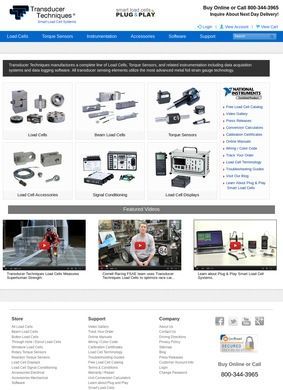
Transducer Techniques is a Temecula, California manufacturer of force and torque measurement hardware, operating from an address on Rio Nedo. The product range is narrow and deep in the way you would expect from a specialist instrumentation maker: load cells in button, through-hole donut, miniature and beam configurations, rotary and reaction torque sensors, signal conditioning gear, digital panel meters, data acquisition systems, and the logging software that ties the readings together. Transducer Techniques is building for engineers who already know what a strain gauge does, not for a general-purpose electronics buyer.
Smart load cells with IEEE standards
A few specifics set Transducer Techniques apart from a plain parts catalog. The company builds what it calls Plug and Play Smart Load Cells conforming to IEEE 1451.4, the transducer electronic data sheet standard, so a sensor can identify itself and report its calibration to the host system on connection. The strain gauges use bonded metal foil construction, which is the established route to stable, repeatable readings under load. Transducer Techniques also holds NI Certified product status, meaning its hardware has been validated to work with National Instruments data acquisition platforms. For an engineer wiring sensors into a LabVIEW or NI-based test rig, that certification removes a real source of guesswork during setup and integration.
Metal foil strain gauges for stable readings
The web presence is built for procurement rather than browsing. Buyers can create an account, place orders online, track them, and ask about next-day delivery. There is a technical resource library carrying product manuals, troubleshooting guides and calibration certificates: documents a maintenance technician or quality engineer needs on hand long after the purchase. Transducer Techniques makes these available for download without requiring a support call. Calibration certificates matter for anyone running an accredited measurement process, since the paperwork has to follow the instrument through its service life.
Online ordering and technical documentation
The customer base is industrial measurement first, with some pointed specialist use mixed in. One example named is Cornell Racing, the university's Formula SAE team, which uses force and torque sensors from Transducer Techniques to instrument suspension, drivetrain and test-rig work. Motorsport engineering is a demanding proving ground for this product category because the sensors take vibration, heat and shock while being asked to return trustworthy numbers, so a college racing team choosing this hardware says something about its fitness for rough service.
Field proven in motorsports and industrial use
Availability extends past the company's own storefront. Third-party industrial suppliers such as Radwell International stock Transducer Techniques load cells, which means the parts circulate in the wider maintenance, repair and operations supply chain where buyers often source replacements under time pressure. That secondary presence is a quiet sign the products have been in the field long enough to generate an aftermarket.
Stocking through secondary industrial suppliers
Reputation, assembled from what is publicly visible, is solid if not loud. The Better Business Bureau lists Transducer Techniques as an accredited business with an A+ rating, though no public customer review tally comes with it. On Indeed the company holds a 4.0 out of 5 from four employee reviews, which tells you a little about the workplace and nothing about the products. There is an eBay seller footprint with 4.5 out of 5 product ratings across a modest number of transactions. Google, Trustpilot and Yelp turned up nothing. That absence is unsurprising for a business-to-business component supplier, where buyers are engineers and purchasing departments who rarely leave star ratings, but it does mean the public verdict rests on the BBB standing and the certifications, with no crowd of customer voices to add to the picture.
Checking credentials and certifications
Getting in touch is straightforward, which counts when a test stand is down and you need an answer fast. A toll-free line and a local Temecula number are both posted plainly, and the company maintains profiles on Facebook, Twitter, YouTube and LinkedIn. Nothing about reaching a human requires navigating a form-only wall.
The honest weak spot is the one the search turned up: outside the trade-specific indicators, there is little independent customer commentary to draw on. A first-time buyer cannot read fifty reviews and triangulate. What stands in its place is verifiable substance: the IEEE conformance, the NI certification, the documented calibration trail and the BBB accreditation. For a technical product, that combination is arguably more useful than anonymous star counts, because it can be checked against published standards. Transducer Techniques has enough documented credibility to justify a direct inquiry, and the product depth suggests this is a company that has spent years refining a narrow offering rather than chasing breadth. The gap in public reviews is not a red flag; it is simply the norm for B2B instrumentation suppliers at this level of specialization.
Business address
Randy Baker
42480 Rio Nedo Rd,
Temecula,
CA
92590
United States
Contact details
Phone: 9517193965
Fax: 9517193965