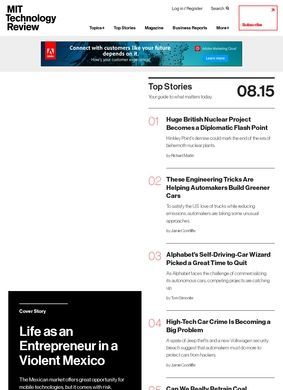
Where does a reader go for technology coverage that takes the underlying science seriously without drowning in press-release hype? MIT Technology Review is one of the few outlets built around that question. It traces back to 1899 and operates as an independent media company affiliated with the Massachusetts Institute of Technology, which gives it a footing that most tech blogs simply do not have. The work spans seven topic areas: artificial intelligence, biotechnology and health, climate change and energy, space, culture, policy, and business. That spread tells you the editorial brief is wide but not scattershot, since each area circles back to the same concern, which is what new technology means for the people it touches.
Format and delivery channels
The format mix is worth spelling out because it changes how the publication gets used. There is the steady stream of website articles, but also audio, video, a digital and print magazine, and a set of newsletters where a reader picks topics and gets only those. The newsletter customization is a small thing that pays off over time, since someone who only cares about climate and energy is not forced to wade through space coverage to find it. I tend to trust outlets that let me narrow the feed instead of pushing everything at once, and MIT Technology Review does that cleanly.
Editorial franchises and recurring series
A few editorial franchises give MIT Technology Review its shape. The annual "10 Breakthrough Technologies" list is the best known, a yearly attempt to name which advances are about to matter rather than which ones are merely loud at the moment. "The Algorithm" runs weekly and stays on artificial intelligence, which has become the dominant beat for good reason. There is also "10 Things That Matter in AI," "What's Next," and "Hype Correction," and that last title is telling. A series explicitly built to push back against overstatement says something about how the newsroom sees its job.
Article types from explainers to investigations
The article types underneath those franchises run from quick explainers to long-form features, investigations, interviews, opinion, and analysis. Investigations are the part that separates a real newsroom from an aggregator, since they cost time and money and occasionally make powerful subjects unhappy. Explainers do the opposite kind of work, taking a tangled subject and making it legible for a reader who is smart but not specialized. Having both under one masthead means a person can land for a five-minute primer and stay for a piece that took months to report.
Who reads MIT Technology Review?
The audience MIT Technology Review writes for is broad in a way that holds together. Technology professionals, business leaders, researchers, academics, policy makers, and ordinary readers curious about science all show up in the reader profile, and the writing seems calibrated to keep the specialists honest while staying open to everyone else. That balance is hard. Lean too academic and the general reader leaves; lean too breezy and the researchers stop trusting you.
Subscriptions, events, partnerships
What MIT Technology Review sells alongside the journalism is straightforward. Paid subscriptions come in digital and print flavors, with subscription management handled at a dedicated subscriptions portal. Beyond that there are live events and conferences, custom content partnerships for brands, republishing licensing for organizations that want to reprint pieces, and international editions that carry the coverage into other markets. The events and the brand partnerships are the commercial engine that lets the reporting stay ambitious, and keeping them visible rather than buried is the more honest approach.
Support resources and submission guidelines
On the practical side, MIT Technology Review carries a help center, an FAQ, and pitch guidelines for writers who want to contribute. The pitch guidelines are a quiet signal of how the place runs. An outlet that publishes what it expects from outside contributors is one that takes its standards seriously and wants them met before a draft ever arrives. The help center and FAQ cover the ordinary friction of a subscription product, which is exactly where most readers tend to have questions.
Paywall strategy for different readers
If there is a tension in the MIT Technology Review model, it is the one every serious publication now lives with. The deepest reporting sits behind a subscription, while a meaningful amount of explanatory and newsletter content stays open. A reader has to decide whether the paywalled long-form work is worth the price, and that calculation depends entirely on how much the subjects matter to them. For someone whose job intersects with AI policy or biotech funding, the math is easy. For a casual reader, the free tier and the topic-specific newsletters may already be plenty, which is a reasonable way to handle this entry without committing to a subscription on day one.
Editorial restraint amid technology hype
The thing that keeps pulling me back to MIT Technology Review is the editorial restraint. In a field where coverage tends to swing between breathless and dismissive, a publication that runs a series called "Hype Correction" and still finds the genuine breakthroughs worth naming has found a difficult middle. The MIT affiliation supplies credibility, but the day-to-day choices, what gets investigated, what gets explained, what gets quietly ignored, are what earn a reader's time. Plenty of outlets borrow institutional prestige and then publish thin work under it. This one does not appear to coast on the name.
International editions and print magazine
Worth noting too is how the international editions extend the reach. Technology stories rarely stay inside one country, and a publication that runs versions for other markets is acknowledging that a breakthrough in a Boston lab and a regulatory fight in Brussels belong in the same conversation. Combined with the print magazine, which still exists when many peers have abandoned paper entirely, MIT Technology Review keeps more delivery channels alive than most. The print issue is almost a statement in itself, given how few science and technology titles have held onto a physical edition, and it suggests an editorial confidence that readers will pay for something they could in theory scroll past for free.
Across the whole offering, MIT Technology Review reads as a publication that knows precisely what it is for. It is not chasing pageviews with thin takes, and it is not so academic that it forgets the reader. The AI coverage is the busiest corner right now, but the biotech, climate, space, and policy beats carry their own weight, and the franchises give regulars something to return to on a schedule. A person who wants to follow where technology is heading, and who wants the analysis to come with reporting underneath it, will find the menu here unusually complete. The 1899 founding date next to a weekly AI newsletter is the kind of contrast that sums the place up: very old institution, very current beat.